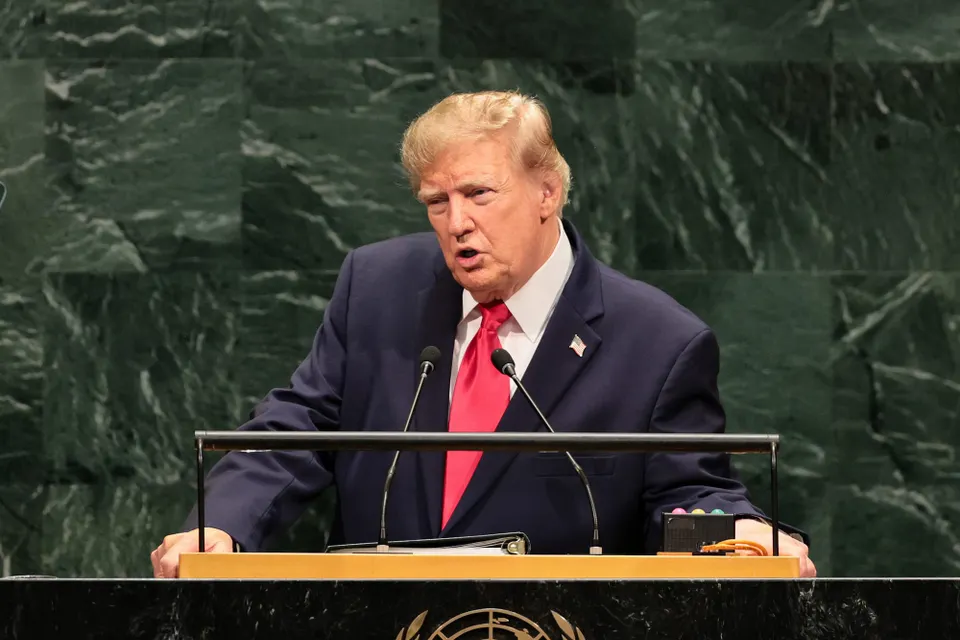
The United Nations summit on the impact of the current world economic recession on the poor, held in New York on 24-26 June 2009, reflects some recognition by the "international community" of the increasing hardship across the majority world of the depth of this crisis. There are however doubts about the degree of commitment to the issue: none of the western states has sent a head of state or government, and the high-level attendees almost all come from poorer countries (see Thalif Deen, "U.N.'s Enormous Potential Being Marginalised", Terra Viva/IPS, 23 June 2009).
Paul Rogers is professor in the department of peace studies at Bradford University, northern England. He has been writing a weekly column on global security on openDemocracy since 26 September 2001
Bradford's peace-studies department produces frequent podcasts on its work, including a regular
commentary from Paul Rogers on international-security issues. Listen/watch here
This neglect is a signal of a deeper problem that surrounds the summit and comparable initiatives: that the primary response of powerful states to the enormous deprivations and dislocations of 2008-09 is a military-security rather than a sustainable-security one. Even now, when so much is known about the failures of the "control paradigm" of the 2000s and the accumulating issues that must be addressed if the world is to become sustainable (not least climate change), a huge amount of serious attention and resources that could be devoted to meeting the needs of civilians are expended on the "war on terror" and other military projects.
A shifting target
The New York conference takes place at a time when the global food crisis, much discussed in 2008, rages undiminished. The UN's Food & Agriculture Organisation (FAO) estimates that the effect of the great recession is to spread malnourishment among 100 million more people - taking the world total to over a billion for the first time ever, and double the number at the time of the world food crisis in 1973-74. At that time, the FAO reckoned that a ten-year investment programme equivalent to just 2% of world spending on the military would be enough to eliminate the great majority of the world's food deficits. This did not happen (see The world's food insecurity", 29 April 2008).
The escalating poverty and hardship have been greatly exacerbated by the economic downturn of 2008-09. The crisis, however, has had virtually no effect on military spending. The estimate for annual military spending in 2009 published by the Stockholm International Peace Research Institute (SIPRI) is of a 4% worldwide increase over 2008; the rise over 1998-2008 has been 58% (see "Iraq, AfPak, beyond: the global cost of war", 18 June 2009).
This increased emphasis on military spending is fuelled in part by a specific focus on the need to respond to insurgencies and different forms of irregular warfare. This entails a shift of emphasis away from the nuclear weapons and massed-tank armies characteristic of the cold war, and towards new kinds of weapons: armed drones and precision-guided mortars being at the top of the shopping-list, though scores of other instruments are coming to the fore (see "Drone wars", 16 April 2009).
This trend goes well beyond the current emphasis on the Taliban, al-Qaida and the continuing insurgency in Iraq (which a spate of ferocious bombings suggests is again on a rising arc, as American troops withdraw from Iraq's cities by the 30 June 2009 deadline). For the military is if anything even more concerned by the risk of a broader "insurgency" of people in desperate and angry protest against the intolerable conditions in which they are forced to survive. Among the multiple local examples are the vigorous Naxalite rebellion in India and the intense social unrest in China, reflecting the deep divisions within these emerging giants of the world economy (see "China and India: heartlands of global protest", 7 August 2008). The antagonism directed at the corruption of regimes in the middle east from the socio-economic margins, the social unrest in France's overseas territories such as Guadeloupe, and the discontent over land-rights in Peru are likewise part of this pattern of burgeoning discontent (see "A world on the edge", 29 January 2009).
A tale of two complexesIn addition to his weekly openDemocracy column, Paul Rogers writes an international security monthly briefing for the Oxford Research Group; for details, click here
Paul Rogers's books include Why We're Losing the War on Terror (Polity, 2007) - an analysis of the strategic misjudgments of the post-9/11 era and why a new security paradigm is needed. A third edition of his Losing Control: Global Security in the 21st Century (Pluto Press, 2009) is forthcomin
It is not clear that the United Nations summit on the effects of the economic crisis, or the work of other international agencies and coalitions, can address the problems manifest here at their root (see Alison Evans & Dirk Willem te Velde, "Too little, too late? The UN and the global financial crisis", 23 June 2009). Their ameliorative efforts at a time when millions of people around the world are being deprived by the economic downturn of the means of livelihood are at least in the public arena and widely discussed. By contrast, a little-reported current military development indicates that many states remain locked into a very different kind of response to the emerging realities of world disorder.
An earlier column in this series highlighted the construction in southern Israel of a mock Arab town for use in urban-warfare training. This was Baladia, a $45-million project built and financed by the US military that would be used both by United States and Israeli forces as they prepared to control regional insurgencies (see A tale of two towns", 21 June 2007).
A much larger facility was opened across the border in Jordan on 10 May 2009, weeks before the UN conference on the impact of the world economic crisis on development. The King Abdullah II Special Operations Training Centre (KASOTC) will specialise in internal security and counter-terrorism (see "Jordan unveils world's largest special forces training centre", Jane's International Defence Review [IDR], July 2009)
The centre, the world's largest facility of its kind, will stretch over 600 hectares and cost twice as much as Baladia. It will initially be used by special forces from the US, Jordan, Kuwait and Bahrain; but the plan is that many armies from around the world - including the middle east and Africa - will send contingents to train there in the coming months and years (see Joan Kibler, Construction Progressing on the Special Operations Training Center in Jordan", Special Operations Technology [6/2, 2008]).
KASOTC has permanent mock-ups of villages, commercial buildings and towns. Its numerous facilities include (again, in the words of the IDR) "a large live-fire urban training centre; an aircraft breaching site; a vehicle training rang; close-quarter battle houses; sniper training ranges; vehicle mock-ups; housing; and mess hall facilities that can accommodate 650 people at a time." In addition, strenuous efforts will be made to ensure that the training is as realistic as possible; this will involve "rooftop explosions with debris, concussion wave cannon, automatic weapons simulator, simulated smells, fog generator and improvised explosive device kit".
Many armies have similar facilities, albeit on a much smaller scale. KASOTC's transnational character, however, will make it unique. The US military may be prominent in its design, construction and organisation, but KASOTC is a centre of genuinely global significance. It is also an impressive marker of changing attitudes to security. Across the world - in north America, western Europe, India, China and many other regions and countries - ever more military attention is being focused on maintaining the status quo against "revolts from the margins"; and it is this global environment of disorder that the centre is intended to address (see "A world in revolt", 12 February 2009).
The King strikes back
The King Abdullah II Special Operations Training Centre will host its first courses in August 2009 - weeks before the third meeting of the G20 states in Pittsburgh on 24-25 September 2009 which will be attended by the heads of government of the world's most powerful states. The armed forces of many of those states will utilise KASOTC in its core purpose of protecting and consolidating the present world system of power-relations and wealth distribution.
The construction of this enormous military facility, at the very moment that elsewhere in the "global governance" landscape there is an intense search for ways to contain widespread social distress by alleviating the plight of the poor and marginalised, is one of those weird coincidences of timing that sometimes shed unexpected light on the heart of current global problems.
For forensic insight into such developments, a good strip-cartoon is often the place to look. This has long been true of one of the best: The Wizard of Id. In an early strip, the Chancellor goes to the King with a query: "Sire, you have allocated billions for defence but not one cent for the poor". "Right", replies the King. "What is the explanation?", asks the Chancellor. For the King, it is simplicity itself: "When the rebellion comes I'll be ready".
----------------------------------------