
Lars von Trier is a tantalising film-director who provokes his audiences sometimes to the point of humiliation. He is also a master of visual theology. His Antichrist is the antithesis of Mel Gibson's tawdry and emotive The Passion of the Christ, offering as it does an exploration of the violent underbelly of the Christian story of sin and redemption. If Antichrist offers us any glimpse into the tortured psyche of its director, then it is a psyche sculpted around a visceral Catholicism of a much darker and more existentially credible kind than Gibson's lurid fantasies of crucifixion. A number of critics at the Cannes film festival derided von Trier for his dedication of Antichrist to Andrei Tarkovsky, and in doing so missed their affinity: for like the great Russian director, von Trier has a capacity to use the moving image as a celluloid icon through which to offer us glimpses into the depths of the Christian unconscious with its metaphysical terrors and yearnings.

In von Trier's Breaking the Waves, the female character Bess (Emily Watson) is a Christ-like figure, a disturbing representation of mysticism and madness who sacrifices her life to redeem the man she loves. It is a harrowing and controversial film, not least for the questions it raises about the extent to which Bess's prostitution and murder reinforce violent sexual stereotypes about female sexuality and martyrdom. Antichrist pushes these questions even further by asking us to contemplate what it would mean to portray woman not as a Christ figure but as Eve, who in the Christian theological tradition has been represented as the personification of evil and bringer of death to the world.
Tina Beattie is professor of Catholic studies at Roehampton University, England. Among her books are God's Mother, Eve's Advocate (Allen & Unwin, 2002), New Catholic Feminism: Theology and Theory (Routledge 2005), and The New Atheists: The War on Religion and the Twilight of Reason (Darton, Longman & Todd, 2007). Her website is here In the 2nd century, Tertullian wrote of women: "You are the devil's gateway: you are the unsealer of that (forbidden) tree: you are the first deserter of the divine law: you are she who persuaded him whom the devil was not valiant enough to attack. You destroyed so easily God's image, man. On account of your desert - that is, death - even the Son of God had to die." Von Trier takes his audience into the malevolent brew of these masculine beliefs and the havoc they wreak in women's lives.
The elusive source
Antichrist is an allegory of the Genesis myth which exposes the psychological terrors of Christian beliefs about the origins of sin. It draws its imagery not only from modern horror films but also from the teeming fears of medieval imaginations with their pervasive sense of evil and the power of Satan. The Antichrist of the film's title is everywhere and nowhere - a viscous and elusive presence that seeps through nature, including human nature, and infects it with futility, death and decay. The Antichrist is perhaps also the God-man himself, alluded to in the figure of the husband, whose misogynistic cult has sacrificed generations of women through persecution, burning and torture, while implanting in women themselves a deeply rooted sense of guilt and self-loathing.
The film opens with a prologue of exquisite pathos, filmed in black and white and played in slow motion to ethereal music (the Lascio Chi'o Pianga aria from Handel's Rinaldo - "Let me weep over my cruel fate, and that I long for freedom"). As the nameless protagonists (superbly played by Charlotte Gainsbourg and William Dafoe) make love, their toddler climbs out of his cot and down the stairs, briefly witnessing his parents' entwined bodies before falling to his death in the snow outside. Thus von Trier begins his exploration of the shadow side - the feminine side - of the Christian story of salvation, focusing on the Mary/Eve figure whose child must die to bring redemption to man; but at what cost to her? Also by Tina Beattie in openDemocracy:
"Pope Benedict XVI and Islam: beyond words" (17 September 2006)
"Veiling the issues: a distractive debate" (24 October 2006)
"Religion in Britain in the Blair era" (10 January 2007)
"Religion's cutting edge: lessons from Africa" (14 February 2007)
"The end of postmodernism: the ‘new atheists' and democracy" (20 December 2007)
"Rowan Williams and sharia law" (12 February 2007)
"The dark (k)night of a postmodern world" (21 August 2008)
"Along the precipice: visions of atheism in London" (6 November 2008)
"Banksy in Bristol" (24 June
Von Trier's woman is Madonna and whore, a tender and grieving pietà and a voracious and deadly seductress. In flashbacks we see how, the summer before her child's death, she had taken him to a cabin in a remote forest known as "Eden" to work on her doctoral thesis. Her topic was gynocide - a term coined by feminists to refer to the persecution and killing of women, particularly in the Christian tradition. As she studied she became convinced that the knowledge she sought was a lie, and that women really are guilty of the evil of which they have been accused. And so this young mother becomes von Trier's Eve, seeker of forbidden knowledge, bringer of death, bearer of the guilt of the human race, cause of the death of the Son of Man.
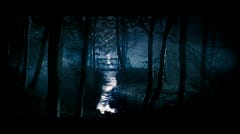
The husband is a therapist who decides to take control of his wife's rehabilitation, offering himself as her confessor and saviour as she plunges into the depths of inconsolable grief and madness over the death of her child. When she admits to him that she is terrified of the forest, he insists they go back there so that she can confront and rationalise her fears. Thus this human pair - Adam and Eve, everyman and everywoman - cross over a bridge which symbolises the boundary between culture and nature, reason and chaos, sanity and madness: the bridge into hell. The narrative of the film disintegrates as von Trier takes his archetypal western man of reason through the nightmares of his most repressed and irrational fears - the swamp of violent female sexuality and the savagery of nature.
There are several scenes where the husband tries to analyse his wife's fear of the forest. She tells him that her greatest fear is not the forest but something else. He draws a triangle and writes "Eden (garden)" near the top, leaving a question-mark in the top position as he tries to find a word for the real source of her fear. At one point, she tells him that nature is "Satan's Church', and he puts Satan in the top position. Then, as he discovers the depths of her sense of personal evil and blame, he puts the word "me" - her ultimate fear is herself - only to cross it out again. I was reminded of Paul Ricoeur's study of Genesis, in which he ponders on the pre-existence of evil in the Garden of Eden, suggesting that we find ourselves in a world in which evil precedes us as an unnameable mystery. The symbols of the fall pervade this film, but the serpent never appears. Whatever the source of evil, it has already done its work before we enter this poisoned Eden.
The gynocidal story
Lars von Trier made Antichrist during a time of deep depression, and his antipathy to therapists is well known. Yet his target here is not just the therapy industry, but the controlling power of the rational masculine mind which refuses to acknowledge the mystery of good and evil, the primal chaos of nature, and those aspects of human experience which are beyond language and the control of reason. If it is a condemnation of modern psychotherapy, the film is also an oblique homage to Sigmund Freud who dared to venture into the forest of our darkest and most haunted dreams.
A recurring motif is the three beggars who symbolise grief, pain and despair and who provide the chapter titles for the film which, like Breaking the Waves, has its narrative interrupted by title pages: Grief, Pain (Chaos Reigns), Despair (Gynocide) and The Three Beggars. It might be pushing the symbolism too far to suggest that these allude to the beggars in Russian folklore who, like Christ, offer wisdom and compassion through suffering - it is hard to find any redemptive message in von Trier's portrayal of suffering here. The epilogue has a repeat of the Handel aria but it offers a kitsch fantasy of redemption. The man - saviour turned murderer - is wounded but alive in an Eden apparently restored to its original goodness, while the women whose dismembered bodies have recently littered the forest floor rise up in a general resurrection. But it is an ironic and mocking ending.
Whatever the meaning of redemption, the mystery of evil remains, and von Trier seems to imply that no resurrection or return to Eden can erase the gynocidal story which precipitates the biblical drama. As the closing credits rolled, I for one was left wondering whether those women were supposed to represent the redeemed at the heavenly banquet, or a hoard of vengeful harpies about to set upon the solitary man.
The mother of sorrows
So what to make of this? Antichrist has been condemned for being misogynistic and anti-Christian, but I think this is simplistic. Perhaps von Trier is even pointing a finger at those critics who seek to deny the chtonian depths of the human psyche by their moral posturing. The woman in this film is a vengeful and violent force of nature, but the film invites another reading too. She is also the mater dolorosa, the mother of sorrows whose grief is too vast to be contained in a world dominated by the forces of objective and rationalising masculinity. The more the man seeks to control her, the more uncontrollable she becomes, mutating into the woman of Genesis who is condemned to bear her children in pain and longs for the husband who will lord it over her (Genesis 3:16), but whose child will also be the source of their redemption.
There is a scene when the woman describes hearing her son's voice crying in the forest. She goes in search of him but he seems to be nowhere and everywhere. Suddenly, the camera pans up so that we have a God's eye view, and the child's cry becomes the cry of a cosmic Christ, suffering for the sins of the world. This imagery is reinforced by the mother's subsequent discovery of her child, playing in the cabin with a piece of wood in a pose reminiscent of paintings of the young Christ in his father's carpentry workshop, foreshadowing the wood of the cross. Later, the woman will use that same piece of wood in a castrating attack on her husband, in one of the film's most disturbing and explicit scenes of sexual mutilation and abuse.
This Eve is not the passive victim of male control. She seeks vengeance, allowing her terror of abandonment and forsakenness to drive her to extremes of sadistic and masochistic violence as she seeks to entrap the man, so that audiences have been appalled by the brutality of the film. But that may be part of its oblique message. Audiences of horror films have an apparently insatiable appetite for the penetration, mutilation and murder of female bodies. Just like those medieval images of burning and tortured women, the cinema reveals us to be a gynocidal culture, accepting as normal the mutilation and abuse of women by men, but horrified when it is women who become the abusers.
The missing half
Nevertheless, one is left with the uneasy question as to whether von Trier simply adds to the catalogue of gynocidal horrors which he exposes. Ultimately, it is not the woman but the man who survives, as the crucified one becoming the crucifier, and the woman inflicts upon herself the most savage sexual punishment for the evil of which she stands accused in her own eyes.
These ambiguities are part of the film's disturbing potency. Von Trier peels away the veneer of a domesticated, civilised religion and shows us the human condition as it appears in the darker, more pessimistic aspects of the Christian tradition, suggesting a fall into evil which plunges man, woman and nature into a state of savage alienation and violence.
One can of course argue that this is a deeply distorted reading of Christianity, for the woman at the heart of that tradition is Mary, the New Eve, whose divine motherhood symbolises God's peace with creation and the goodness and grace of woman redeemed. Yet as many feminists point out, Mary has occupied a position of unique purity and holiness in the texts and traditions of Catholic Christianity, while all other women have been identified with Eve as a primordial force of nature, chaos and death which must be resisted and controlled by the rational masculine mind. Von Trier might only tell half the story, but it is the half which has too often been allowed to define the whole in the history of western religion and culture.
Among openDemocracy's essays on world cinema:
Rosemary Bechler, "All our (Gothic) yesterdays: the really special relationship" (25 April 2002)
Maryam Maruf, "Spider-man!" (31 October 2002)
Geoff Andrews, "The life and death of Pier Paolo Pasolini" (1 November 2005)
Emiko Ohnuki-Tierney, "Letters to the past: Iwo Jima and Japanese memory" (23 February 2007)
Stephen Howe, "A murderous muse: Idi Amin and The Last King of Scotland" (12 January 2007)
Maggie Gee, "Babel: worlds within worlds" (17 January 2007)
Birgitta Steene, "Ingmar Bergman and Sweden: an epoch's end" (6 August 2007)
Patrice de Beer, "Calle Santa Fé: between Chile and freedom" (16 January 2008)
Grace Davies, "One day of life: a Romanian odyssey" (13 March 2008)
Tarek Osman, "Youssef Chahine, the life-world of film" (29 July 2008)

