
The siege resulting from Israel's declaration of the Gaza Strip as ‘a hostile entity' has had a devastating impact on Palestinians living in Gaza. With everyone having their own personal story, there are numerous stories of people seeking medical treatment. One such story was of a family, whose child was dying of cancer. The child needed treatment outside Gaza. Many times the family sought permission from both Egypt and Israel for the child to leave, but each time they were refused. Israel finally relented, but it was too late. The child died. There are also many stories of Gazan students that received scholarships to study abroad but who were unable to leave to take them up. One such student had already been attending classes in Egypt before the sudden halt on the freedom of movement for those living in Gaza. After one year of studying in Egypt, he went home to visit his family. When he tried to return to Egypt, the authorities denied him access. There are also many stories of young men and women that are unable to marry because of the siege. A man working as a civil engineer had proposed to the girl he wanted to marry. But the closure of the borders and the prohibition on building materials being permitted into Gaza resulted in the loss of his job. With no employment and income, he was unable to rent an apartment or to start a family. His marriage, like everything else, will be put on hold until the siege ends.
The siege has affected every man, woman and child, young and old living in Gaza and everyone who has family members there. The emotional, physical and financial toll of this siege cannot be measured statistically or accurately described by words. And all these stories need to be told and heard. The problem is not that the stories are being silenced, but rather that governments are not listening. They are not listening to Palestinians or to their domestic populations who are calling for change and an end to the siege on Gaza. One such government not listening to the call is Egypt.
Egypt was granted observer status of the Rafah Crossing in the 2005 Agreement on Movement and Access from and to Gaza. The Agreement stipulated that the entry points would operate continuously under the control of the Palestinian Authority on the Palestinian side and Egypt on its side, according to international standards, in accordance with Palestinian law, and subject to the terms of the 2005 Agreement. Operation of the passage was affected by the 2006 Palestinian elections, which left Change and Reform winning a majority in the Palestinian legislative council, and the governance of Hamas in Gaza following the failed coup attempt in 2007. These results prompted Israel to suspend the 2005 Agreement and the United States to pressure Egypt to also suspend the flow of goods and people in and out of the Gaza Strip. The Egyptian government's position is that it cannot open the crossing to permit the flow of goods and people because it would be in violation of the Agreement and thereby international law. The situation is more complex, however.
Rachael Rudolph is an Assistant Professor of Comparative, Regional and Islamic Studies at Emory & Henry College in Virginia, USA.
Her books include: From Terrorism to Politics; Mobilizing Movements, Mobilizing Contemporary Islamic Resistance; and, Saudi Arabia's Counter-terrorism Policy from 1929 to 2003.
Egypt is the second largest recipient of US foreign economic assistance. Therefore, without the explicit or implicit support of the US, it cannot permit unfettered access of goods and people in and out of the Strip. Moreover, Egypt has received additional aid from the US to close the tunnels used mainly to bring in food and medical supplies not permitted to enter Gaza by Israel. Egypt also imports a significant amount of goods from Israel, while exports from Gaza are prohibited from entering the Egyptian economy. The economic dependency of Egypt, as well as its domestic political problems factor into the government's decision not to open the Rafah border permanently for humanitarian and medical supplies.
Despite the stance of the government, Egyptian political opposition groups and activists have continued to call for their government to lift the siege. In particular, opposition groups and activists call for the government to take positive measures against Israeli aggression against Gaza. They call for Egypt to be a model for the Arab and Muslim world by taking specific measures such as dismissing the Israeli Ambassador to Egypt and closing Israel's embassy; opening the Rafah border permanently for humanitarian and medical supplies; halting exports of gas and oil supplies, as well as cutting economic ties with Israel, and ending the process of normalization of relations; and, permitting unfettered public protests, without the fear of repression, in support of Gaza.
Many in the Egyptian public have been steadfast in their support for Gaza and Palestine, despite the dangers faced. Some views expressed among the public are as follows: Gazans are our brothers and sisters, so it is our duty to stand beside them in the face of adversity and siege. Moreover, a solution to the destiny of Palestine is essential for Egypt's national security. Those who are vocal and take a public stance do so in the face of personal and physical danger. Many opposition members and activists have been arrested, detained, subjected to beatings and torture, and other acts of intimidation at the hands of Egyptian security. As one Egyptian stated, "we will sacrifice our souls and blood for Palestine." Another stated, "if not for the silence and weakness of some, the Israeli entity would not have dared to commit the Gaza holocaust."
Egyptians have also engaged in direct non-violent forms of resistance by organizing campaigns such as the Egyptians for Gaza Campaign and the Egyptians Against Normalization of Relations with Israel. Others have begun blogging in an attempt to bring greater awareness to the grassroots campaigns and to develop linkages with activists worldwide. In addition to these activities, Egyptians have taken part in protests in solidarity with Gaza during the war and afterward; and, camped out at the Rafah border alongside international activists from the International Movement to Open the Rafah Border. These brave men and women, who take to the streets and publicly criticize their government, do so at severe personal and physical risk due to Egypt's state ‘security' system.
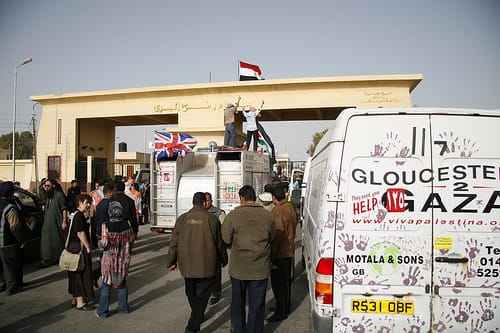
Although the Egyptian government refuses to permit the continuous flow of goods and people in and out of Gaza, it has granted the occasional opening of passage to convoys organized by various international organizations seeking to provide humanitarian assistance to Palestinians. The most recent convoy permitted access was that of Viva Palestina-USA. Additional convoys into Gaza via Egypt are expected in September and December. In addition to permitting the passage of convoys, the Egyptian government has also given permission for Egyptian and international activists to camp at the Rafah border in protest over the continued siege on Gaza. However, access to Rafah and Gaza is not granted these activists without qualification: there is a massive amount of red tape.
The most recent convoy organized by Viva Palestina-USA had significant difficulty in gaining access to Gaza, despite months of planning. The convoy was delayed several days. On July 13, a 200-strong delegation from Viva Palestina was to leave Cairo to meet up with others in al-Arish in order to cross the Rafah border on the following day. The buses were delayed and activists were required to obtain affidavits from their embassies before being permitted to leave. The embassy had agreed to stay open just for the US activists to obtain their affidavits. After waiting at the Grand Pyramid hotel for hours, with the buses still being prevented from going to the hotel, many of the activists took taxis to the US Embassy. They were escorted back to the hotel by the Egyptian police where they found that permission still had not been granted for the Viva Palestina delegation to leave Cairo. As it turned out, the delegation coming from Alexandria had to return to Cairo in order to obtain the affidavits from their respective embassies. The convoy was finally granted permission to leave and to enter Gaza for twenty-four hours on July 16, 2009.
Protesters camped out at the border have similar obstacles to overcome. The International Movement to Open the Rafah Border began a sit-in at the Rafah border on June 13, 2009, which will continue until the siege has ended. Some of the Egyptian activists interviewed told stories of being threatened and ordered to leave by border security while others say they were beaten when trying to aid those prohibited from entering Gaza. Two American activists who have been camped out at the border from the beginning of the sit-in reported having to climb over the iron fence to the locked bathrooms; not being able to take showers due to the water being turned off; not being able to charge their mobiles because the electricity had shut down.
Neverthless, the Egyptian government is still permitting the presence of Egyptian and international activists at the border. This is a small triumph in the gathering international campaign to break the siege led and organized by the people for the people of Gaza.
Worldwide protests, lobbying campaigns, petitions drives, and since the Gaza war broke out, the organization of convoys and sit-ins - what impact is this mobilization likely to have on ending the siege on Gaza ? Success depends on the formation of a shared identity among all the various activists, and on the strategic use of the opportunities provided by the political environment. A whole range of activists involved in the movement to break the siege in Gaza do now have a shared identity. And they are utilizing the opportunities that emerge both in their domestic and the international environments. But the challenge for the worldwide international movement as it exists today is organizational. This too is crucial for political success.
Despite having a common goal, these organizations and activists are operating in a framework that is extremely decentralized. A successful movement must employ strategic, coordinated policies of collective action to maximize political success. For example, protests, sit-ins and public awareness campaigns should be synchronized simultaneously around the world; organisations fund-raising for convoys should combine their efforts and resources; the various bodies planning and leading the convoys should be working together rather than separately; and, activists should be developing links and communication between the various networks around the world. All of these efforts need to provide some structure to the chaotic disorder that currently exists and prevent the future fragmentation and splintering that is common among international movements. Signs of fragmentation are already visible. A quasi-decentralized organisational structure would permit the implementation of coordinated policies of action within the international movement. Action must be taken if people are not to lose the power they have already acquired through their strenuous mobilisation efforts.

