
When I started researching the Iron Curtain, I shared the widespread assumption that this symbolic device first descended into the world on 5 March 1946, when Winston Churchill went to the small town of Fulton in Missouri and, standing in a college gymnasium with President Truman at his side, gave the famous speech in which he warned of the new division of Europe: "From Stettin in the Baltic to Trieste in the Adriatic, an iron curtain has descended across the Continent . . ."
I assumed that the story of the Iron Curtain reached forward from that inaugural moment, through four decades of cold war to the events of 1989, when the Berlin wall was breached, the wire that had long divided Austria and Czechoslovakia was twisted into a great heart-shaped sculpture, and "people power" seemed to triumph at last. This was indeed the reality of the Iron Curtain as experienced by many millions, but it wasn't long before I realised that it was also a formulaic conception, and one that remained tightly framed by cold-war attitudes.
Patrick Wright is a cultural critic, historian, and broadcaster, and professor of cultural studies at Nottingham Trent University. Among his books are On Living in an Old Country: The National Past in Contemporary Britain (Verso, 1985), The Village that Died for England (Jonathan Cape, 1995; new edition, 2003), The River: the Thames in Our Time (BBC Worldwide, 1999), (as co-author) Stanley Spencer (Tate, 2001), and Tank: the progress of a monstrous war machine (Penguin, 2003). His latest book is Iron Curtain: From Stage to Cold War (Oxford University Press, 2007). His website is here.
This article is an extract from the introduction to Iron Curtain: From Stage to Cold War
Also by Patrick Wright in openDemocracy:
"The stone bomb" (8 April 2003)My doubts intensified when I visited Fulton in April 2003. There can, of course, be no question that Winston Churchill came here to deliver his epoch-making speech. Yet it remains a strangely theatrical experience to drive into this small town in the American mid-west and to find at its heart a Churchill memorial consisting of a relocated London church by Sir Christopher Wren, bordered by a little "English" garden on one side and an artistically adjusted stretch of the Berlin wall on the other.
It was also curious to stay across the road at the Loganberry Inn, a late Victorian timber house with bedrooms named after previous guests, remembered as if they had only just departed: Margaret and Denis Thatcher, President Lech Walesa.... Churchill's speech was a vast event for Fulton, but the enthusiasm with which his brief visit is now commemorated as the opening act of the cold war left me scratching my head at the breakfast table.
My suspicions were confirmed soon enough. Shortly after returning to England from Missouri, I happened to go to Grantchester, the little village just west of Cambridge, in order to visit a distant cousin. David Roden Buxton was very elderly by then, and we sat by the fireside as he reminisced over some albums of photographs. He had travelled alone in the USSR in the late 1920s and early 1930s, studying and photographing medieval churches, including many marvellous examples of both stone and wood that had been destroyed later in the Stalinist period. Asked how he had come to assemble this evocative record, he explained that he had first gone to Russia with his sister and parents in the summer of 1927. The family had visited Moscow and other cities, and also walked considerable distances through the countryside.
During the course of this conversation, he produced a copy of a book written by his father, a now forgotten Labour politician, humanitarian and colonial reformer named Charles Roden Buxton. In a Russian Village contained a description of the days its author had spent, seven years earlier in 1920, exploring conditions in several villages near Samara on the Volga. It was a work of vivid testimony, rendered all the more poignant by the fact that the settlements Charles Roden Buxton observed in their early encounter with Bolshevism had been overwhelmed by famine in the months between his visit and the completion of his book.
Yet, this was not all. Pasted inside this battered family copy was a newspaper article clipped from an edition of the New Leader, the paper of the Independent Labour Party. Headed "Behind Russia's Curtain" and published in October 1927, this yellowed fragment contained Charles Roden Buxton's reflections on his more recent second visit to Soviet Russia. The title alone caught my attention and I was further surprised by the first paragraph, in which Buxton quoted an earlier condemnation of the "iron curtain" written by a certain Vernon Lee.
At that time, I was vaguely aware that a woman named Violet Paget had lived behind this pen-name and that, in the 19th century, she had written aesthetic studies and also stories concerned with history and the supernatural. Yet here was Vernon Lee as a political writer, lamenting the isolation, ignorance and hatred into which the "iron curtain" had plunged its violently separated peoples, and doing so some three decades before Churchill went to Fulton.
To begin with, I resisted this discovery as a meaningless coincidence of language: a verbal snare that should have had a large sign stating "Digression" posted beside it. I tried to shake off the idea, returning to the later story of McCarthyism, rereading the spy novels of the time, and flying to Lübeck in northern Germany to walk along the little beach at Priwall where, from 1952, the fence dividing East from West Germany had joined the Baltic Sea. Yet that reference to Vernon Lee persisted in my mind and I eventually decided to track it down.
It took me the best part of a year to locate the original article by Vernon Lee. By then, I had found several other instances of the phrase "iron curtain" being used in this earlier period. I had also come to the conclusion that these usages could not be dismissed either as trivial accidents or relics of an intriguing but ultimately irrelevant prehistory. It was surely they, and not the Missouri ground supporting Fulton's transported Wren church, that indicated the true foundations of Churchill's famous expression.
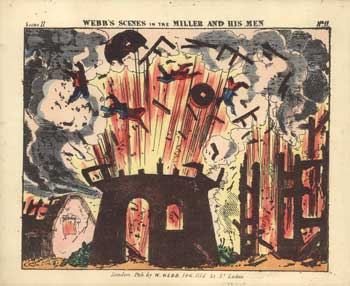
Blow-up scene from The Miller and His Men, the young Winston Churchill’s favourite play for the Victorian toy theatre
While the book that resulted from these researches - Iron Curtain: From Stage to Cold War (Oxford University Press, 2007) - is indeed concerned to trace the emergence of a political metaphor, it is also an anticipatory exploration of the division that came to be known as the Iron Curtain after 1946. That barrier was, after all, a powerful political and cultural reality, and certainly not just an armed frontier between east and west Europe. Many of its characteristics, including the pronounced sense of theatricality it would bring to international politics, were inherited from the period before the second world war.
The historian Eric Hobsbawm has introduced us to the idea of "the short 20th century". My investigation is shaped by a connected hypothesis, which might be identified as the long cold war. It journeys through the back of Winston Churchill's mind, and into an early 20th-century world where the "iron curtain" was first described by a largely forgotten collection of Internationalists for whom it testified to the resurgence of the European nation-state, with its habits of imperial rivalry, secret diplomacy, press-stirred chauvinism and war. My purpose in excavating this earlier history - a story of lost horizons as well as of new vertical divisions - is not to reclaim the Iron Curtain for Europe, but to assist in the ongoing task of dismantling cold-war perspectives, "triumphalist" or otherwise, and of creating a differently informed understanding of the problems besetting international relations in the 21st century.

