
The Enlightenment faith that knowledge will lead to understanding, and understanding to a better world, is central to openDemocracy's being. It informs both what we publish - in-depth analysis and commentary by public intellectuals, professionals, writers, academics and activists - and how we view ourselves: the product, process and the purpose alike.
openDemocracy’s business, our raison d’etre, is to combine the expertise of our contributors with our own judgment and filtering in ways that serve our readers, create high-quality dialogue across frontiers in which minds are stretched and opened, and thus fashion the knowledge about society that is essential to its improvement.
This Enlightenment conviction in the power of knowledge has marked my own involvement with openDemocracy since its pre-history. I met Anthony Barnett, openDemocracy's founder, in 1996 when he and Roger Scruton convened the "Town and Country Forum" monthly seminar at Birkbeck College, London University. We met in the philosophy department, in the house in which, 120 years before, a modern anaesthetic was first administered for a dental operation. The seminar was a sort of anti-anaesthetic: in a time when the sirens sang from the "end of history", the seminar brought around a table, from diverse political a prioris, those who saw the importance of questions outside the grasp of the then pervasive liberal consensus: identity, particularism, the globally shared transformation of every community, however great the diversity between them.
This seminar was a template for how the Enlightenment ideal might work: not by dissolving difference in some totalising idea, but by creating an atmosphere in which the sympathetic understanding of difference could become mutually enriching to divergent views. A constructive encompassing, not a dissolving universalism. Anthony founded openDemocracy (with David Hayes, still our deputy editor) to extend that vision, and to replace the physical meetings in the house of an-anaesthesia with meetings in the ether, whatever that would come to mean.
A crisis of trust
Eleven years on. The internet revolution has neither connected all of us, nor has it yet brought wisdom to all those who are connected. The potential for the technology to be part of the construction of our ideals is clear every day, but so is the extent to which the web is another mirror to reflect humanity, to change it, deflect it again ... That regress of reflections is nowhere near settling down, and what knowledge we make on the web are so many differently shaped mirrors. In which ones do we see the best of ourselves and what we might - need to - become? What we do now will change humanity.
Neither panacea nor plague, the web continues to confront us with the hard questions of knowledge making. Today, it is clear that the Enlightenment faith in understanding must have consequences for how we produce knowledge, and that the new technologies of knowledge-making will change what we can know. In the ideal, understanding subsumes authority: nothing is taken for granted, no opinion believed just because it comes from the pulpit. This ideal, influenced both by technological utopianism as by a consumer-centric world view, pervades current social attitudes towards media and other knowledge-making institutions. Increasingly people want to base what they think and believe on their own experience and authority and do not want to be preached at.
This healthy attitude is frustrated by the way people are also finding it harder than ever to know who or what to believe. To take three examples:
- - science no longer enjoys the respect and authority it did a generation ago: from reproduction to genetic modification, from creationism to technophobian ecology, science is doubted or ignored
- - the defining media, such as CBS and NBC or the New York Times in the United States, the BBC and the Times in the United Kingdom, Le Monde in France, which were once highly trusted sources are now much less so
- - organisations of commitment such as political parties, churches, unions, are much weaker.
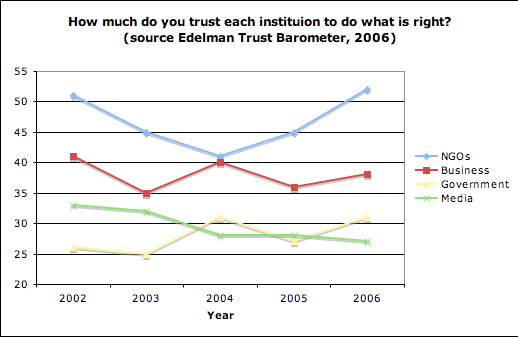
"How much can you trust this institution to do what is right?" When asked this in an Edelman "Trust Survey", European and north American respondents place media lowest, with government next and NGOs and business coming top. The downward trend for media has been worsening in the past five years, and is consistent in Europe and the US. The trends there suggest that trust is coming from commitment: people trust "doers" rather than "talkers", people whose everyday actions in the field exhibit commitment.
Drilling down to different sources of media, the new digital media do poorly. Throughout the world, nationally-based television and newspapers achieve - at least relative to other media - high trust ratings, while blogs and news websites achieve the lowest ratings. Despite this, when an individual loses trust in a traditional media source, they tend to switch to online sources. Therefore, the trend is of a growing audience for the least trusted sources of news. In fact, the fastest growing source of information is online media, and it is also the least trusted. There is a real need for ways of establishing trust in online information.
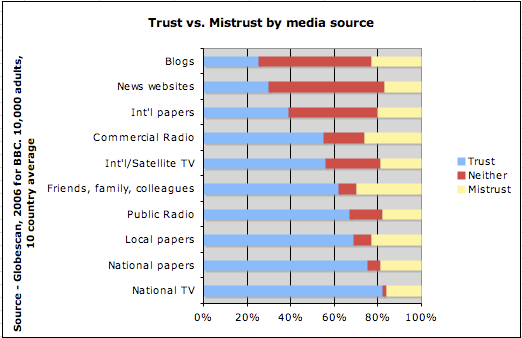
"Committed" organisations like NGOs and corporations are considered to be more trustworthy than media sources, and the most trusted media sources are those that are most established in terms of reputation, age and institutional form. Amongst the most valued channel for information is "friends, family and colleagues", which suggests that authenticity is an important underlying characteristic for the trusted source. News websites and internet blogs, without history, reputation or commitment, do not offer strong signals of credibility. When asked which spokespeople are considered to be credible, the rankings put "people like me", "academics" and "NGO representatives" near the top and "bloggers", "celebrities" and "PR people" near the bottom (source: Edelman Trust Barometer).
In a world devoid of signals of credibility, the talk of strangers has to be assumed to be "cheap". Commitment communicates because it carries its own signal: you must believe that the world can be changed for the better, to take just one example, by freeing digital copyright, in order to, like Laurence Lessig, devote ten years of a brilliant career to the issue. There is no doubting that sincerity. Similarly for "friends and family": if we doubt their sincerity, we know their history to understand exactly how to discount an opinion. But the speech-acts of the writer, the celebrity endorser and the PR person, carry very little weight: it is not that they always falsify, it is that it is very hard to understand in any given case what their perspective is.
The layers of the real
The challenge I see for openDemocracy, in our goal to make better knowledge, is that we need to bring argument and content that comes from the domains that carry their own signals of credibility - activism (including corporate and political action), academia, "people like you and me" - while combining them with the virtues of the best outreach and journalism: accuracy, relevance, and narrative. If we succeed, we will create a space in which analysis that is credible, engaged and accessible can be made. This will not be exactly "citizen journalism", with its connotations of the celebration of the amateur and of the undifferentiated citoyen. Instead, in the economy of knowledge, we will seek contributions from each according to their best abilities, balancing the virtues of the insider, of commitment, with the critical qualities of the outsider, of detachment.
Just as the great challenge of globalisation might be thought of in just this way - how to remain connected insiders while recognising that we are also all of us together inside the group of those that are others' outsiders - so we find that in order to make better understanding, we need to reproduce that balance of insider and outsider in the way in which we make analysis. In the best of cases, I think that openDemocracy comes close to this ideal - not in every article, but taken as a whole. In a number of specific projects, we are trying to systematically apply the notion of building contents through "coalitions of credibility".
Three current and recent projects illustrate the approach. First, our coverage of the Democratic Image exhibition in March 2007 brought a community of practicing photographers into a conversation that surprised me, a complete outsider to the world of professional photography, by its intensity and seriousness. The article by David Levi Strauss that Jessica Reed and David Hayes commissioned around the event distilled that energy into ideas that will continue to raise questions for many years.
A second example is terrorism.openDemocracy.net, our section on the democratic alternatives to the war on terror. Its editor Kanishk Tharoor provides a daily digest of terror-related news, allowing us by his framing to remember the constant and diverse background rumble of violence throughout the world. The section involves activists, negotiators, academics and public intellectuals to comment on the same material.
The third example is Anthony Barnett's conversation on the future of Britain - ourKingdom.openDemocracy.net. Anthony has been a campaigner and thinker on this topic for many years, founding Charter88, a pressure-group promoting constitutional reform in "Our Kingdom", in 1988. Almost twenty years in, the time for radical reform seems to have come, and Anthony is assembling rapid analysis and commentary of developments with more general coverage on openDemocracy itself.
These three examples all show how intensive communities of interest can come together to produce news analysis and commentary that "works": the intensity of the community interest provides a bedrock of sense, while the generalised and hewn material is both a window for outsiders and a public performance for insiders. When it does work, it makes knowledge worth the candle.


