
Two weeks into the public scandal over excessive expenses-claims by members of parliament, and the air is thick with cries for reform.The blogosphere rings as the liberal commentariat cry with one voice ‘Electoral Reform! A constitutional convention now! Charter 88 at last!'
(Can I exempt myself from this caricature? Sadly not. A well-known commentator and activist phoned me up the other day to ask what I thought the democratic left should be proposing. My response? ... ‘a constitutional convention!')
But as usual, the bulk of the liberal commentariat wants too little too late, is still fighting the battles of the previous generation, and remains in denial about the sheer scale of the challenges which it faces (with notable exceptions). So let's see if we can't move this debate along into the 21st century.
It may have been a long time coming, but this is the first moment in living memory when the palpable disillusion of the public with our entire system of representative government has become a major news story in itself. Such occasions come rarely, and when they do, they must always be examined for their inherent risks as well as for the opportunities which they present. My purpose here will be to examine both risks and opportunities, and to suggest that the analysis offered by even the most radical reformers amongst the political mainstream is too weak, localised and ahistorical to grasp the nature of the crisis and the character of any possible solution to it. Let me begin, however, by offering some evidence for my overall claim that the nature and scale of our democratic crisis remain poorly understood. Simply this: that this crisis clearly should have been a major news story - indeed, it should have been the major story - for at least the past five years, and yet it hasn't been. On at least two major issues, the democratic dimension has been overlooked by almost all commentators.
War and Privatisation: A Programme that Nobody Voted For...
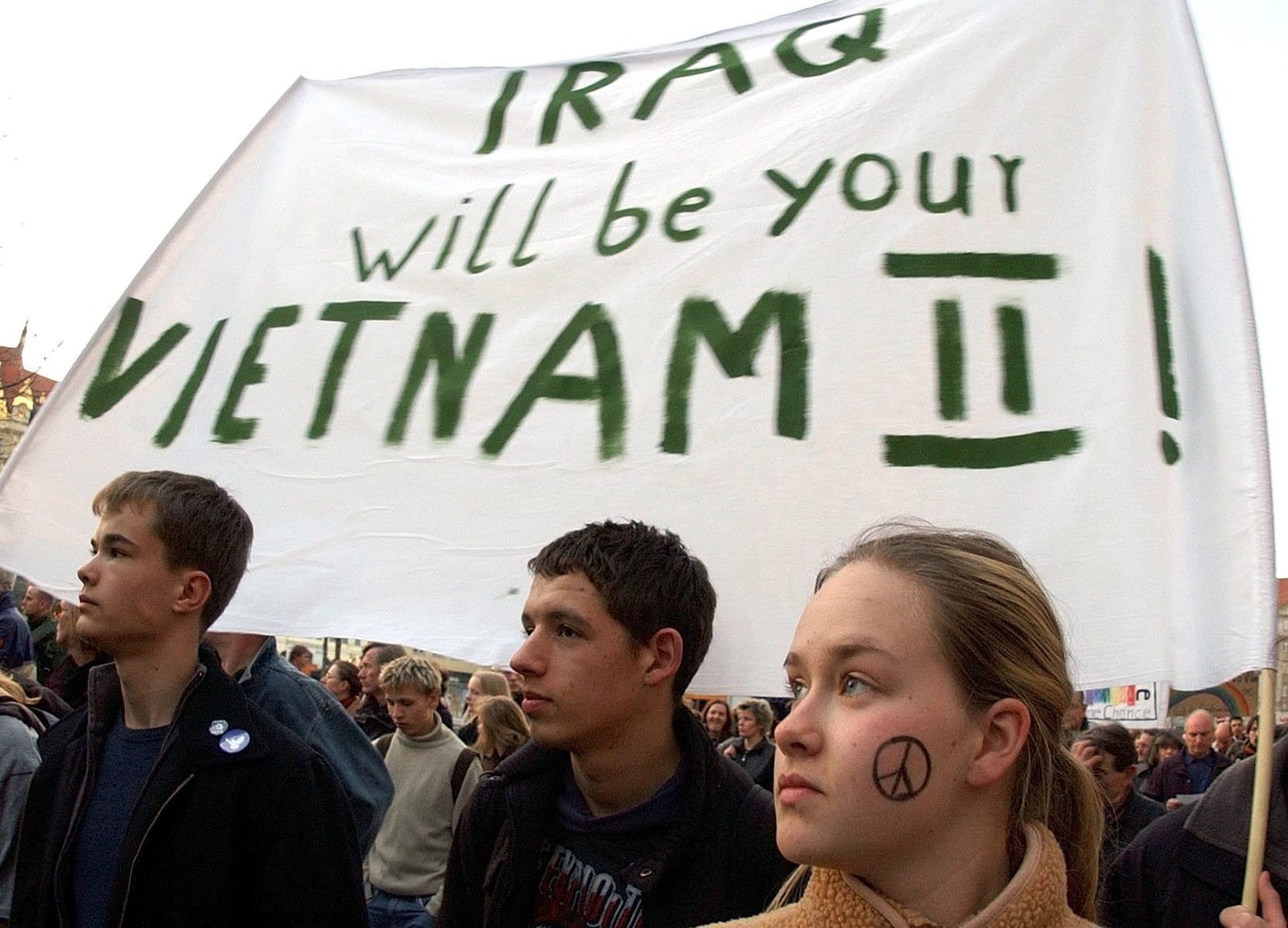
Most strikingly, public anger towards the invasion of Iraq in 2003, and the large-scale willingness to mobilise against it, have tended to be interpreted, not least by the Stop the War Coalition itself, as a manifestation of moral outrage against the invasion and its human consequences. While this, of course, was an important factor, such an explanation does not begin to account for the peculiar trajectory ofthe campaign, so markedly different from that of its nearest historic equivalent, the campaign against the Vietnam war in the late 1960s. February 2003 saw by far the largest public demonstration in British history, involving on some estimates almost 2% of the entire UK population taking to the streets of London to express opposition to the invasion. The unprecedented intervention of the Daily Mirror in openly calling for support for the demonstration showed what mobilising capacity the press still retains in this era of plummeting print-media sales. But more than anything this event demonstrated - as such events are intended to do - the scale and ubiquity of opposition to the war. Within months, however, the campaign had all but dissipated. Why?
We can only answer this question by considering the massive unpopularity of the war during the months leading up to the invasion; and the importance of the fact that the public knew the war to be unpopular, and strongly desired to exercise their right to make a ‘wise, well-judged refusal' of the decision to invade. It is true that opinion polls showed majority support for invasion at the precise moment when it occurred, but this slender majority didn't last long. Clearly boosted by the mainstream tendency to support a war which has become a foregone conclusion, for fear of showing insufficient support for ‘our boys' on the front line, it was not clear support for the decision to go to war. Most importantly, it was sustained only at the moment when the government was insisting that intelligence showed Iraq to present a clear and present danger to world peace, with ‘weapons of mass destruction' that could reach western Europe within a matter of minutes of being launched. The spurious nature of these claims has long since been accepted by all parties to the debate, and support for the war fell below even the level which preceded the run-up to invasion once it became clear that they had been the product of little more than government mendacity.
Despite its transparent lack of democratic legitimacy, the invasion went ahead, as no equivalent action could have done during the ‘golden age' of representative democracy (say, 1930-1970). For most of the period of the occupation, its consequences for Iraq's material and social infrastructures - and for the lives of its people - have seemed to be even more disastrous than predicted by its most pessimistic critics. And yet: public outrage has not mounted, has not built up to the fever pitch of indignation which might have been expected, if humanitarian morality or even explicit anti-imperialism had been the true basis for that historically unprecedented expression of public will. Instead, the campaign against the war and the subsequent occupation of Iraq went into headlong decline immediately following the invasion. Anybody active in radical politics during the ensuing months and years will have been aware of the air of despondent resignation which seemed to fall over much of the population at that time.
This particular pattern of build-up and decline, of shifting moods and fluctuating publics, ceases to be mysterious if we understand what was really going on in February 2003. The anger which was being expressed during that month was not against the war as a military crime as such, but against the clear intention of the government to ignore or crudely manipulate public opinion in the pursuit of a manifestly unpopular policy. Consequently, it was the failure of a massive exercise in peaceful democratic protest to alter this course of action which provoked such disappointment. From a humanitarian point of view, there was every reason for discontent to increase and intensify as the occupation persisted (and I write as one who personally did continue to protest against the war on those grounds). From a democratic point of view, however, once the decision had been taken to invade, the argument was over and had been lost. Both the anti-war movement and the journalistic classes failed to appreciate that this was the real story in the UK: not the war as such, but the democratic deficit which had made it possible, and the palpable public frustration at their inability to make their voices count.
My other example is more straightforward. There can be little question that one of the major projects of the New Labour administration, with some of the most profound and permanent consequences for both everyday life and the distribution of power in the UK, has been its programme of public service ‘reform'. One way or another - through the Private Finance Initiative, the introduction and intensification of internal markets, or through the outsourcing of service-delivery to commercial agencies - this programme has involved the introduction of profit-seeking and commercial relations into as many areas of service design and delivery as possible. A mountain of polling evidence demonstrates that a small minority of the public - and a negligible proportion of Labour voters - has ever supported any element of this programme.
Ministers can point to the commitment to ‘public-private partnership' in published manifestos. However, it hardly needs spelling out that manifestos are read by few voters and are invariably short on detail; nobody can seriously doubt that most Labour voters have always assumed that they were voting against the general principle of privatisation and commercialisation when they voted Labour, and if they do doubt it then they can consult the polls. The fact is that most voters rely on broadcast and print media to inform them about the intentions and actions of government. On this issue more than any other, however, British journalism has demonstrated its scandalous inadequacy to the times. How many stories in the mainstream media have set out to explain to citizens the nature and scale of this historic transformation of public services? We all know the answer: not enough.
We also know perfectly well the defence which journalists would make of this lapse: this is a complicated issue, involving technical details and convoluted policy paradigms which are difficult to narrate, to explain, to make ‘sexy'. It is hard, they would no doubt tell us, to get the public interested in such things, and to make the issues in any way comprehensible. We may sigh and grimace at this kind of lazy self-justification. In fact, however, this is not just a lame excuse for professional negligence, but an observation which brings to light one of the key truths about the nature of our democratic crisis: contemporary politics is too complicated for twentieth century institutions to get to grips with.
The BBC and the print press are, to an extent, institutional relics of the industrial age, and they will not have the capacity to shed adequate light on the complexities of contemporary power and decision-making unless they rethink their intellectual parameters as radically as they have expanded their technological capabilities. In such a context, elites - for example, bankers and ministers - will pursue their own agendas with impunity, exempt from effective public scrutiny. The fact that MPs have been called to account for fiddling their expenses but not for trying to dismantle the public sector, and that overpaid bankers had to wait for the collapse of the entire financial system to attract any attention, only proves this point. In both of these cases, even once the issues have come to light, most of the relevant reporting has turned a story which should have been about a systemic lack of accountability in our most powerful institutions into a petty tale of personal greed. Such accounts ultimately obfuscate more than they clarify the real nature of our situation.
Post-Democracy
This situation is characterised, quite simply, by a chronic inability of our political institutions to give the public any real influence over policy. Any analysis of the broader crisis of democratic representation has to start here. There is no question that the self-serving greed of MPs, and the disparity between public expectations and parliamentary actuality, is an issue worthy of comment in itself; but it is also symptomatic of a much more profound mismatch between the received notion of what MPs are for and their actual role and function within the circuits of power which shape social, cultural and economic outcomes.
MPs, it is still fondly believed, ought to act as the conduits for the views of their constituents, causing those views to inform as fully as possible the key legislative decisions of parliament. Instead, the truth is that MPs are fairly junior members of a technocratic, managerial elite whose most exalted members were, until recently, the merchant princes of finance capital. It surely stands as proof of this claim, that both the US and UK governments have come close to bankrupting themselves in the effort to rescue these lordlings from the fate that they have brought upon themselves.
Sub-groups of this elite may be highly differentiated in terms of style, cultural tastes and mores; but on the whole it pursues its own political agendas with a high degree of consistency, and is more-or-less indifferent to public opinion. The continuity of core policies - despite the shifting emphases on ‘family values' or ‘personal freedom' - since Callaghan and Healey agreed to the IMF's conditions for economic aid in 1978, is sufficient proof of this. Membership of this elite does not necessarily confer great personal power: it would not be in the gift of any one of its members, from the US presidency downwards, radically to alter the course of global capitalist development which is its fundamental shared mission, even if they wanted to. Membership is assumed, however, to confer considerable personal influence in small matters, and above all to carry considerable material rewards. It is therefore hardly surprising that members of parliament have been trying to boost their incomes while largely acting as a rubber-stamping body for the government's agenda, which is itself merely a local adaptation of that international neoliberal programme which the UK was first committed to by Healey and Callaghan.
This is a situation which has been well documented and described by a number of first-class analysts and commentators (E.g. Anthony Barnett,This Time: Our Constitutional Revolution. London: Vintage,1997; Colin Leys, Market Driven Politics, London: Verso, 2001; David Harvey, A Brief History of Neoliberalism, Oxford University Press, 2005). Among the most lucid is Colin Crouch, who argues that we have now entered an epoch of ‘post-democracy',within which the established institutions of democratic representation simply do not function to represent or to enact effectively the collective will of the citizenry.
One of the best-known and most widely understood explanations for this situation is that it is the key political consequence of economic globalisation. Put very simply: where governments no longer have the degree of control that they once did over flows of capital, labour, ideas, or people, then the capacity of individual national legislatures to determine what happens within their own borders is severely curtailed. Everything from wage levels and rates of inward investment to media content and the cultural makeup of local populations could once be regulated by the state, and now cannot.
As the capacity of governments to manage such broad factors shrinks, they are increasingly likely to emphasise the importance of their capacity to do the only things still in their power: for example, isolating individual scapegoats for social problems and subjecting them to highly visible forms of punishment. In the long-term, however, the ineffectuality of such measures can only generate an increasing sense - amongst both public and politicians - of the impotence of politics in the face of global capitalism. Such impotence breeds frustration, and frustration will manifest itself in various ways: for example, in an increasingly self-serving attitude amongst professional politicians, and a growing resentment of them amongst the people whom they are less and less able to serve effectively.
This account (which is my own, although it is derived from Crouch and others and summarises a widely-circulated position) is powerful, and demonstrably accurate as far as it goes. However, the problem with it is that it tends to face us with an insuperable dilemma. If the problem is the weakness of national governments, then surely the answer is to look to those supra-national bodies which enable national governments to co-ordinate their actions and pool their power, exerting a greater influence over the world and its directions. The trouble with this solution is: the more power is ceded to these bodies, the more they appear to pursue agendas which have nothing to do with the wills of citizens and the more purely do they seem to reflect the assumptions and goals of the global neoliberal elite.
The classic instance is the European Union. At the end of the 1980s, it might have seemed realistic to hope that something like a European civil society would emerge, as the European parliament became more and more influential over EU policy, and an increasingly-educated public came to pay more and more attention to it as a key arena of debate, boosting participation in European elections and fostering the growth of transnational political blocs and movements. Even before the recent financial crisis - with the legitimacy of the EU at an all-time low, and its transparent commitment to the neoliberal ‘Washington Consensus' at an all-time high - such dreams looked laughable. After the debacle of the G20 meeting earlier this year, they look now almost incomprehensible: remnants of the mythology of another age. There is clearly no European civil society, and no presently-imaginable prospect of one emerging within the lifetime of any European adult alive today. The EU has proved itself largely incapable of influencing the direction of international neoliberal capitalism. Politics, whether we like it or not, is still lived and enacted at a local and national level, even while capitalism is managed and implemented globally. Doesn't this leave us with an impossible problem, and condemn us to a long period of ‘post-democracy'?
Only if the sole aspect of the situation that we look at is globalisation. The problem with almost all commentary on these issues is that this is the only element that it considers. But there are other issues of equal weight to think about when assessing the nature of our democratic crisis. Firstly, it must be acknowledged that public legislatures were at the height of their power in the ‘developed' democracies in the middle decades of the twentieth century, when the organisational capacity of the labour movement (itself dependent upon an industrial techno-social context), and the threat of international communism, severely curtailed the power and the audacity of capital. This enabled politicians to mediate between different power blocs and to threaten powerful elites with the possibility of revolutionary upheaval if the democratic will of the people was blithely ignored. (See Stuart Hall's ‘The ‘Little Caesars of Social Democracy' inThe Hard Road to Renewal. London: Verso, 1987). None of these conditions obtain today.
Globalisation is only one element of an interrelated set of processes which has seen almost every society on the planet subject to extraordinary levels of complexification. Internally, this can best be understood in terms of the highly variegated and differentiated nature of a society like the UK. The range of lifestyles, career paths, family forms, patterns of loyalty and belonging which are widely tolerated and which shape the lives of British people today would have amazed our ancestors even going back just one generation, never mind half a century. The diversity of personal lives and public views which is now tolerated even within once highly conformist professions such as academia or the law is a good indicator of this. As a result of these changes, individuals cannot be assumed to belong, as they once did, to large, relatively homogenous social groups sharing a largely similar outlook on life and a consequently similar set of political views. However, this is the assumption which underpins the party political system which we have inherited from the 1920s.
In an era when large-scale heavy industry was the foundation of the economy, when mass broadcasting was the key public medium, and when commerce could only offer a small choice of largely standardised products to consumers, it made sense to assume that citizens could be fitted into a few very capacious boxes; that the opinions of all those inhabiting any such box could be assumed to be largely similar on all issues; that bodies of opinion could therefore be collected together behind a small number of banners and allowed to fight it out only every four or five years. It made sense to assume that whichever party won such a contest could pursue a more-or-less stable agenda which more-or-less represented the wills and interests of its constituents, until the next such contest. Today, this model makes little sense. In the present context, the whole idea of mobilising large-scale majorities in support of an entire programme of government for five years without negotiation or adjustment seems improbable; and yet this is all that our political system is designed to enable us to do. It is no wonder that it cannot do it; instead, politicians are obliged to offer nothing but platitudes in order to fight elections, and there are no well-organised lobbies pressuring them actually to represent the interests of their constituents when they win them.
Postmodernity
In fact, this is not a new observation. What I am describing is only what Jean-François Lyotard first called ‘the postmodern condition' way back in 1979. Few thinkers have been more poorly understood by their commentators than Lyotard,and few concepts more routinely abused than ‘the postmodern'. So most readers, through no fault of their own, would do well to forget whatever they think they know about that term (and don't worry about Lyotard for the moment - this is extrapolated from his argument, but is not identical to it ). Whatever you thought it meant, whatever else it means, for the purposes of political and historical analysis what ‘Postmodernity' means is the following.
Industrial capitalism generates massive social and environmental problems, but for most of this its history (say, roughly, 1640-1970), it looked as if human civilisations were developing institutions and ideas which could keep those problems in check, regulating both capitalism and its consequences, even sometimes forming the basis for entire systemic alternatives to capitalism, and generally allowing someone - be it an enlightened despot, a democratic parliament, a General Secretary of the Communist Party or even a corporate Chief Executive - to make clear decisions about the general direction of travel. The history of ‘modernity' was the twin history of the development of both capitalism and these various other mechanisms of prediction and decision, of discipline and control. However, we have now entered an era when none of the ‘modern' institutions of government seem capable of really exercising any control over the material, socialand cultural changes which capitalism continues to unleash upon us. At the same time, none of the large-scale, coherent systems of thought which have been handed down to us from earlier moments seem capable of grasping the full pluralism and complexity of a world of such dense, wild, unregulated capitalism as we see all around us today.
Rather as theoretical physics currently has no coherent paradigm with which to grasp the nature and behaviour of matter at every scale, and is forced to muddle through with a number of diverse hypotheses which seem to hold good in their own contexts but don't apply in all cases, we now find ourselves deploying ideas, policies and loyalties in a haphazard and pragmatic way, unsure as to how it all fits together, and whether it even matters if it does at all. This is the postmodern condition. In a way, the crisis of democracy which we are experiencing today is only a symptom of this deeper shift: which is to say, it is symptomatic of the inability of institutions which were born in the industrial revolution and came to maturity in the era of cinema, railways and mass democracy to get to grips with the mercurial fluidity and speed of postmodern cybernetic capitalism.
This realisation, explicit or implicit, has informed a great deal of philosophical and political reflection in recent decades. One response is simply to throw our hands up in the air and declare politics as such to be a redundant concept, delivering ourselves to the nihilistic thrill of a world without shared values and meanings. We can be thankful that this quasi-Baudrillardian perspective seems not to have made the fashionable come-back of other cultural relics of the 1980s.
Certainly the most influential response is that which came to shape the ideology and practice of New Labour and similar ‘Third Way' administrations around the world: one can already see this perspective emerging in the early writings of Geoff Mulgan, for example, long before he became head of Blair's policy unit, and it is famously expressed in Peter Mandelson's perspicacious claim that the era of representative democracy was over and Philip Gould's touchingly ingenuous claims for the focus group as a genuine tool of consultative democracy. (See Stuart Hall and Martin Jacques (eds), New Times: The Changing Face of Politics in the 1990s, by Stuart Hall and Martin Jacques, London: Lawrence & Wishart,1987: and Gould in episode 4 of Adam Curtis' BBC TV documentary,The Centuryof the Self. ) What emerged here was a response which effectively acknowledged the end of the party-political model of the mid-twentieth century, and which proposed to replace it with government by an enlightened technocratic elite, who would use techniques such as focus groups and market research to find out what would make people happy, would try to give them more-or-less what they wanted, but would always keep in mind that maintaining the profitability of UK companies and investors must be regarded as the first priority of governance. This model works very well during an economic boom. It comes unstuck quickly, immediately, disastrously when the boom ends. This is what is happening before our eyes today.
During a boom, it is not necessary for the governing elite to make choices about how to distribute a limited set of resources. The financial elite can carry on reaping most of the rewards, as long as there is just enough cheap credit and extra tax revenue to keep consumers feeling comfortable and public services afloat. As soon as the boom ends, however, an ugly reality makes itself felt again: the fact that despite the disappearance of clearly demarcated political constituencies, what has not disappeared are clearly identifiable conflicts of interest between sections of the community. The interests of banks and those to whom they lend, of corporations and the employees whose salaries they must pay, of retailers and their customers, of high-rate tax-payers and public-service workers, cannot be perfectly reconciled, because in each case the incomes of the former can only be maintained at least partially at the expense of the latter. It is partly the persistence of such antagonisms, even while the political blocs which once enabled us to name and imagine them have disappeared, which makes politics today so confusing.
Radical Democracy Now?
However, at the same time, it is the unravelling of the technocratic solution to the postmodern problem which presents us with a new opportunity today. As philosophers such as Ernesto Laclau and Chantal Mouffe on the one hand, Antonio Negri and Michael Hardt on the other, have all argued in different ways (despite the mutual antipathy of these two pairs of writers), the postmodern context ought to be seen as in fact a moment of fantastic opportunity, a moment when the force of democracy might finally break free from the constraints placed upon it by industrial society, as the antagonisms which continue to persist within and across the field of contemporary social relations become evident and activated.
For Laclau & Mouffe, it is the very proliferation of such conflicts which might become the basis for a radicalisation of democracy. For Hardt & Negri, it is only in the manifestation of the creative power of ‘the multitude' (the vast collectivity to which all who work belong), against ‘Empire' (contemporary capitalism and its transnational institutional forms), that the possibility of true democracy resides. What is interesting here, is that from either of these perspectives, it is crucial right now to explode the lazy liberal view that yet more technocratic reforms could be sufficient to resolve the crisis of democracy. The fact that real conflicts of interest are at stake, and that a powerful elite has every interest in the continued and intensified de-politicisation of government, must be acknowledged and brought to the fore.
The situation then presents us with a question. What forms of democratic practice could make these antagonisms visible, and so enable democratic contestation to emerge again, in place of the empty theatre of impotence, gesture and resentment which politics has become? Do we really think that proportional representation for the House of Commons is going to cut it, as the Observer evidently does ? It hasn't prevented exactly the same degradation of politics occurring in every one of the ‘mature' democracies as well as many of the newer ones (and it is far too early to decide that Obama represents some permanent turning of the tide in the American case).
Why would it? The aim of PR is to prevent any over-mighty majority from emerging and to enable a pluralistic range of voices to be heard in public debate. No doubt there are key problems with British democracy which PR would remedy (most notably, the appalling over-representation of a few thousand voters in the south of England and the inability of the significant Green minority to establish itself on the national stage), but the lack of pluralism and the tyranny of the majority are not the fundamental problems which we face. In fact the problem is almost the opposite: postmodern culture is ready too pluralistic for its collectivities to be able to operationalize themselves effectively at the level of party politics, and PR would only make a very slight difference to that situation. At the worst, it might exacerbate it, if the endless cycle of parliamentary coalition-management were to leave the executive even freer than it is now to pursue elite agendas.
The crisis we face today is not just a crisis of the British constitution, but of the whole conception of representative democracy which we have inherited from a long-passed era. The very idea that an elected individual can be relied upon to be the political stand-in for a vast and complex community of constituents, while also remaining loyal to a national party organisation, is impossible to sustain in the postmodern context. But what is the alternative?
In the past weeks, we have heard an astonishing array of voices speaking much the kind of language that I have been using here: from Norman Lamont to Esther Rantzen, the value of ‘voting for individuals' rather than for parties has been extolled as one way of ensuring the probity of our representatives and bypassing the apparently corrupting influence of party. On one level, this is an obvious non-sequitur. It is not as members of parties, but as members of the entire technocratic neoliberal elite, that MPs have behaved as they have. There is clearly a level of self-interest involved in other members of that elite (e.g. journalists, newspaper editors and celebrities) trying to distract attention from the fact that they are all, systemically, over-privileged, overpaid and unaccountable.
On another level, however, the non-sequitur itself is telling. Parties are perceived to have become corrupt and corrupting because they are seen quite rightly to have become machines for the servicing of that elite and institutions for the professionalisation of politics, rather than vehicles for the democratic self-expression of broader communities of interest. Tory MP Douglas Carswell has even called for MPs to be subject to direct recall by constituents: this comes close to the classic demand of the far-left Campaign for Labour Party Democracy, although they only proposed that MPs should be thus accountable to constituency parties. But it is in precisely this range of responses that we can discern the real danger of the present situation.
The idea of electing celebrities instead of politicians, like the idea of removing parties from politics, is not an idea which can tend towards the renewal of politics as such. In fact it is the opposite: it is an idea which accepts implicitly the neoliberal premise that politics as such is over, and that all we really need is to be administered and managed by competent and trustworthy (or even merely amusing) individuals. We have already seen the potential impact of this celebrity anti-politics with the election of Boris Johnson as Mayor of London. We could now be about to witness its final triumph over any prospect for the renewal of democracy. Such a renewal may well involve a complete reconfiguration of what we mean by ‘party', but the idea that it can involve either a simple reform of existing party procedures, or government by an individualised assortment of the great and good, or a general election under our present system, can only direct us further away from any prospect of positive change.
Of course, this leaves open the question of what we could mean by ‘the renewal of democracy'. This is not something that I believe can be laid down in a blueprint. ‘Model constitutions' are an ancient plaything of political philosophers, and they have their contemporary analogue in the endless reams of jolly clever policy proposals issued by think tanks, none of which will ever come to anything unless the balance of social forces is such as to make them desirable to some powerful constituencies. The primary issue is not what a twenty-first century democracy would look like, but what such powerful constituencies could bring it into being, and how we might assemble this from the disparate fragments of contemporary discontent (how we might actualise the potential of the multitude, to borrow from Hardt & Negri). I don't know the answer to this question, but would like to propose that it is precisely this question which cries out to be answered. Without the Chartists and their descendants, we would never have achieved what democracy we have in this country. Without a movement which can see past the next election or the constitutional debates of the 1980s, we won't get out of the mess we're in now.
Still, one can't duck the question of policy altogether. Clearly, to address the problems with the existing forms of representative democracy identified here, we need to seek out and experiment with processes of democratic consultation and deliberation which are far more participative and processual than what we have now. Weekly meetings of constituents to whom MPs must be accountable for their votes (and the same thing for local councillors)? An obligatory afternoon off work for all employees, every fortnight, to take part in such meetings? Extensive use of the internet to facilitate participation by those who could not attend physically? A devolution of all remaining powers of the crown prerogative to the parliament? PR for the House of Commons as well as for a new second chamber? Real tax-raising powers for the devolved national governments and the GLA? A return to the Liberal Democrat experiment with ‘neighbourhood councils'? Full election of the judiciary, the boards of hospitals, of school and university governors, of police boards, of the director general of the BBC? Probably, yes: all of the above and many other ideas besides would have to be considered, discussed, played-with and moved-beyond in any ongoing process of democratisation.
These are, effectively, the kinds of policy being experimented with now in some parts of Latin America, and theirs is the animating spirit of the World Social Forum. They are not new, but belong to a continuum of ideas which have been around for a very long time. Greens and radical liberals have been making similar proposals for years. Going further back, the socialist, communist and anarchist traditions have a long history of scepticism towards parliamentary democracy and of proposals for more involved and accountable institutions (from factory councils to autonomous communes). The New Left was always informed by a commitment to the ideal of a democracy that would be more and more participatory.
Today, do such proposals really sound any more utopian than did the demand for full manhood suffrage in the 1830s (never mind full adulthood suffrage)? At any rate, the point is not the details: the point is that without a general movement in this kind of direction, democracy can only ever decay. We have the potential elements for such a movement already before us in the UK: from the ClimateCamp (a hugely successful exercise in ongoing radical democracy) to Compass (whose proposals for the democratisation of public life are at times revolutionary in their implications), from the Green Party to the inchoate army of isolated voices crying out for change. If they could find a way to resonate together, then they could sing a very powerful song indeed today. Surely, if we have learned nothing else, we have learned this much from the past 30 years: democracy can only ever be, in Raymond Williams' phrase a ‘long revolution'. Otherwise it stagnates. It has been stagnating now for over a generation, and it is up to us to launch that revolution once again.
With thanks to Martin McIvor


