
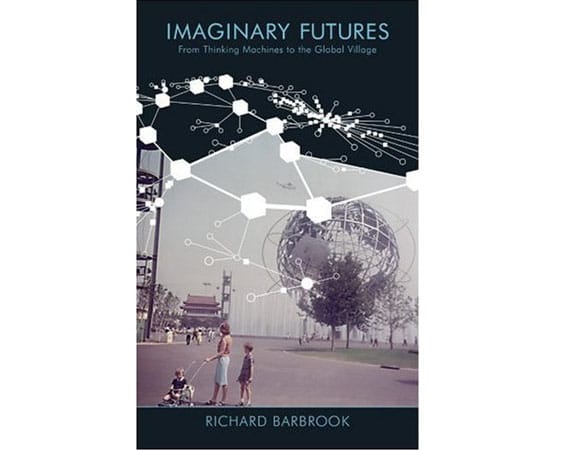
"Imaginary Futures: From Thinking Machines to the Global Village"
by Richard Barbrook
Pluto Press | April 2007 | ISBN 0745326609
Extract from Imaginary Futures:
THE PAST
The model of the future offered to me as an adult in late-2000s London is the same future promised to me as a child at the 1964 New York World's Fair. What is even weirder is that - according to the prophecies made more than four decades ago - I should already be living in this wonderful future.
Computers were described as ‘thinking' so the hard work involved in designing, building, programming and operating them could be discounted.
Richard Barbrook is a senior lecturer in the school of social sciences, humanities and languages at the University of Westminster, London. Among his writings are (with Andy Cameron) The Californian Ideology (1995) and The Class of the New (OpenMute, 2006). His most recent book is Imaginary Futures: From Thinking Machines to the Global Village (Pluto Press, 2007); the book's website is here
Also by Richard Barbrook in OpenDemocracy:
"The Gift of the Net"
(4 Septemebr 2003)
"Imaginary futures: frozen and fluid time" (16 May 2007)
Plus: Rosemary Bechler reviews "The Class of the New" (24 July 2007)
While some prioritised defending civil liberties at home, most of them were convinced that the first priority of the American Left was to prove its anti-Stalinist credentials in the Cold War confrontation. Since socialism - in all its interpretations - was a dangerous foreign concept, a more patriotic form of radical politics had to be developed. During the long period of conservative rule of 1950s, this aspiration became the rallying-call for a new movement of progressive intellectuals: the Cold War Left.
THE NOW
As the most liberal nation on earth, the United States must also be the furthest advanced along the path towards socialism.
The Iraq War was not only a war for oil, but also, more importantly, a war for media. When the US military's hi-tech victories were covered live and in fullcolour on the global TV news bulletins, the whole world would understand that the United States was the most advanced nation on the planet.
For pro-American politicians like Blair, adopting an independent foreign policy implied much more than the dangerous reordering of geopolitical space. Above all, this shift threatened their certainties about time. It was almost unthinkable that the future might not be American.
THE FUTURE
When the owner of the future controlled the present, geopolitical rivalries and class conflicts were focused upon the struggle between opposing definitions of the global village. At various times from the 1950s to the 2000s, the information society was identified as a state plan, a military machine, a mixed economy, a university campus, a hippie commune, a free market, a medieval community and a dotcom firm.
Contrary to the tenets of McLuhanism, the convergence of media, telecommunications and computing has not - and never will - liberate humanity.
The Net is a useful tool not a redemptive technology. Cooperative creativity and participatory democracy should be extended from the virtual world into all areas of life. This time, the new stage of growth must be a new civilisation.

