
In the late 1970s, the former British colony of Rhodesia was being hauled into the modern world, struggling and kicking its way to independence. For me, a young white girl, it was a confusing time of both personal and national transition. Our ordinary family lived an ordinary life in an ordinary suburb. But how ordinary was it when our maid and our garden boy lived in a couple of simple rooms (a kaya) at the bottom of our acre-sized garden? And why were white males men and black males boys? Why did African women have to leave their own children in the family village and travel to the cities, towns and farms to look after the children of the white boss and madam?
Did I sit around wondering how these left children were? Or about the state of mind of the woman who was on her hands and knees polishing the floor as I left for school in the morning? No, I did not. I was too busy climbing trees, swimming in pools or freewheeling down roads on my bike, in a haze of happiness that was to be shattered when my family left Rhodesia/Zimbabwe soon after the 1980 elections; along with hundreds of other white Rhodesians who took the gap (the Rhodesian expression for fleeing the country).
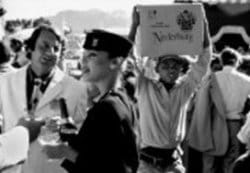
Coloured workers bring reinforcements at a wine-tasting party near Paarl in the Cape, Ian Berry, 1984
However, even from my childish perspective at the time, the situation was simply black and white. I found it hard to come to terms with the idea of separation, the gaping divide between people groups, especially as most of my friends never questioned it, and all the adults I knew seemed to accept the status quo as part of the wonderful Rhodesian way of life along with their membership of the Salisbury Sports Club, the sundowners and braais (barbecues) at the weekends, the fishing trips to Lake Kariba. Why did Johns (the gardenboys) children only visit now and again? Why couldnt they come to the cinema with us? Its not that I couldnt play with Josephine or Johns children, I could hang out at the kaya, which I frequently did. It was just that Johns children were not allowed to go anywhere with us. Some older adults still referred African children as picannins. They would say: why does your daughter play with the picaninns?
As a whole, white Rhodesians were not necessarily a cruel or brutal people. As the guerrilla war raged in the bush around them, many simply did not question what lay behind the war. Why was it happening? What caused the war? Why were the majority population of Zimbabwe restricted by laws that reserved the best land for the white community? Here were a vast disaffected, disenfranchised people whose plight was ignored by the average white Rhodesian. The repercussions are being keenly felt in Zimbabwe to this day.
The general feeling was that the then government of Ian Smith would deal with it (the war). Our boys (the Rhodesian army) would wipe out the terrs (terrorists) and keep the black Marxist hordes at bay.
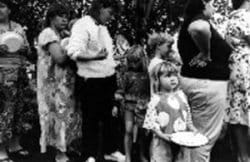
Poor whites standing in food lines in Orange Free State, Ian Berry, 1994
I was approaching my teens when we took the gap and I was soon even more aware of the social and political anomalies experienced by the different racial groups. In 1980, South Africa was a country of far greater cultural diversity and an even stronger system of separation and oppression. In Johannesburg, I was soon standing on the verge of a vaster social and political gap.
Perhaps I noticed it more keenly then, as I was the outsider. I was the 12- year old with the flat chest and the skinny tree-climbing legs looking up at the tall girls, a year or two older, with their kohl-ed eyes and carefully-flicked hair. One boy in that first year of high school was sixteen, an immigrant from England, who was kept in the first year because he kept failing Afrikaans, a prerequisite for moving up to the next grade; one of the myriad ways that the apartheid regime used to ensure that we knew which side of the gap we stood on.
I hated Randpark high school. I hated South Africa. I hated my parents for robbing me of my beloved Rhodesia, the landscape of my childhood and of my imagination. I was not fully aware of how deeply this would affect me; how I would carry this around with me for the rest of my life; how I would eventually come to align myself with a people group who were being denied their land far away in Burma.
Learning to live
A mission doctor uses a trading store warehouse as a clinic to treat his patients, Ian Berry, 1961
It was this departure from Rhodesia that would provide the impetus for my writing and thought. At Randpark High, I felt like a tadpole amongst frogs, but I grew legs when I went to the Art, Ballet, Drama and Music School in the centre of Johannesburg and began mixing with the other arty freaks. Here were students who thought and expressed themselves differently; teachers who encouraged us to push the boundaries; young men who were appalled at the idea of national service.
Locked into their police state, most white people in South Africa (though obviously not all) did not question. Life went on despite the lack of intelligent cultural and political debate in newspapers and on television, though much went on underground. At 14 I began bunking out of the school hostel to go out to subversive places where blacks and whites mixed: a naughty thing to do in the apartheid era. I got tear-gassed once, at the Chelsea underground in Hillbrow: I remember my make-up pouring off my face along with most of my other bodily fluids. I didnt stop going to these heady places.
The South African police were frightening. As a teenager, intervening on behalf of some little black kids who were being thrown into the back of a police van for dancing on the streets for a few cents, I walked away after the police threatened to take me for a ride. I had heard about going for a ride. Being taken in the back of a police van over rough bush roads at a pace that knocked you around a bit. I had heard the stories of women being molested by the police. Of men who never returned. I felt impotent with rage.
In 1986, following my matriculation from school, I was so desperate to leave South Africa, that I bought electrical goods in South Africa and sold them on the black market in Zimbabwe in order to buy a plane ticket to London, arriving soon after my 17th birthday (I still had my Zimbabwe passport then, a few years later I had to choose between keeping my Zim passport or relinquishing my British one I kept the British one for practical reasons).
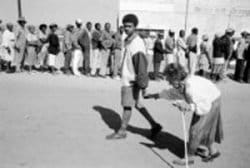
A solitary elderly white woman is led in to vote by her black companian in Western Transvaal, Ian Berry, 1994
People have said to me: How brave, taking a stand like that! Leaving at that age! It seemed simple at the time. You joined the struggle or you left if you had a foreign passport. But I knew that had I stayed, I could have done more, though you risked your life in the process: there were people, black and white, Coloured and Asian who were devoting their lives to the cause. I was defiant. But this time, I took the gap.
I arrived in London with £20 in my pocket and the address of one of my uncles ex-girlfriends. I have been here ever since. I spent my 20s in something of a hedonistic, self-involved fug. The birth of my son, Luca, in 1996, shook me out of my inwardness. I went off and took a couple of degrees, got myself a teaching qualification, and started taking my writing seriously.
Why Burma?
In 2002, as I was coming to the end of a six-year period of study, I became friends with a woman who was going to live in Thailand with her husband, a doctor, to work with the Karen refugees of Burma (renamed Myanmar in 1998 by the SPDC military regime), members of one of the largest ethnic minority groups in the country. The SPDC the State Peace and Development Council is responsible for systematic, grinding repression that has inflicted thousands of civilian deaths; it has also kept the democratic leader and Nobel Peace Prize winner Aung San Suu Kyi under house arrest following her National League for Democracys sweeping election victory in 1990.
Burma is a country of many ethnic minorities Karen, Karenni, Shan, Chin, Arakan and Mon among them with their own language, religion and cultures. Thousands of Karen people, as well as people from these other groups, are being forced to flee their villages, displaced from their traditional homelands, after attacks by the SPDC junta as part of its effort to homogenise and control the country and its vast energy and timber resources.
I was appalled by what my friends told me was taking place in Burma. Periodically, I received emails from them, detailing the atrocities that were taking place against ethnic minority people, and what had happened and was happening to the families of the children in the schools and orphanages that they were supporting near the Thai/Burma border.
One letter, in particular, affected me powerfully. It described how one of the schools that my friends were supporting had almost run out of food there were only one or two sacks of rice left, but no money for vegetables or anything else. I thought of the excesses of the area where my son goes to school in Hampstead, north London: the well-fed, fussy children; the mothers driving their children through the leafy lanes in their four-wheel drive cars; the money spent on cinema, Game Boys, trips to McDonalds. I decided to tap into some of this excess cash.
I teach arts and crafts part-time to children. In summer 2003 I ran some workshops with volunteers, sending the proceeds to the schools/orphanages in Thailand. I liked the idea of children here (in London) helping children there (in Burma) a sort of global awareness/educational exchange.
From this point, I involved my sons school, which will soon begin to share artwork, letters and photographs with the refugee children at school in Thailand. They have already taken part in a fundraising day to benefit the refugee schools on the Thai/Burma border. Our children will be able to see what it might be like to be far away from home, at school in exile. They can also see (they receive photos and updates) where the money they raise goes the educational supplies that their money has bought.
It benefits both sides: both sides working practically and creatively together. Towards the end of 2003, my friends asked me and some other friends to set up Hand in Hand for Asia. The simple desire to do something practical about the world, that had begun years ago in Rhodesia/Zimbabwe, has been given an opportunity to be realised. The charitys official launch date is 26 June 2004.
Travelling home
You may well ask why I have not decided to work in aid of the peoples of Zimbabwe or anywhere else for that matter. The short answer is: I dont intend to stop here. The longer is: you have to start somewhere, and perhaps one place is as good as any other.
Here was an opportunity, coming at a time when I was able to take it, given the skills and abilities I possessed at that moment. I am a single mother on a low income, so giving money was not an option. However, giving skills and some time was. In a democracy, anyone can do that even if it is putting pen to paper, or digit to key, to fire off a letter to your member of parliament demanding why your government is not doing more for the suffering peoples of Burma, Zimbabwe or Sudan.
The stories coming out of Burma are devastating, but they emerge very rarely, and in secret, as there is a complete press blanket. The government controls everything in Burma: there is no free press; no tourism that is not controlled; no NGOs in the areas where the ethnic cleansing is taking place.
During a recent trip to the Thai/Burma border where I visited Karen refugees, I was told of systematic killings and torture, the kidnap of villagers to be used as porters for SPDC building projects, and of children being used as landmine sweepers. I saw secret film footage of women describing multiple rape by SPDC soldiers; of civilians with bullet and landmine injuries; of people in flight from burning villages, desperately trying to retrieve their rice supplies to carry on their backs. These internally displaced people (IDPs) usually try to cross the border into Thailand; during this time they are forced to hide in the jungle without shelter or adequate food, hoping to be able to return home at some point.
In a particularly harrowing piece of tape, a Karen couple told of how the SPDC came to their village, burnt it and then threw their children onto the fire. Children, the elderly and infirm are dying from basic diseases due to lack of food and simple hygiene. Women are dying in childbirth on the jungle floor. Foreign NGOs are denied access to these areas. Against all this, the resistance wings of the Karen, the Karenni and the Shan are fighting a battle that seems futile; facing the might of a regime that may spend half the national budget on the military.
In the main refugee camp on the Thai/Burma border, I was deeply impressed by the beauty of the landscape: towering mountains with clouds circling them like hula-hoops, emerald green trees climbing up to the blue skies. But underneath, the Karen refugees live in bamboo shacks, tolerated by the Thai authorities in a camp where so many have lived and died during forty years of war in their homeland.
Karen refugee settlement in Thailand, Simon Hillman
At an orphanage we support, I was given pink bananas, whose deliciousness I cannot describe. The children put on a concert for us. Most had escaped through the jungle with fellow Karen. Some had been separated from their parents; others had parents shot or killed by the SPDC. It was hard to believe that these singing children, in this place, had undergone such experiences and that across the river in Burma, their people, and the people of other ethnic groups, were being subjected to unspeakable acts.
You could travel to the beautiful Myanmar promoted by the military junta if you choose. Travel agencies, keenly supervised by the military government, could arrange for you to view the temples and buddhas of Rangoon. You would be escorted carefully, and you certainly would not see the slave- and child-labour put to work in the SPDCs profitable building programmes. You would not, I think, be able to guess at what lay behind the regimes façade, where the beauty of the landscape conceals so many secrets among them the desire of a regime that would like to see the ethnic minority people of its country vanish from the earth.

