
Lange Eyland, Nieuw Nederlandt (New Netherland), Flora, The Ridings (East and West) Nassau Island, Nahican, Sewanhacky, Sewanhacking, Suanhacky, Sweanhaka, (Place of Shells), Mattowak, Mattawake, Matouwax (Land of the Periwinkle or Country of the Ear- Shell), Paumanok, Pommanocc (Land of Tribute), West Egg, East Egg, Ponquattuck, Broken Island
. . . so white and silvery, calm and pleasant. . . with its long-rolling waves in summer, sounding musically soft against the hard sand; yet how many ship has met her death-wreck, driven on those sands, in the storms of winter.
Still, there will come a time. . . when nothing will be of more interest than authentic reminiscences of the past.
Please enter the Principality of Ponquattuck, the Land of Water.
Please enter the Chapter of Maquiogue in the Principality of Ponquattuck, to meet some old friends, and reacquaint yourself with this place and its many versions of water.
Please cross the Hemplestead Plains, make your way through the Chapters of Laketown, Bayville, Atlanticville, Waterville, Pacific Beach, Oceanford, Bayshores, Seatown, and pass through the Dictionary of Indian names until you reach Rivertown, the County seat, and finally the tiny blink-and-youll-miss-it Chapter of Maquiogue which is located pretty far down island, which is at the heart of it, in its small-town way.
It is preferable to approach by sea if possible, even-though this is hardly the favored means of transport these days.
At every turn, in the great principality of Ponquattuck, you meet an inlet or harbor. Every street in every Chapter as the towns are called ends in some version of water:
Bays: with pebbled, seaweed-encrusted shores, its sand sprouting patches of brick-rust iron, pock-marked with crab and steamer breath-holes.
Kettlehole Ponds: one of the many mementos from the last glaciers thump and melt, fed by freshwater springs. And bottomless, according to legend.
Rivers and creeks.
And, of course: The Sea.
Thats the big one.
Once visited you take the smell of the sea with you everywhere, for the rest of your life, take the smell of its adornments, the necklace of sculpted driftwood and seaweed pods, the husks of crabs and shellfish and eels.
For the rest of your life, your feet can feel that white sand, fine as talc, scorching at midday and cool at night. Your heels and the balls of your feet are toughened from walking over stones, razor-clams, and burning sand, so that the rest of your life you can walk over broken glass as you do, as you will.
Even from miles inland you can hear the surfs constant murmur, especially at night when the wind and darkness carries every tidal nuance through the air. The crash, thump, thunder and wallop of more storm-wracked days.
During the blazing high summer, when the pattern and size of the waves seem more welcoming, warmer, more human-scale, and the sound of the breakers softer, more playful, you breathe in with the suck of the undertow.
The seas voice is persistent but changeable: sometimes it is argumentative and barracking, sometimes deceptively soothing, sometimes instructional, and at other times resigned.
Even under the huge but fast diminishing stretch of Pine Barrens which extend down the middle of Broken Island like a spine of low brush scrub twisted and stunted oak forest even under this dry tinderbox made by nature to ignite regularly, there is water.
Under and over everything: water, water, water.
It all started with a huge glacier inching forwards then backwards, leaving an outwash, sand and moraine, which is all Broken Island is.
You could point to the sea, how it greedily devours objects to live, but in fact it may be the water tables flooding Ponquattuck first of all, before the ocean gets to it.
One way or another, it is heading to the bottom of the water.
If you have just come from the Great City, after acquiring a taste for bridges and water, a taste for Broken Islands, you should know that the people around here wont welcome you.
It may be that you cannot swim, but neither can many sailors. It may be that you are afraid of water, but these same sailors or fishermen might call that a healthy respect for the habitat theyve never pretended to rule.
It is not your silly and romanticised concept of country folk that makes you unwelcome, but your silly notion that the people of Ponquattuck are a service industry for city people like you. You probably think that Ponquattuck residents exist solely to supply the citys finest restaurants.
That they are there to dig for your little-neck steamers, pot your lobsters, basket-scoop your cherrystone clams, pick your samphire grass, tug your clumps of mussels from the knotted marsh grass, and pole-net your soft-shell blueclaw crabs, net your shrimp and scallops, catch your eels, fish your bay snappers and their parent bluefish, your sturgeon, your tilefish, your flounder, your striped sea bass
That they are there to pick your water cress, your butter and sugar corn, your beach-plums and blueberries and boysenberries from the low brush forests and dunes, your blackberries from the bushes along the road.
To make it worse, you may also feel that, here in the spectacularly beautiful Principality of Ponquattuck, in the Chapter of Maquiogue, things are not as they used to be. They are not the way you remember them, the way you would like to remember them to be. It would seem that the box-turtles slow crackle is not a sound you hear much anymore. You cant recall the last time youve seen that ribboning crossfire from an army of fireflies. Or the blowfish plumping up the nets. Or the local oysters. The miniature china-delicate bay scallops.
As if in collusion with the Great Citys ironing out of green, the Pine Barrens the Desert of Arabia as it is called has been cut into over and over again over on Rivertown Highway: car dealers, fast food, mini-malls of pizza places and video stores and 7-11s.
Maybe memory has played its usual tricks on you. It may also be that nothing is as unbelievably beautiful here as you thought it was. In which case, youd rather not know you were wrong.
It wouldnt be surprising if Ponquattuck forests were filled with voices of the dead: your own personal dead, as well as the growing numbers of the extinct, which youre more bound to notice more now than you used to.
There are other familiar and ordinary treasures of sounds and sights, some natural, others natural in a different way: the railroad; crossed phone-lines (convenient for keeping up with the neighbors); a heron sailing across the marshes; squawking geese and ducks; the midday siren courtesy of the Fire Department.
This Fire Department, made up mainly of local volunteers, the fathers of people you knew, has its own well, part of Ponquattucks treasure of water, which brings you back, always brings you back to the main treasure, the big treasure, the treasure of treasures:
The sea.
And with those seas and bays, more treasures: the smell of rusted hooks and wet, salted docks and rotten fish; the smell of wild rose on the roadside mixed with the smell of melting tarmac and the feel of your bare feet sinking into it; the buzz and thump of motorboats; foghorns and drawbridges; lighthouses; the flap of a sailboat; the plish-plosh of fish; the light lapping waves of the bay.
This is a place where husbands sank in boats just yards from shore, within sight of their home and wife and children or sometimes even with their wife and children. From these shores the whaling industry prospered and declined.
All of this is stuff you didnt really know consciously, but now you are part of the history too, and the thing about history is that it always depends on whos telling it and for once, youd like to tell your own small version.
Every time you are near the sea, you grapple with an intimate memory which never quite arrives but is always in the process of appearing.
Heres how you return.
You pull up in a perfectly ordinary village, on a perfectly ordinary Main Street. It is late morning, and the town seems empty. You almost expect to see horses and carriages, but this is not very far back in time.
In fact, it might even be slightly in the future. Its hard to tell in a place like Ponquattuck where the past and future are so entangled.
It may be Spring, late springout of season anyway, the streets are still empty of city people.
In any case, Maquiogue is not one of the more upmarket Chapters in the Kingdom of Ponquattuck. The local Realtors cant charge top prices here in Maquiogue.
In Maquiogue there are no cafes in which to sip Iced Lattes, eat rabbit food or goat cheese. The appeal of Maquiogue is its sleazy and downmarket feel. In Maquiogue you will find a place like Frankfurter Beach, I ask you.
For regular guys playing pool and downing a few Buds, try the Maquiogue East Bar.
For the more kitschy upscale, try the Casa Nuova with is crystal chandeliers, marble bars and flecked glitter wallpaper. Downstairs in the basement theres reputed to be a non-stop Poker game, launched sometime in the 50s and better not to check out so it may continue to be so. However, in the large glitzy dining room, tipsy, you can make pals with the middle-aged piano man who sports a toupee and is busting out of his tux.
Or stroll past the peroxide bar-flies crammed into short, tight skirts; take home an overweight married man with slicked-back hair and gold medallions lost in a twisted mass of chest hair.
No, Maquiogue is very different from the classier Yeasthampton (as it is christened by Mrs. De Robben) and even from Wastehampton (as it is christened by Mr. De Robben) which feels superior to Maquiogue in the way that cons in prison create their own hierarchy of crime, and the proper gun-toting robber lords it over the petty first-time thief, and murderers can be as is parked on thrones.
And, speaking of blood, let us not forget that these Hamtowns grew from the graves of Indian tribes: their dead languages, their food, their very bodies and the land theyd ridiculed the white man for wanting to own, since anyone with half a brain knows you cannot own land, anymore than you can own the gods who live there.
Now, you feel very close to those ghosts.
The Hamtowns mainly run down the spine of Middle Island, between the North Pork and the South Pork.
As they were as they are christened by Mr. and Mrs. De Robben.
Depending on the timing of your visit.
Mr. And Mrs. De Robben run the local stationers ran the local stationers and you would definitely like them more than most of the other adults around here. You could imagine her hanging out with a bunch of you, even taking a toke on your joing, laughing at your silly jokes.
Him, you could imagine as your favorite grandfather, puffing his pipe, his intelligent eyes peering through the sweet, curling smoke. He might not smoke pot, but he would never criticize you, he would never treat you like a child, he would never tell you off, except as maybe a gentle suggestion you were free to ignore, in your pseudo-adult way. Also, hed always listen carefully to every childish word you said, nodding that slow careful way which showed he took you as seriously as you took yourself.
Does this sound familiar? If not, you should be sorry, because theres a small treat you missed.
Click here to read This first chapter (part two).
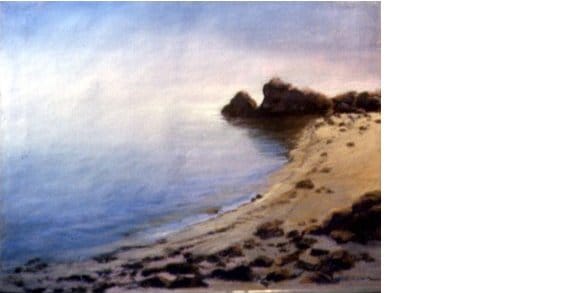
Long Island as it appears: morning, Eleanor Berger
Also in Shorelines, Long Island sound three poems by Eva Salzman.

