
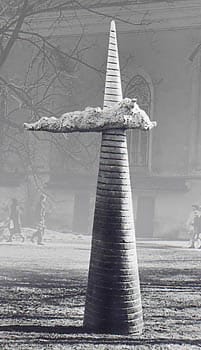
Mati Karmin: He and Us, Monument
Estonians are generally not very outspoken in offering praise or recognition of others' achievements, but one utterly complimentary attribute can be heard from their lips almost every day: the word tubli. This adjective of wide and flexible application can express a range of positive personal qualities and behaviours - from good, orderly, strong, capable, hard-working, persistent, and productive, to setting an example or model to others, behaving properly, or having will-power.
This small Baltic nations Finno-Ugric tongue has a rich folklore in which tubli features prominently. One proverb emphasises perhaps the words most important aspect, work: Tublidus ei tule tööta, osavus ei hooleta (Being tubli will not come without work, nor skill without care).
When tubli is ascribed to a child, its meaning is a synthesis of good, well-behaved, obedient and diligent. The combination is so deeply desired by parents that it can push children to stress and depression under the weight of high expectations. Indeed, a recent article published in an Estonian newspaper - Nii tubli, et ei jaksa elada (So tubli that it is hard to live) - reported that 70% of children feel guilty that they are not tubli enough.
Once into adulthood, a tubli person persists in the face of hardship; she not only copes with but overcomes difficult situations, and wins respect and admiration as a result. She may then be told tubli (well done!) but what is being recognised is not a particular act but the person herself, her qualities and the effort she has invested towards achieving the goal.
There is a further nuance in the phrase Ole tubli! (ole is the singular imperative form of the verb to be), which expresses the speaker's concern and care towards the addressee; this can be translated as take care, do it well, 'be strong, or even don't worry.
Tubli, in short, is very deeply rooted in the language of this tiny country of only one million Estonian speakers. Perhaps being tubli is a local expression of a universal need: to express Estonians affirmation of themselves in relation to larger and more powerful neighbours. Perhaps it is a way of compensating for smallness in size and population by seeking to acquire moral stature: being (as individuals, and by extension as a nation) efficient, resourceful, strong, well-educated and hard-working. Perhaps too, in changing economic and political circumstances, it has come to reflect peoples determination to be equal to or even better than their trading partners and competitors, even when the country's opportunities, resources, or experiences are more limited.
The word tubli, then, has a national and even political dimension. Estonia only regained her independence from the Soviet Union in 1991, having had her first chance over the short period of 1918-1940. Throughout centuries of various occupations by Danes, Swedes, Germans, and Russians - being tubli may have been part of Estonians way to survive and endure in adverse conditions. Indeed, the phrase väike, aga tubli (small but tubli) has become one of the self-identifying concepts of Estonians as a nation.
This has frequent echoes in political and media commentary. Mart Laar, then prime minister, once wrote an article headed Väike, aga kas ka tubli Eesti? (Estonia is small but is it also tubli?). Lennart Meri, a former president, has been praised as someone who was able to create a positive image of Estonia as a reasonable, intelligent and tubli country.
For Estonians, to perform well a person does not have to be old or powerful, big or wealthy, privileged or experienced one has only to be tubli.

