
Buy now: UK, US, Worldwide
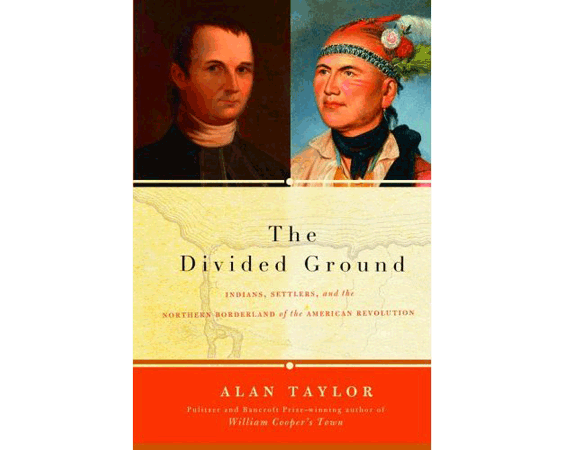
"The Divided Ground: Indians, Settlers, and the Northern Borderland of the American Revolution"
by Alan Taylor
Knopf | February 2006 | ISBN 0679454713
"Alan Taylor tells the story of the American Revolution as we have never heard it before a story of the Iroquois confederacy's struggle for self determination in the borderlands between the fledgling United States and the British Empire's outposts in Canada. This is compassionate, innovative history."
Elizabeth A. Fenn, author of Pox Americana
Extract from The Divided Ground: Indians, Settlers, and the Northern Borderland of the American Revolution:
Property
In July 1761, as Joseph Brant traveled east to join Wheelock's school, Sir William Johnson headed west, ascending the Mohawk River into the country of the Six Nations, his five boats hauled thirty-eight soldiers, their equipment, and presents for the Indians. The traveling party also included his nineteen-year-old son, John, and their cousin and secretary, Guy Johnson. In high spirits, the Johnsons anticipated a victory tour in Indian country to consolidate the recent British conquest of French Canada. With the French banished from North America, British officials expected easily to control the Indians.
Instead, Johnson found pervasive Indian dread and disgust, even among the nearby Mohawks, who had so long cooperated with him. As British allies, the Mohawks had lost about 100 warriors, half of their men, during the recent war with the French. In return for that heavy sacrifice, the Mohawks expected Johnson to protect their villages against conniving land speculators and encroaching settlers. Frustrated in that expectation, the Mohawks complained bitterly to Johnson, who reported that they felt in "danger of being made slaves, and having their lands taken from them at pleasure, which they added would confirm what the French have often told the Six Nations."
Preaching patience, Johnson promised justice to the Mohawks but New York's leaders and settlers kept breaking his every promise. Fed up, the Mohawks threatened to move away deeper within Indian country. That possibility delighted settlers and speculators who lusted after Mohawk land, but alarmed Johnson, who relied on his special Mohawk connection to influence the Six Nations. Without nearby and content Mohawks as allies, his superintendency would become impotent.
Proceeding upriver beyond the Mohawk country, Johnson reached German Flats, colonial New York's westernmost settlement. There, Johnson met Oneidas, who also bitterly complained of encroaching settlers. The chief Conoghquieson warned Johnson that the Oneida settlers would fight rather than lose their lands. Instead of consolidating British power over the Indians, the conquest of Canada threatened to unravel the alliance with the Six Nations that was essential to frontier security.
In helping the British to attack Canada, the Iroquois had miscalculated, for they had never expected such a rapid and complete collapse by the French forces. No longer could the Indians play off the French against the British to maintain Iroquois independence, to maximize their presents, and to ensure trade competition. A British general explained, "They saw us sole Masters of the Country, the Balance of Power broke, and their own Consequence at an End. Instead of being courted by two Nations, a Profusion of Presents made by both, and two Markets to trade at, they now depend upon one Power." That dependence exposed Iroquoia to land-hungry colonists.
To read the remainder of this extract and a review by Matthew Price, click here
* * *
About the author: Alan Taylor is a professor of history at the University of California at Davis and a contributing editor at the New Republic. He is the author of Liberty Men and Great Proprietors, American Colonies, and William Cooper's Town which won the Pulitzer prize for American history in 1996.


