
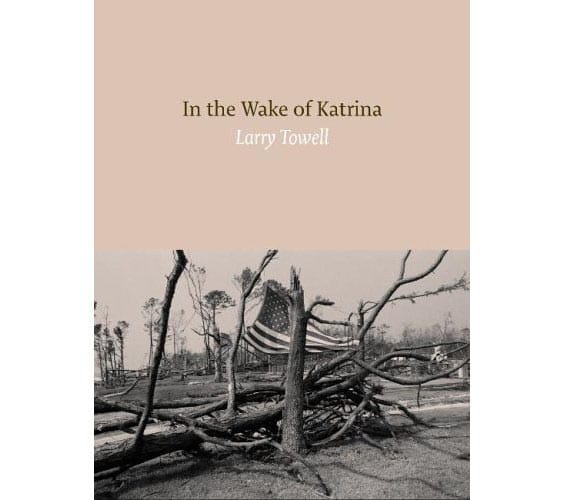
Between 311 September, 2005, photographer Larry Towell, accompanied by novelist Ace Atkins, travelled along the coast of Alabama, Louisiana and Mississippi, documenting the dramatic aftermath of Hurricane Katrina.
Buy now: UK, US, Worldwide
"In the wake of Katrina
by Larry Towell
Chris Boot | August 2006 | ISBN 0954689496
Afterword by Ace Atkins
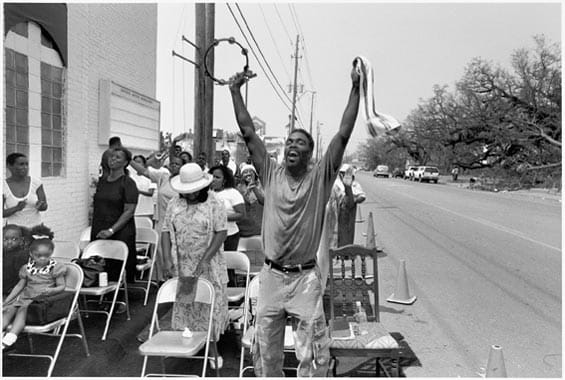
Larry Towell and I met Atlas Brown at a black church revival, just days after he'd saved an elderly man from drowning in a flooded neighbourhood of Biloxi, Mississippi. With his every worldly possession destroyed, Brown had walked to the Lighthouse Apostolic Church for an old-time service, wearing a borrowed chef's outfit and shoes several sizes too small. It was there, after Pastor DeBruce Nelson's sermon, that he'd told me his hurricane story.
The compact, powerful man had taken a lot of satisfaction that Sunday in just being alive. And when I found him again the following February, amidst the decaying debris of the city, he still had that gentle, careful smile of someone who had returned from hell with a confidence he could survive.
Brown was one of the few survivors I could find on my return. The neighbourhoods stood empty six months after Hurricane Katrina, with the Gulf Coast still as desolate and broken as it had been when Larry and I travelled there immediately after the storm.
I'd often thought about the people we met amid the wreckage as we both worked on an essay for Outside magazine about the hurricane's aftermath. In those first days after the storm hit, we had often seen shell-shocked faces as they raised their eyes from the wreckage to tell us their story. They were black and white, Latino and Vietnamese. Many we had found in the destruction were poor and had lost everything, without insurance against damage caused by storm or flood.
The memories of the first trip still seemed skewed and surreal: gigantic barges in the middle of cities, roads twisted, broken, and curled, and entire neighbourhoods swept out into the Gulf leaving only concrete foundations behind.
I wondered if people had stayed to rebuild or had been scattered across the country. When I loaded up my Jeep once again and headed south from my home in Oxford, Mississippi, this time I was on my own. Larry was on assignment in the Middle East.
It seemed strange following the route we had come to know so well. Gone were the trucks and SUVs loaded down with food, water, and fuel that clogged highways. Still, trees lay across broken houses and piles of debris and garbage waited for pickup along the roadside.
I headed to the Beach Bar first. This was where Larry and I had sat, on the beach in Bay Saint Louis a town so cracked and ripped and twisted that even the railroad tracks had been curved like a long piece of taffy candy sharing a drink with the regulars at a bar once known as Day Dreams. We had watched the sunset with the crew as they nailed the bar's sign back on to pilings that had once supported walls. They were construction workers and Vietnam veterans and cops and cocktail waitresses.
The bar hadn't been battered. It had simply disappeared, washed out into the Gulf the booze, the furniture and even the jukebox full of golden oldies. The only things left were the pilings and the sign found on the shore.
"Of course, we'll be back," Todd Key, the pony-tailed bartender, had said. "See us in six months. This place is like family."
But on the chilly night I arrived there six months later, I found the old town section of Bay Saint Louis exactly as we had left it. The rubble of offices and restaurants. A downtown full of garbage, with no sign of life. I hit the high beams on the Jeep and drove through the little village, careful around the wreckage, and found nothing and no one.
Down the road, I asked people at the gas station about the bar. One man, who had just come off a construction job to buy a case of Budweiser, grew impatient with me. "You don't understand, do you? Nothing has happened since the storm."
The next day I returned, hoping to find a better story.
I wanted to find a better story. After all, what would make a better epilogue than to explain how the battered people of the Gulf Coast were bouncing back after one of the worst disasters in US history?
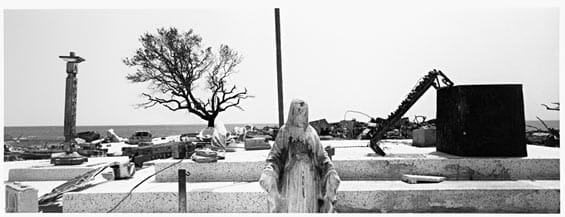
It rained that Saturday and I stopped for a few moments in Gulfport to witness a pitifully attended Mardi Gras celebration winding its way through downtown streets. Then I continued east along Highway 90, the road that hugs the Gulf of Mexico, where antebellum homes, churches, hotels, and restaurants had been washed away. I saw absolutely no sign of rebuilding, only the hollowed-out homes, the limbs of dead trees, and a few pilings that had managed to survive the thirty-foot storm surges.
I finally arrived in Biloxi, where Larry and I had spent the most time documenting some of the worst of the storm. Most newspapers and televisions had become so obsessed with a flooded New Orleans that many forgot and continue to ignore the major towns in Mississippi that were hit harder.
We had wandered through the neighbourhoods finding poor people returning to uninsured homes trying to salvage mildewed clothes and water-logged photo albums. I recalled the elderly black woman I had met along a street called Huff Alley, who spoke to me at length with all of her dresses hanging to dry from her porch.
She had told me about growing up in Alabama, where she only had feedsacks to wear to school. As a grownup, the only thing she dreamed about was being able to have nice clothes. She had toyed with the hems of the gilded and beaded fabric church clothes and had begun to cry, waiting for a family member to come.
She had been waiting several days.
I looked for her on my return, but she was gone. Her home waited in the same shape, and empty. The others we'd met in Biloxi were gone, too. Their homes were either still in shambles or in piles of debris where the bulldozers had rolled through. A few government trailers sat next to wrecked homes. And sometimes you saw small camping tents along the roadside, and stray dogs and cats eating from rotting heaps.
This was what you call Back Bay Biloxi. It was all poor. Mostly black. Old homes stood in the spots where the casinos the main draw to the city are now planning to move, inland, away from the shore they'd been restricted to before. One of the first "hurricane recovery' acts of Mississippi's governor after the storm was to push through legislation for land-based casinos.
Katrina had bashed those barges like bathtub toys, tossing them inland, flattening houses and beaching them heavily on neighbourhoods. In February, although somewhat dismantled with blow torches, they sat there still, amid the devastation.
You remember people by their stories or their tragedies. Woman Who Clung to Oak. Old Man Who Found Dead Body. Family Who Lost Grandmother. I remember Eugene Lincks and Billy Burton from their dog. Smokey. Smokey was a miracle of sorts, a 13-year-old black Chow mix, deaf and blind, who had survived a shooting, several car wrecks, and a near-drowning in a neighbour's pool.
Eugene and Billy are scruffy working-class white men who've known each other since they were kids and are so familiar with each other that they finish each other's sentences. They had lived on the same street most of their lives, with their hero Smokey.
"When the water got about knee-deep in the house, Smokey just kind of jumped for it,' Eugene had said. "He paddled out into the water. I told him, "you're on your own now, boy."'
Eugene had smiled and paused at this point in the story. "Two days later, he comes wandering up the street and runs his nose right into the fence that the storm had moved. His piss markings must've overrode the water. You know?'
After the water had receded, Billy had slept on the street outside the mildewing house, with Eugene hunting in abandoned houses for dry clothes. They had looted groceries from a nearby convenience store to stay alive, living off beef jerky and potato chips. And beer. "Lots of beer', they'd told me. And laughed. Without beer, they said they weren't sure they could live with the idea of their whole town becoming a trash dump.
They would take baths by opening up a nearby fire hydrant. It was almost a week before relief workers started cooking hot meals.
"You did what you had to do," Eugene had said of the days after Katrina. "Someone raided the Church's Chicken freezer and cooked up chicken nuggets and the chicken and everything that was still good. And then the preacher there asked us all to pray to 'Thank the good Lord and the church's chicken.'"
Their home still bears the watermark from the storm, and tools sit out on their porch where they've been working on repairs.
"Biloxi is never going to be the same," Billy had said, "I don't think anybody was prepared for this. I was only five years old when Camille hit in '69 but the day after, relief was coming in here and clean-up crews were coming in here."
Government checks have been slow. Help has been slim. And as a result, most of their neighbours haven't returned. The family has to deal with colds and flu and infections that afflict the sodden, trash-laden neighbourhoods.
At night, there is light in the windows of one standing house out of maybe fifty you pass.
The entire town smells of decomposing garbage, with stagnant pools of filthy water puddling the cracked streets.
"If you want something done," Eugene had said, "you got to take care of it yourself."
Back at the Lighthouse Apostolic Church with Atlas Brown, I remembered that first Sunday after Katrina. Pastor DeBruce Nelson had stopped cars with his sermon as they wound past the folding chairs set up on the street. Larry and I had seen a white woman and her teenage daughter, both covered in mud and filth, park their truck in the middle of traffic and join in with the women of the church to sing and praise God.
Today, Atlas Brown and his companion of 24 years, Brenda Boykin, seem to find peace and obvious pride as they point to newly redone offices and a church sanctuary where flood waters had risen fourteen feet. They seem most proud of a mosaic of a lighthouse laid at the entry way to the building.
We talked for a long while about how Brenda and Atlas were separated after the storm and how it was nearly five days before she knew he and her mother and brother were still alive. "I was so worried I couldn't sleep, eat or concentrate," she said. "It tore me up. Lord, how could I eat not knowing where they were? Oh, I was just devastated."
For months, even though they lived in the centre of the hardest hit area, government help was scarce. Only through their church had the couple found volunteers to begin to rebuild their home. And now it's one of the few solid structures for miles. But there is some sadness to their recovery.
"They want to build more parking lots, have everything set up for the casinos, but we're looking beyond the casinos," Brenda said. "We're looking for people to come home. It was nice having neighbours that would sit out, have barbecues, and you could walk down the street and smell barbecue and holler 'Hello, how you doin'?' This is what I'm looking forward to as people are coming back."
Still, she doesn't know if this will happen.
But, she said, she has faith.
I said my goodbyes to them. I told them I'd check back with them in a few months and they invited me to one of the special services where some good southern food is served - chicken, black-eyed peas and cornbread. Something I can't pass up.
We shook hands and hugged and they left for a second service that day.
I got into my Jeep and headed home, travelling hundreds of miles before the wreckage, the twisted tracks and broken roads and garbage and splinters, were behind me.
The images are hard to forget.
It's much harder for the people who still live within them.
Oxford, Mississippi
March 2006
* * *
About the author: Larry Towell is one of the world's leading photojournalists. Exhibited worldwide, he has been the recipient of some of photography's most prestigious prizes, including the Eugene Smith and Cartier-Bresson awards. He lives on a farm in Ontario, and is a member of Magnum Photos. His website is at www.larrytowell.com.


