
"what it is to be human..."
Buy now: UK, US, Worldwide
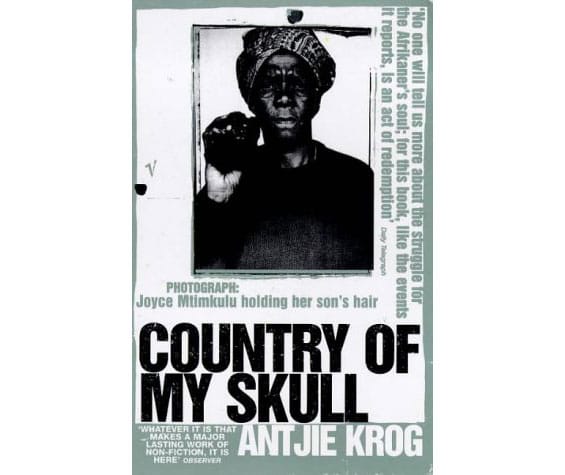
"Country of My Skull"
by Antjie Krog
Vintage | November 1999 | ISBN 0099289792
Recommended by Ruby Russell:
In April 1996, ten years ago this week, the South Africa's Truth and Reconciliation Commission heard its first testimonies. Reporting on the Commission for SABC Radio, Antjie Krog spent two years travelling across the country from plush city halls to backwater community centres, hearing first hand accounts of the atrocities that had been committed under apartheid. Aside from the Commission's final report this book is the most comprehensive account of this revolutionary experiment in the healing of a nation to be published.
The Commission expected to receive around 200 applications for amnesty. The final number was closer to 8,000, of which 2,000 were given a public hearing. Those asking for amnesty were not officially required to show remorse, only to give a true account of their crimes. They appeared before the Commission as un-appointed representatives of a whole system of abuse. Some did not tell the truth, or not the whole truth; others recounted brutal violence in terms of cold lists of figures, dates and locations, which were frustratingly out of step with the human level on which the trials operated. F.W. de Klerk was not seen to go nearly far enough in taking responsibility and P.W. Botha would not appear before the Commission at all. But through the stories told by both perpetrators and victims a picture emerged of the horrific extent to which black South Africans had been subjected to violent oppression by the state.
For many, being present at the trials was a traumatic experience in itself. But Krog admits that the tears were wept by white journalists, while their black colleagues remained stony-faced, as they listened to what they already knew, what was already a part of their personal histories. Krog writes from the perspective of an Afrikaner, struggling to come to terms with the fact that her nation has been built on massive, widespread human rights abuses, of which her race have been the perpetrators and the beneficiaries. She also writes as a journalist whose work it was make these stories part of the consciousness of the country as whole, to make white South Africa listen. Krog quotes a fellow journalist:
"The truth that rules our fears, our deeds and our dreams is coming to light. From now on you don't only see a smiling black man in front of you, but you also know what I carry inside of me. I've always known it now you also know."
And it is on this level that the Commission seems to have succeeded. Whites can no longer deny what took place. If they now deny knowledge or collusion, at least the argument had moved forward a step. The Commission revealed the extent to which apartheid dehumanised blacks and allowed ordinary men to commit horrific acts of abuse, and it introduced a moral language in which the past could be confronted.
Genuine remorse and forgiveness were often distant ideals and reconciliation an ambiguous aim. Krog says that the trial went beyond law and into the realm of theology. If anyone was clear on the Commission's aims, it was Archbishop Tutu, the Commission's chief architect and chairman. Tutu based his idea of reconciliation on Christian forgiveness, but drew more explicitly from Ubuntu, the African idea of shared humanity. This idea seems to have resonated powerfully with some of the victims who gave evidence, like Cynthia Ngewu, mother of Christopher Piet, one of the Guguletu Seven:
"This thing called reconciliation if I am understanding it correctly it means this perpetrator, this man who has killed [my son], if it means he becomes human again, this man, so that I, so that all of us get our humanity back then I agree, then I support it all."
The Commission tried to strike a balance between the need for truth and the need for justice. This book, like the Commission itself, puts the personal experiences of individuals at the heart of South Africa's evolving history. It is a highly readable and honest account of the trials which combines story-telling with political analysis, shifts into poetry when prose seems inadequate and carries the reader on a journey through a damaged nation's self-examination.
Krog is far from detached and never claims impartiality. And it is here that the book's strength lies. She describes the chaotic, heart-wrenching ordeal that the trials often became with a passionate and infectious desire for the redemption of her country. She pulls up the Commission's shortcomings while maintaining that it is something of which South Africa can be proud. The result is a powerful and important document that leaves you with a haunting sense of the extremes of what it is to be human, from the most brutal acts of cruelty to most compassionate acts of forgiveness.
About the author: Antjie Krog was born in 1952 in Kroonstad in the Orange Free State and grew up on a farm. During the 1970s she lectured at a segregated black teacher's training college, and in the 1980s, became actively involved in the anti-apartheid movement. Reporting as Anjtie Samuel she and her SABC radio team received the Pringle Award for excellence in journalism for their coverage of the Truth and Reconciliation Commission. She has published eight volumes of poetry in Afrikaans and has followed up Country of my Skull with A Change of Tongue, a second work of English prose chronicling the ten years of change following South Africa's first democratic elections.

