
At the G8 summit in Gleneagles on 6-8 July, several of the worlds most powerful leaders will meet to strum guitars, crack jokes and shake their fabulous bodies. The ongoing Live8 roadshow will see the hegemons of rock n roll sitting down to roast anjou squab and chew over how best to carve up the planets resources. For many of the hundreds of thousands of protesters and political tourists pouring into Scotlands capital city Edinburgh this week, the masters of the universe are at once the barons of the rich world and the godfathers of rock.
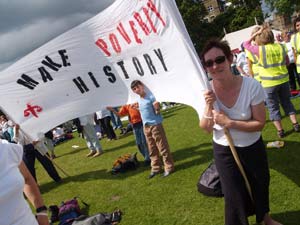
Edinburgh protestor - photograph by Amy de Wit
In much of the press and for the vast majority of the white-clad 225,000 who marched through Edinburgh on Saturday 2 July demanding debt relief, more and better aid and trade justice for developing countries, the G8 has become a totem, a spectacularly distorted fetish of revolutionary change. The efforts of Make Poverty History (MPH) the coalition fronted by Bob Geldof, Bono and Richard Curtis and executives of 500 British NGOs and campaigning groups have burnished the G8s image as a prospectively benign interlocutor and agent in the fight against global poverty.
No one questions the good faith of the pop stars at Live8 in Hyde Park, and in eight other locations around the world, on Saturday. No one says Bob Geldof is a shaggy Machiavelli. But, as leading intellectuals and anti-poverty NGOs on the frontline have been saying for months, their good intentions could have a devastating effect for they are offering the G8, a central part of the network of institutions sanctifying the gross inequalities of global trade, the wristband of legitimacy on a plate.
Also in openDemocracy on the G8 summit and the campaigns against and around it:
Carolyn Tan, Auchterarder: a G8 summit visitors guide
Alex Wilks, Selling Africa short
Robin Bell, The Fence
Tom Burgis, Steven Heywood, Emma Silverthorn, Sabrina Manville and others in our G8 blog
A collusion with power?
There is a rift in civil societys approach to the G8 summit, one that has gone largely unreported. On one side are the establishment NGOs among the Make Poverty History coalition, who driven by a mixture of motives among which post-colonial guilt features strongly believe that the key to getting a better deal for the worlds poor is to go to the G8 and ask it to be nice. On the other side are those whose slogan is Make the G8 history and who seek to expose rather than suppress the contradictions in which the MPH effort is enmeshed.
The MPHs inside-outside tactics have brought it close to the British government. The coalitions mantra has always been fair trade, not free trade. But the British finance minister Gordon Brown who publicly supported the Edinburgh protests, and whose International Finance Facility and Marshall Plan for Africa were warmly welcomed by the bulk of development NGOs revealed the relentless logic of this approach when he told British businessmen in February 2005 that to take advantage of the vast opportunities global markets offer we must lead the way again in breaking down international barriers to trade and commerce.
John Hilary, campaigns director at War on Want, one of the minority of NGOs to have realised the risks involved in snuggling up to government, is adamant that Make Poverty History is being hijacked:
Its disgraceful that Gordon Brown and Tony Blair are making out that theyve signed up to the Make Poverty History agenda. We know from government officials that they are going ahead with their aggressive free-trade agenda, and that thats going to condemn millions more to long-term poverty.
The British sherpas the negotiators furiously trying to salvage Blairs goals for his presidency of the G8 before the summit starts are briefing that there will be nothing in the communique on trade, unless it be a call for the World Trade Organisation to complete an ambitious Doha development round in December (an ambition that entails peeling the last fig-leaves of protection from the global souths manufacturing and services markets).
On trade, there is a consensus among campaigners: the subsidies with which North America, Europe and Japan prop up their export agribusinesses lead to the dumping of produce on poor countries and the forcing of farmers in those countries out of business; the exports of those few farmers still able to engage in international trade are throttled by tariffs imposed by the west.
Without wholesale reform of international trade rules, debt relief and more aid are rendered utterly inutile indeed, the conditions attached to both may oblige benefactors to sell off public services and spend their handouts on western products. The communique is unlikely to sanction the rapacity with which transnational corporations plunder the souths natural and human resources. As Mark Curtis put it at the G8 Alternatives counter-conference on Sunday: To talk about development without mentioning transnational corporations is like talking about malaria without mentioning mosquitos.
It is impossible to dispute Make Poverty Historys altruistic aims. They are impeccable. As a senior insider asked me yesterday: Who wouldnt want to lift a billion people out of poverty? But the history of power is the history of assimilating dissidence. Rome assimilated Christianity; the United States absorbed religious non-conformists; Diesel co-opted downtrodden workers. And the G8 nations are perfectly capable of containing the Lennon & McCartney of global poverty.
The radical outside
But just as the elite gathering at Gleneagles can swallow its moderate opponents to maintain a semblance of representation, those locked outside expose a great valley of systemic injustice. For people in the west to be aware of just how super the global market is making their lives, there must be someone worse off than you not difficult, considering that, for instance, a woman in Africa is 100 times more likely to die in childbirth than a woman in Britain.
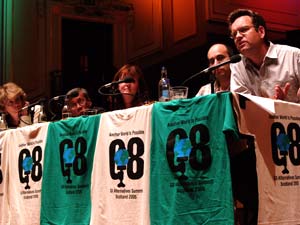
Mark Curtis in full flow - photograph by Amy de Wit
Globalisation is about ruthless competition, explained Susan George, vice-president of Attac France and author of Another World Is Possbile ... If. Its about the ins and the outs. If youre not useful to production, and youre not useful to consumption, globalisation has no place for you.
It is those people for whom the other strand of civil society massed in Edinburgh is fighting. For the outs, eight white men in a golf club cannot be allowed any further sway. Anarchists, radical economists, socialists, greens, gays, peaceniks, clowns, veteran campaigners and, vitally, the leaders of protest organisations from the poor south themselves will march to Gleneagles on Wednesday under the banner of the global social justice movement for a purpose at once indistinguishable from and diametrically opposed to that of Make Poverty History.
They demand that the shackles of poverty be broken. But they prefer to take their own chisel rather than petition the jailers. They argue that the very existence of the G8, regardless of whether it has learnt the words to the 1984 Band Aid anthem, Do They Know Its Christmas, is a blight on the worlds poor. As the Swahili proverb cited yesterday by Inviolata Mmbwavi, a Kenyan HIV/Aids victim, goes: When bulls fight, it is the grass that suffers.


