

The visibility of Iran’s geopolitical rivalry with the United States through the Trump administration’s continuation of economic warfare against the Islamic Republic, has upheld Iran’s state-propagated narrative that the US is the oppressor and the regime is the oppressed. The brutality of economic sanctions and the destruction this policy incurs upon the Iranian people cannot be denied. The effects are compounded as the regime consolidates economic resources for the elite. However, the narrative in which the regime embodies the oppressed group erases the reality of those oppressed just as much by Iranian state structures, if not more, than external sanctions. By structural design, the Iranian state privileges Shi’a Muslims and Persian speakers. Consequently, the conceptualization of the “Iranian people” exported abroad is one that gives visibility to Tehran and other urban areas of the Persian “center,” sidelining those who live on the periphery. Any perceived threat to the center thus becomes the justification for state violence.
In order to build a solidarity movement with the Iranian people, one must look beyond the Iranian government to define the population’s struggles. The majority of Iranians (~60%) are Persian, yet the most extreme forms of state violence are inflicted upon minorities who are disproportionately represented in Iran’s prison system and comprise the majority of those sentenced to death or killed extrajudicially. The 1% of the population belonging to recognized non-Muslim religious minorities are second-class citizens, and non-recognized religious minorities are afforded no constitutional rights. The 10% of the Iranian population that is Sunni Muslim rather than Shi’a is largely non-Persian. The intersectional suppression of ethnic minorities such as Kurds, Baluchis, and Arabs, in addition to non-Shi’a and non-Muslim religious minorities, points to glaring gaps in international solidarity.
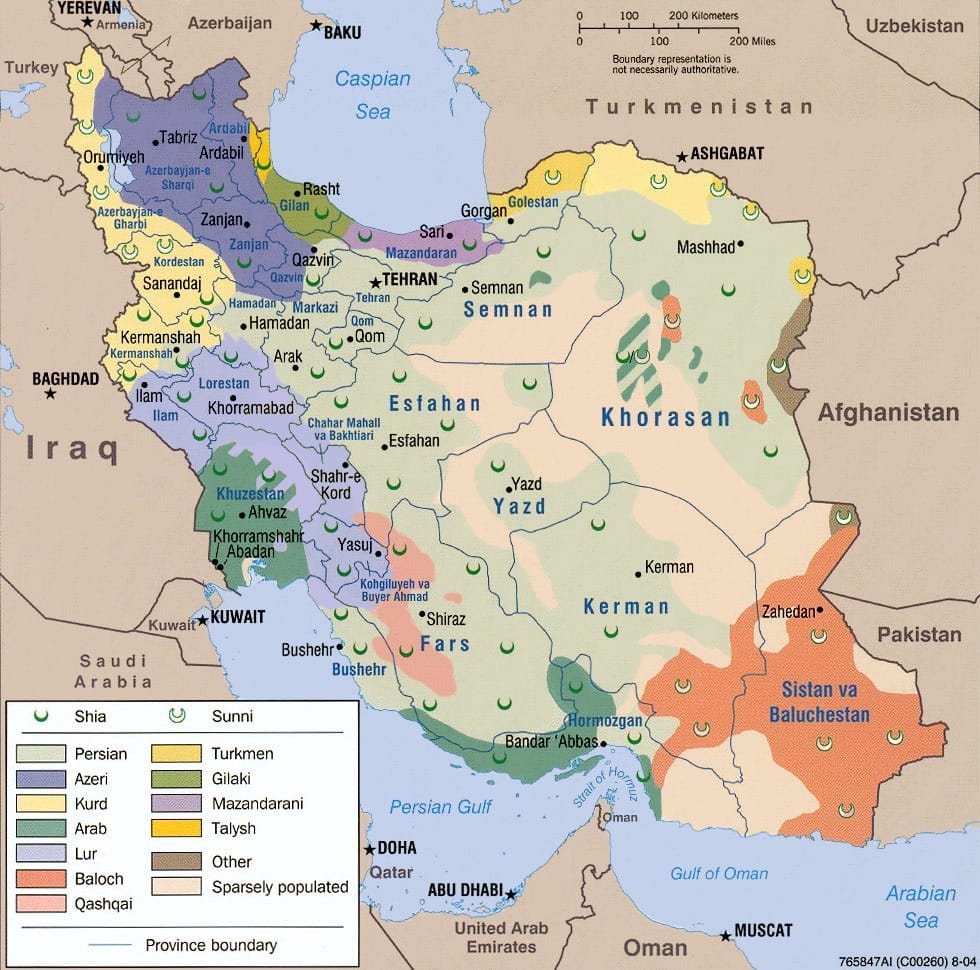
Center vs periphery
The concentrated location of ethnic minorities, particularly Kurds, Lurs, Arabs, and Baluchis near the western and southeastern borders, provides a geographic lens into how the Iranian regime takes out its dissatisfaction with the economic and political performance of the center on the mostly non-Persian periphery. In light of this persecution, the strategic erasure of religious and ethnic minority voices in both western and Iranian media becomes a boon to the Islamic Republic, bolstered by the historic and growing importance of proving one’s religious ideology and nationalist ideology to the Persian, Shi’a state. Any question of these ideologies is considered a license for the state to increase the already considerable and, in some cases, apartheid-level repression of minorities.
