

It is impossible to predict the consequences of the protests which have shaken America. But what is obvious is that hundreds of thousands of participants are deeply convinced that their country is on the brink of great changes. However, Russian public opinion appears to view these events differently – popular discourse is so grimy that one is afraid to wade too far into it, for fear of sinking into the quagmire with everybody else.
From liberal columnists to pro-Kremlin pundits, Russia's opinion formers take the same line on the protests sparked by the murder of George Floyd. Once poles apart, they have merged into a chorus chanting about the death of the West, exposing "political correctness," and gleefully sharing racist jokes. It makes little sense to analyse their specific arguments about the incident, as they are thoroughly unoriginal. A more patient researcher – which I am not – could probably hear echoes of how Russian commentators addressed the events of 2011 in London, the first Black Lives Matter protests in 2014, or the fire at Notre Dame last year. Nine years ago Yulia Latynina, a popular columnist for the independent newspaper Novaya Gazeta, wrote an article attributing the imminent collapse of "left-liberal" Europe with expanding voting rights. She argued that votes would be wasted on ignorant immigrants and the poor, so the reforms should be ditched as soon as possible.
Latynina's words led to a public discussion in which I took part. It was late 2011, just a couple of months before Moscow's Bolotnaya Square protests, in which many of Novaya Gazeta's loyal readers took to the streets to demand the cancellation of rigged parliamentary elections. This surge of protest activity was quickly replaced by disillusionment, in turn followed by another surge, as a new generation demanded "fair elections" and were outraged by the impunity of Russia's police. But when George Floyd was killed at the hands of an American police officer in Minneapolis, Latynina published another article in Novaya Gazeta denouncing politically correct leftist witch-hunts and impudent racial minorities.
What explains these fierce and hateful reactions on the part of opposition commentators like Latynina, and Russian society as a whole? Can they be explained?
The causes of post-Soviet racism and forms of "social racism" (hatred of the poor and unlucky) are often looked for in Soviet-era traumas. Whether they emigrated to the West or stayed here in Russia, older members of the Soviet-era intelligentsia regarded any talk of racial oppression or social inequality in America and Western Europe as a reproduction of Soviet ideological talking points. Thus the intelligentsia, which had itself survived as a minority oppressed by the Soviet state, outgrew its previous role. Invoking racist language, it was now able to rebel against what was perceived as new oppression of mainstream western political correctness.
The refusal to offer sympathy to other victims of oppression became a manifestation of the Russian intelligentsia's new freedom from their own
Therefore, the refusal to offer sympathy to other victims of oppression became a manifestation of the intelligentsia's new freedom from their own. This perverse dialectic of master and slave doubtlessly deserves serious consideration from the standpoint of postcolonial theory.
This anti-Soviet motif is closely connected to another, which is more commonly expressed by the younger generation of Russia's intelligentsia. Namely, it is the jarring disconnect between the real and imaginary West. The latter is seen as a land where social harmony reigns and democratic institutions function perfectly. This imaginary West has been undermined in recent years by the disturbing reality of deepening inequality in western societies and the rise of extra-parliamentary protest movements on both the right and the left. America is at the heart of the imaginary West; it may as well be the centre of the cosmos, home to the ideal order of things, around which the rest of this imperfect world inevitably revolves.
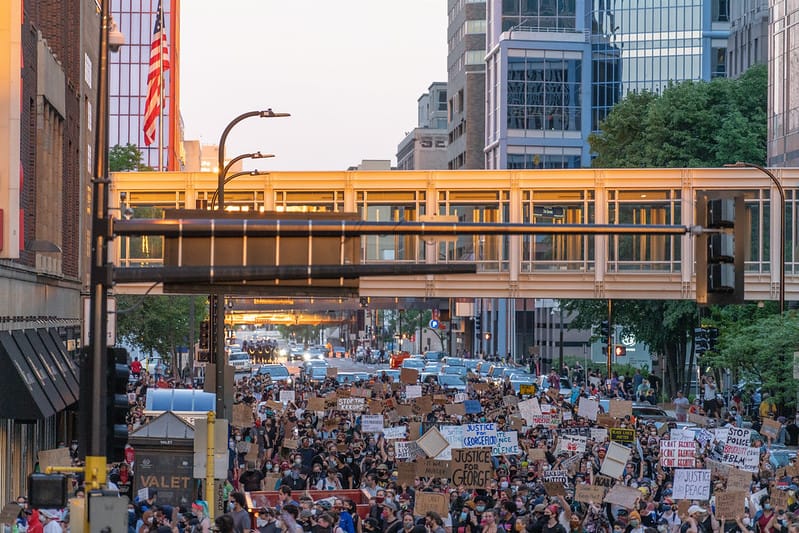
It is therefore surprising that the magical concept of a "transition" to democracy, which has been seriously discredited globally, has largely retained its strength in Russia. And nothing undermines the imaginary West, revolving around an imaginary America, more than the explosion of public dissent provoked by Floyd's murder. The crowds on America's streets and squares prove mercilessly that racial discrimination is not simply a relic of the past which can be corrected through enlightenment and democratic participation (as implied by the "political correctness" so loathed in Russia), but a problem inherent in the very foundation of American society.
The protests in America remind us that even within what is supposedly the most perfect democracy, there is an eternally alienated population who can never become equal. To recognise that is to question the reality of political equality in modern America. Therefore, the nervous reaction on the part of Russia's liberals has nothing to do with concern for other people's property – it is first and foremost a concern for the integrity of their own worldview. It is the abiding fear that, as Yegor Letov once sang, "inside your harmonic world, they're playing the harmonica."
Contrary to popular belief, discussing the protests in America is no distraction from the political agenda in Russia – whether the upcoming referendum on constitutional amendments, the massive decline in living standards for the majority of the population, or the growing, if silent, discontent from below. In a curious way, Russians' fascination with events in faraway America reflects these issues all too well.
