

Insidious attacks in the night
According to UNRWA (the UN Relief and Works Agency), there are currently 828,328 registered Palestinian refugees in the West Bank. They are Palestinians, and their descendants, displaced from their homes during the Nakba of 1948 (in Arabic, the catastrophe or cataclysm, referring to the expulsion of an estimated 750,000 Palestinians), and the hostilities of 1967. When traveling with an Eyewitness Palestine delegation as a leadership team member this past fall, I and other members of our group were hosted for the night in the home of a family in Dheisheh Refugee Camp, near Bethlehem. We had spent the day learning about refugee rights in the Palestinian context, including a lecture by Lubna Shomali at Badil Resource Center for Palestinian Residency and Refugee Rights, and an afternoon in Aida refugee camp.
Dheisheh camp was established in 1949 and built to house 3,000 refugees. It is now home to an estimated 15,000, according to UNRWA, and an even larger population, as of 2018, of 17,503 people according to Badil’s latest survey. Aida camp was established in 1950, and had a pre-1967 population of 1,977 people. As of 2018, Badil calculates that Aida is home to an estimated population of 6,545 people.
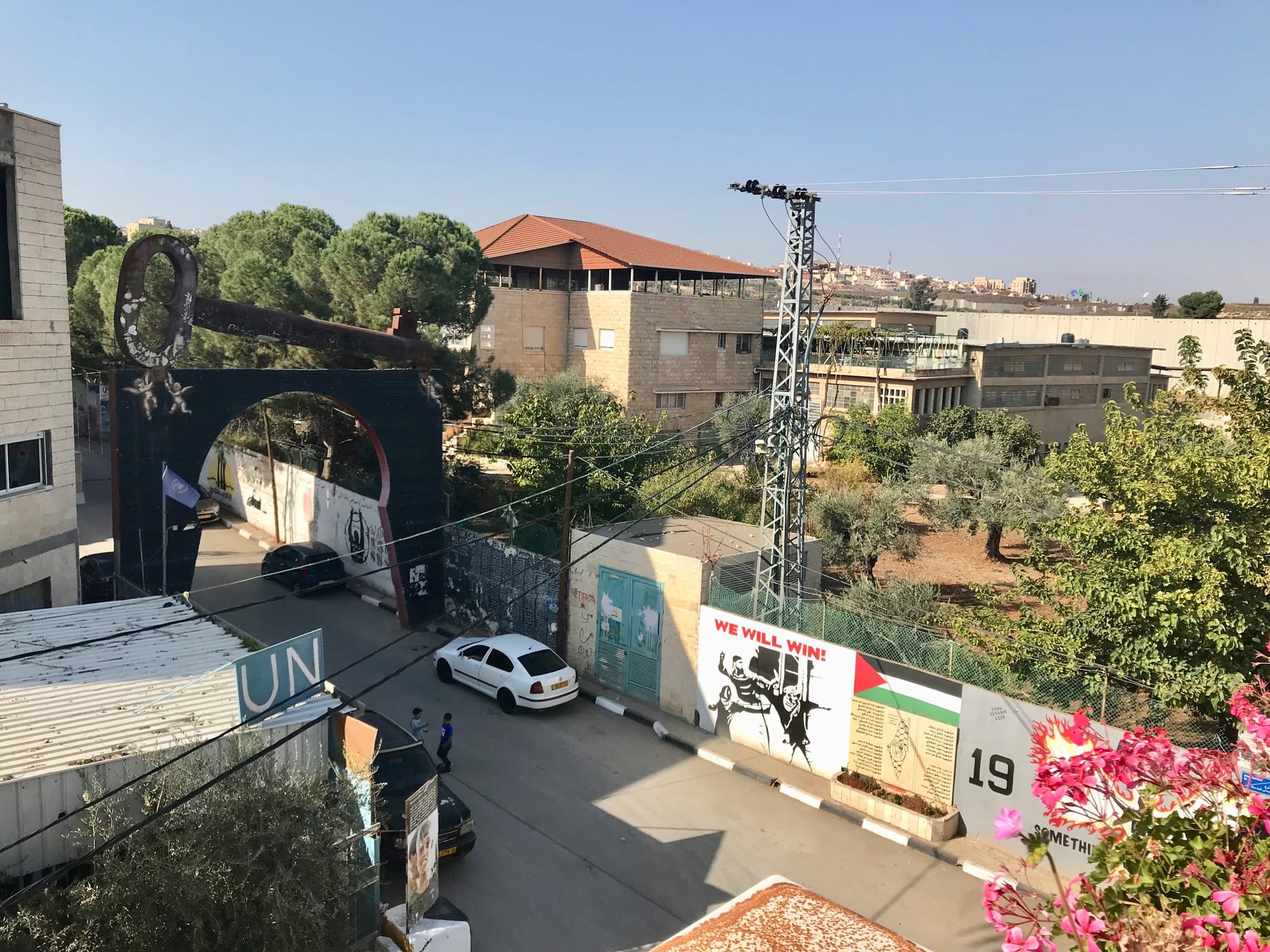
When visiting, you do not need all these astounding statistics to notice that both camps are extraordinarily crowded. With nowhere to go but up, families have built additions on the roofs of narrow buildings, which clog the camps’ skylines, often only permitting narrow rays of sunshine to enter the camps as you walk the winding streets. UN and Badil estimates place Aida’s population density somewhere between 77,464 and 90,000 people per square kilometer, well above some of the world’s most densely populated urban centers (e.g. Dhaka, Bangladesh, estimated by the UN to be the world’s most densely populated city, has a density of 44,500 people per square kilometer). Despite these conditions, after as long as 72 years of residency, the camps reflect community efforts to make them feel like a home—artwork abounds on every corner.
