
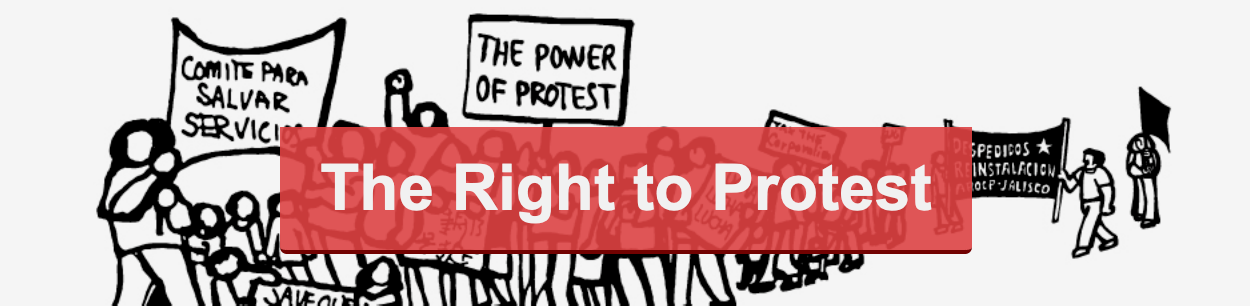
PROTEST: A MATTER OF HUMAN RIGHTS. Public mobilisations, social protest and human rights are intertwined. Firstly because people generally take to the streets to reject state violence and protest against violations of their rights: to land, to food, to work, to housing, to religious freedom, and so on.
Secondly, the act of protest itself entails exercising rights, such as to freedom of expression and the rights of assembly, petition and dissent. Democracies are enriched by protests because of their expressive nature, but also their deliberative and confrontational tone. More about the project→ –– Español→
Large-scale protests have become more numerous and geographically widespread in recent years. While much debate among international relations experts has focused on the shift in power away from the West to rising economies, equally significant in the nascent era of global politics is the rise of citizen mobilisation.
Previous periods have, of course, witnessed bouts of protest. Today’s wave of protests is relatively unique, however, in effecting all regions of the world, with similar patterns of revolt spanning diverse national and cultural contexts.
 Richard Youngs
Editor's choice
-
 Published in:Home👍Detained and injured: why does the Argentine state repress the Mapuche people?
Recent events in Mapuche territory in Argentina suggest a growing spiral of repression and violence towards the...
-
 Published in:Home👍Why does Canada spy on its own indigenous communities?
Indigenous nations have emerged as vocal defenders of land and water, but state surveillance of these groups is...
-
 Published in:Home👍Indigenous social movements: journalism versus activism in times of resistance
Labelling Native American journalists as "activists" simply because of their heritage helps to further diminish the...
A partnership with CELS and INCLO, with support from the ACLU: