
Quote of the day

It will be interesting to see exactly which customs the Vatican is going to allow from the past rich five centuries of Anglican worship, life and thought.

Syndicate content

Columns

Paul Rogers

Global security


Li Datong

China from the inside


Fred Halliday

Global politics


Mary Kaldor

Human security


Daniele Archibugi

Cosmopolitan democracy

Email & RSS

Sign up to oD's editorial summaries email:


Enter your Email


Powered by FeedBlitz


Follow oD on Twitter:


Join our Facebook group:
Add oD to your Netvibes: Add to Netvibes

Demotix witness*upload*share

Navigation


View 4 comments

The neighbor in the self

James R Mensch, 28 - 08 - 2008
Religions and States, even when apparently open, are subject to "auto-immune" reactions which make them turn against the other within. They need to make the effort to recognise the other as a constituent of themselves.

There is a famous passage in the Gospels, where a lawyer questions Jesus with regard to the command to love God with one's whole heart and to love ones neighbour `as oneself.' The lawyer asks, 'And who is my neighbour?' (Luke 10:2). Is he someone who lives close by or a co-religionist or is he a stranger, a follower of a different faith as Jesus suggests by answering with the parable of the good Samaritan? The 'religions of the book,' Judaism, Christianity, and Islam, have difficulties answering this question. As their respective histories show, they all manifest a double potential. They show themselves capable of promoting acts of love and extreme self-sacrifice in their followers. But they also have histories marked by religiously motivated struggles, intolerance and acts of brutality. What is the root of this double potential? How can they promote both love and violence?

openDemocracy's collection of material relating to Religion and Difference is here.

Tina Beattie's "The dark (k)night of a postmodern world" reflects on the notion of the other in Christopher Nolan's Batman.

Recent history, from the terrorist acts inspired by Islamic fundamentalism to the actions of the religiously motivated settlers on the West Bank all bear witness to religion's negative potential. Christianity, in its complicity and indifferent to the fate of the Jews in the Shoah, also provides an example. Despite its focus on charity and loving one's neighbour, it has, historically, often violated its these teachings in its attempts to preserve the purity of its doctrines. Both in its religious wars and in its persecutions of sects deemed heretical, its attempts to protect itself have contradicted the beliefs that most distinguish it.

Derrida, reflecting on these facts, saw religion as a victim of an 'autoimmune reaction.' In biology, this term refers to the body's turning its immune reaction on itself. Systems designed to protect the body to immunize it from biological attacks from without turn inward attacking its own structures. As Derrida observes, religion can suffer this fate in its attempts to preserve itself. Doing so, it fails to grasp its own self-identity. Like the body suffering the autoimmune reaction, it takes as 'other' what is actually part of itself.
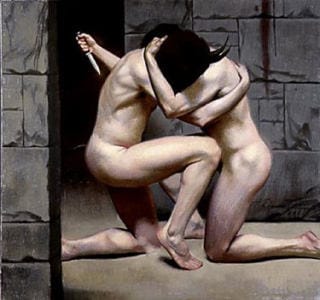
Courtesy of Harvey Dinnerstein and Frey Norris Gallery

All the religions of the book manifest this phenomenon. The violence of their reactions is, in fact, a measure of 'the other' they exclude being, in fact, part of their self-identity. Thus, the Judaism inherent in Christianity has often led to anti-Semitic reactions. The same holds for the Christian component of Islam, Christians being regarded as 'infidels' by Muslims. It also holds for the Catholic component of Protestantism. Judaism's reactions to the religions that preceded it in Canaan can also be added to this list.


In each case, we seem to have an instance of Jacques Lacan's doctrine that the 'unconscious' that aspect of myself I cannot recognize is 'the censored chapter of my history.' This refusal does not just result in the repression of the other. Insofar as the other is part of my identity, it results in a distorted self-knowledge. In Lacan's words, this self-knowledge is marred by 'the distortions necessitated by the linking of the adulterated chapter to the chapters surrounding it.'
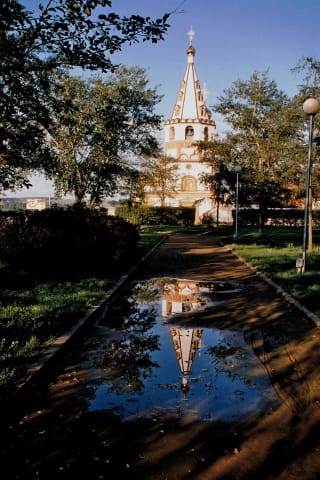
The positive potential comes from a fact that all three religions of the book believe in a transcendent, creator God. Such a God exists before the world he creates. This means not just that he is independent of it, but also that he inherently transcends all definitions taken from its terms. Not being of the world, he cannot be defined by it. As all three see mankind as the `image' of God, they necessarily acknowledge, each in its own way, an analogous transcendence of individuals. This means that human beings cannot be completely defined. There is something within them that escapes all categorization in worldly terms. The result of this aspect of religion is a radical opennessto who counts as a neighbour. This is because, in his identity with the divine, no human being can be stereotyped. One cannot, for example, say that women, children, slaves, people of different races or colour do not, as such, bear this image. In the ancient world, the result this view was a solidarity that led to the abolition of infanticide. A parallel impulse led to the religious agitation against slavery in 19thcentury Britain and the United States.

This very transcendence is the common root of the double potential of the religions in question. Religious selfhood, viewed in terms of its point of contact with the divine, is necessarily indefinable. The openness this leads to is the very thing that makes these religions prone to the autoimmune reaction. This is because an identity that cannot be pinned down can be felt as threatened. The unease it provokes is a constant temptation to define it negatively in terms of what it excludes. Given that each of the religions of the book emerged from its predecessors through a struggle to define itself as distinct, the excluded `other' naturally tends to be such predecessors. Insofar as each religion's history is also marked by struggles with its successors, they too can function as this `other.'

Image courtesy of: http://www.flickr.com/people/86778817@N00This point is applicable not just to these religions but also to the modern secular states that have succeeded them in the West. We need not adopt Hegel's dictum, `The state is founded on religion,' to see that our modern conception of civil rights has historical antecedents that reach back to our religious past. As a number of scholars have argued, behind the limitations of state power that are embodied in such rights is the thought that human nature involves a certain transcendence. The self's inviolability with regard to state power is a function of the transcendence implicit in its point of contact with the divine. Similarly, the openness to the other that characterizes genuine political debate points back to the radical openness of religion as to who is to count as a neighbour.

The state's inability to acknowledge these facts can be traced to the struggles by which it defined itself as modern and secular. The earliest impulses for the formation of its `secular paradigm' came from the religious conflicts that marked the Reformation. The exhaustion resulting from the Thirty Years War and other similar conflicts led to the issuing of various `edicts of tolerance.' Their intended aim was to permit the practice of sects that were distinct from the officially approved religions. Indirectly, however, they led to the exclusion of religion from the secular sphere. The developing plurality of religious practices led to the belief that none could command the public, official realm. With this came the impulse to consider this realm as a separate sphere, one conceived in opposition to the different religious practices. The secular paradigm that developed, thus, included a withdrawal of the religious consciousness into the strictly private realm. Correspondingly, the state defined itself in opposition to this consciousness. Its guiding sentiment was that `religion and politics do not mix.' Any attempt to introduce religion into politics was viewed, at best, as misguided. At worst, it was considered as undermining the foundations of the modern secular state, an undermining that could ultimately lead to the religious conflicts that marked the birth of the secular period.
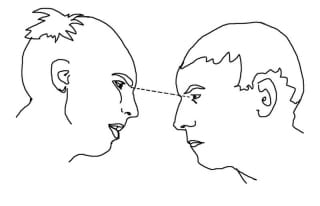
The limitations of this paradigm does not just show themselves in specific areas such as is the ongoing and, apparently, irresolvable debates on how Europe should come to terms with its Islamic minorities and the related issue of Turkey's EU membership. They also involve the modern state's incomplete grasp of its own identity as an open society that respects civil rights. Its inability to see the religious component of its inclusiveness implies the same sort of self-deception that characterizes religions when they attempt to define themselves negatively. It can, in its own way, lead to an autoimmune reaction, one leading to the denial or, at least, suspension of its most cherished values.

http://commons.wikimedia.org/wiki/Image:Staring_contest.jpgThe remedy, here, is as unremarkable as it is difficult. It involves acknowledging the other in oneself. Institutionally, it means being honest with regard one's relation to one's predecessors as Roman Catholicism has attempted, in the past decades, with regard to
Judaism. Such predecessors are not just the otheragainst which the religions of the book and the modern secular state had to struggle to establish their successive identities. They are also a part of their identities. Like the parents and other figures in childhood development, they are not just overcome, but internalized. As such, they remain as sedimented layers of the institutional identity. The same holds for the successors against which the religions struggled. They too are part of their histories. When we view such others in terms of the openness that is the positive aspect of the transcendence of the divine, they can no longer function in our attempt to define ourselves negatively. Here, openness to the other is also openness to the other in oneself. We have to admit that this other is also our neighbour. As the parable of the good Samaritan suggest, he could be the stranger, the follower of a different faith.

Average rating
(4 votes)
AttachmentSize
Staring Contest.jpg41.16 KB
Reflets_The_revenge_of_reflection_!.jpg684.48 KB
Harvey-Dinnerstien_Facing_the_Other.jpg31.26 KB
Staring Contest-sm.jpg19.62 KB
Reflets_The_revenge_of_reflection_sm.jpg248.51 KB
Harvey-Dinnerstien_Facing_the_Other-sm.jpg20.83 KB
 
This article is published by James R Mensch, and openDemocracy.net under a Creative Commons licence. You may republish it without needing further permission, with attribution for non-commercial purposes following these guidelines. These rules apply to one-off or infrequent use. For all re-print, syndication and educational use please see read our republishing guidelines or contact us. Some articles on this site are published under different terms. No images on the site or in articles may be re-used without permission unless specifically licensed under Creative Commons.
This article adheres to the openDemocracy.net principles.

Comments


Comment viewing options

Select your preferred way to display the comments and click "Save settings" to activate your changes.

Not logged in Lawrence Efana (not verified) said:


Thu, 2008-09-04 12:15

Open democracy needs articles of this kind to nurse and continue polishing democracy for peaceful coexistence of peoples and states in modern world. I would therefore state that James R. Mensch rocks, re-vibrates, invokes hence stirs and wakes the world on issues of religious [in]tolerance, sectarianism and secularism. By implication, "religion" and "politics" are at the center of his article. The italicized text above summarizes much of its corner-stone: "Religions and States, even when apparently open, are subject to 'auto-immune' reactions which make them turn against the other within...". Thus "transcendence" defined by 'panthesism' and 'immanentism', lends the 'theoretical particles' for the summary - when closely examining given references].

A key issue here is: human [nature] - its vulnerability to evil, no less a problem that also worried Plato, among others in past centuries. It is about "dark-side" pressures in man also played out in "Star Wars" film, with 'Luke' - one of the key 'actor-characters'. Here, note: also Anne Baring - not verified said: lifting President George Bush's thesis "The Axis of Evil"; imprints of archaic solar mythology; and influence of archetypal ideas on behaviour at times to demonise non-existent evil: a project to support using force to eliminate its threat? Here cases can be made particularly for or against intolerance. Obviously there are many questions also to answer!

Beyond the potentials of evil in religions, it is interesting to see in 'Blessdkrumheit' said, the concepts: 'ponerology' or 'penerology' synonymous? used to explain the subject "evil", further elucidated by "Hubris" in that comment. The central issue here is 'evil' in relation to politics as might be understood in terms of the problems of secularism because good governance is now and then dented for unaccountable - call 'immoral' reasons]. Looked at from the background of both commentators, the article theme benefits from value-relativism, no lesser also for the 3rd commentator, who though agrees with Hegel on origin of religion and state, blames and negates their dual relationship, equating religion with war - a reason to separate it from the state!

Who speaks for or against, where, why and how? History and human nature sincerely pose problems. Branches of the tree RELIGION, consequent upon multiplicity of human beliefs becloud TRUTH, making it rather than manifest, latent variable value - inflammatory at times. Difficulties thus induced confuse rallying for consensus with enormous adverse effects on the organisation and management of human political, economic, social and environmental affairs conflict-free. Even so it is possible to construct new conciliatory discourses, if humans allow themselves benefit from accumulated lessons and pains of failures or threats of co-existence. EVERYONE IS HAMMERING ON CHANGE NOW NOW - WHY, IF WE DO NOT MEAN IT?

Wars are debris of failures. While relationship between religion and state will keep hunting moral values and notion of secularism, there are some quite positive though who see apocalypse ahead if care is not taken. Even in our Christian faith some cannot stop recalling contextually the narratives in the Holy Book that on the way carrying the Cross - they say], Jesus turned to the weeping crowds along the roadside, saying to them "weep not for me for this happens when the grass is still green, what about when it will be dry" - my emphasis]. People are not and should not be forced to believe or disbelieve so religion can indeed be democratic - being convinced! Many are inclined to ague that belief is personal, though sometimes group and culture bound.

History should not be wiped out as enlightenment continues and modernisation presses on. Secularism is over-dramatised many would argue. Here many are not too confused about what Jesus meant, for example, when He - in the narrative] said to PETER: "You are the rock; to you I give the KEY - whatever He shall bind on Earth shall be bound in Heaven". Humans have nearly lost the "inner" light and touch - no doubt they are unable to grasp the narratives of Adam and Eve or Gain and Abel! However, a question not necessarily from this single frame, worth raising is: What things make sense to us, able to UNITE RELIGIONS and BELIEFS to the benefit of SECULARISM and a politics [in which the state is MORALLY concerned and simultaneously democratically accountable?

There is a saying that what should unite us ought to be greater than that which could divide - important to take to heart that the "grass is not dry", because we shift our faith to science and technology given to us to nurse by the grace above! Returning therefore to unity of religions and need for the peace needed to support sustainable development, 'Wikipedia'- one of the reference sources in the article, identifies sectarian religions across: Judaism, Islam, Christianity, Sikhism, Hinduism, Baha's Faith, Wicca and Neopapanism, and the Death of God and end of Transcendence, etc.", is worth consulting on interrelated arguments. Implicit as a frame, the essence is that beliefs and faiths are multiple and culturally a thing with overwhelming impact across political, social, economic and the environmental hence aspects of secularism: a particular problem the article lifts to the forefront and we should be able to cope with. The rationality is pluralism of values and practices, not as negative...! It does not therefore surprise me that the writer of this article chooses to carefully consult "transcendence" defined by 'panthesism and immanetism'- as the logical base on which empathy is raised for overcoming the other in us, using narratives of the "openness", "our neigbour" and "the good Samaritan". Who cannot understand even in the vaguest sense the dualism of relationship between religion and the state here? Thanks to open democracy for raising hope to transcend themes of this kind on its desks!

Lawrence Efana [Finland]

Donald Harris (not verified) said:


Sun, 2008-08-31 16:31

I agree with Hegel - the origin of religion and of the state are in the same state of ignorance and conjecture. the essay heading the web site mentioned above deals in part with this idea; an idea which is also the foundation of the concept of the separateness of mind and matter - dualism.
Recommended reading: the God Delusion, by Richard Dawkins. "God's a bastard" said Randolph Churchill - we need to expel him from civil society, religion means war.

blessdkrumheit said:


Sat, 2008-08-30 16:22

I recommend examining the websites on the subject of ponerology or penerology, the study of evil, especialy as it

relates to politics. That was a study taken up in medieval times

but abandoned as the Enlightenment imbued thinkers with optimism related to inventions, discoveries and economic progress. The past Twentieth Century confronts our present in that it revealed that every individual has capabilities of the dark side, almost unlimited.  It is the medieval philosophers who warned against our dark side; the seven deadly sins of which Hubris is the top of them all.

The deceptions of Hubris, covering the excess of power under the claim of religion; were attacked by  the moderate skeptics such as Autrecourt and  Occam. They asserted  that one should continue to doubt that which we believe most lest our

acting on our beliefs violates actual truth.


Anne Baring (not verified) said:


Sat, 2008-08-30 10:47

Thank you for this interesting article. I would like to add the comment that the violent behaviour of the three "religions of the Book" carries the imprint of an archaic solar mythology which appeared some 4000 years ago and speaks of a cosmic battle between the forces of good and evil, light and darkness, portrayed as a battle between a god or hero and a great dragon, serpent or monster. The mythology of this battle entered into the texts of all three religions. So enduring is its influence that it appears in modern guise in the contemporary struggle against the “Axis of Evil”.

The psychiatrist C.G. Jung commented on the power of archetypal ideas such as this one to influence our behaviour, whether in a religious or secular context. In many essays he drew attention to how, unconsciously, we project our "shadow" onto an opponent, demonising him as "evil" when it suits the purpose of ensuring our supremacy or eliminating a threat. The "other" within us is often our own unrecognised capacity for evil that we happily project onto our opponents.

Post new comment

The content of this field is kept private and will not be shown publicly.
  • Allowed HTML tags: <a> <em> <strong> <cite> <code> <ul> <ol> <li> <dl> <dt> <dd><b> <i> <br> <p> <div> <img> <map>
  • Lines and paragraphs break automatically.
  • You may quote other posts using [quote] tags.
More information about formatting options