
I heard a hilarious story from a big burly London taxi-driver. To please his younger daughter, he had got up very early one morning and drove all the way to Cardiff to buy her an expensive rare-breed dog. "It cost me an arm and a leg and it looks like a toy sheep. Now, of course, at the end of my shift, my wife is at work and the girls are at dancing class, I have to walk the dog. I don't know why, the missus bought this pale pink lead with gold studs. So I'm walking along when I spot a mate driving his cab and I try and stuff the dog in my pocket because I don't want him thinking I'm gay."
Here I bridled a little. But this was a nice guy. Although he was one of the lads, he adored his family and clearly would do anything for them, he was able to laugh at himself and he entertained me. None of my gay friends would be seen dead walking that dog either. The wider point is that the cabbie defined himself too narrowly, drawing on the stereotypical view that you can't share characteristics with a group you don't belong to.
Patricia Daniel is senior lecturer in social development at the Centre for International Development and Training, University of Wolverhampton, England. Her website is here
Also by Patricia Daniel in openDemocracy:
"Mali: everyone's favourite destination" (11 May 2006)
"Soldiers without guns" (3 November 2006)
"Africa: tools of liberation" (23 November 2006)
"Is another world possible without a women's perspective?" (18 January 2007)
"Africa and HIV/Aids: men at work" (10 April 2007)
"Merkel's G8 - spot the difference" (15 May 2007)
"Clearing the fence" (12 June 2007)
The world seems to be ruled by this kind of binary thinking. From the technology we use to terrorism, it's the one / nought principle, the on / off switch, the yes / no question, the in / out classification or for / against challenge - which, by limiting individual identity, imagination and allegiance, creates and exacerbates social division. Those in power use it deliberately for their own advantage. The binary logic of politicised group identity means that belonging to one group equals conflict with another. As Diane Enns puts it in a new paper from the Berghof Peace Centre, we inhabit "a world in which identities are endlessly generated in binary pairs, pitted against each other."
Binary thinkers then set up false dichotomies in an attempt to solve society's problems. A false dichotomy occurs when two alternative, often extreme, positions are presented so that it appears they are the only possible options which are mutually exclusive - when in fact there may be a whole spectrum of possibilities. The media follows suit, in the name of balanced reporting, presenting binary opposites as equivalents for debate. These are reasons why conflicts become impossible to resolve, as recent writing on the middle east, Turkey and India attempts to unravel.
Unfortunately the use of binary logic tends to be a male characteristic. For example, analysis of success in school examinations has indicated that boys are "bolder" at choosing a right or wrong answer, while girls hesitate because they think themselves into the situation and ask "what if..."
But I'm falling into the same trap here when clearly I'm trying to see beyond simple stereotypes. In order to counteract binary vision, we have to go back to the indivisible, the prime number.
Each one of us is a universe
One of the most powerful analyses of identity I know is the spiral model of "community understanding" conceived by the Wales Curriculum Council back in 1989 for primary and secondary schools. It is still innovative and inspiring and has a different ethos from "citizenship education" as taught in England.
The spiral (see below) takes the individual as its starting-point, the centre of the world. We can see how s/he belongs to different communities or cultures and engages in a range of allegiances at one and the same time. Thus personal identity is per se intercultural rather than monocultural, as it is so often perceived. Each of us is uniquely multidimensional while subject to the same complex range of influences.
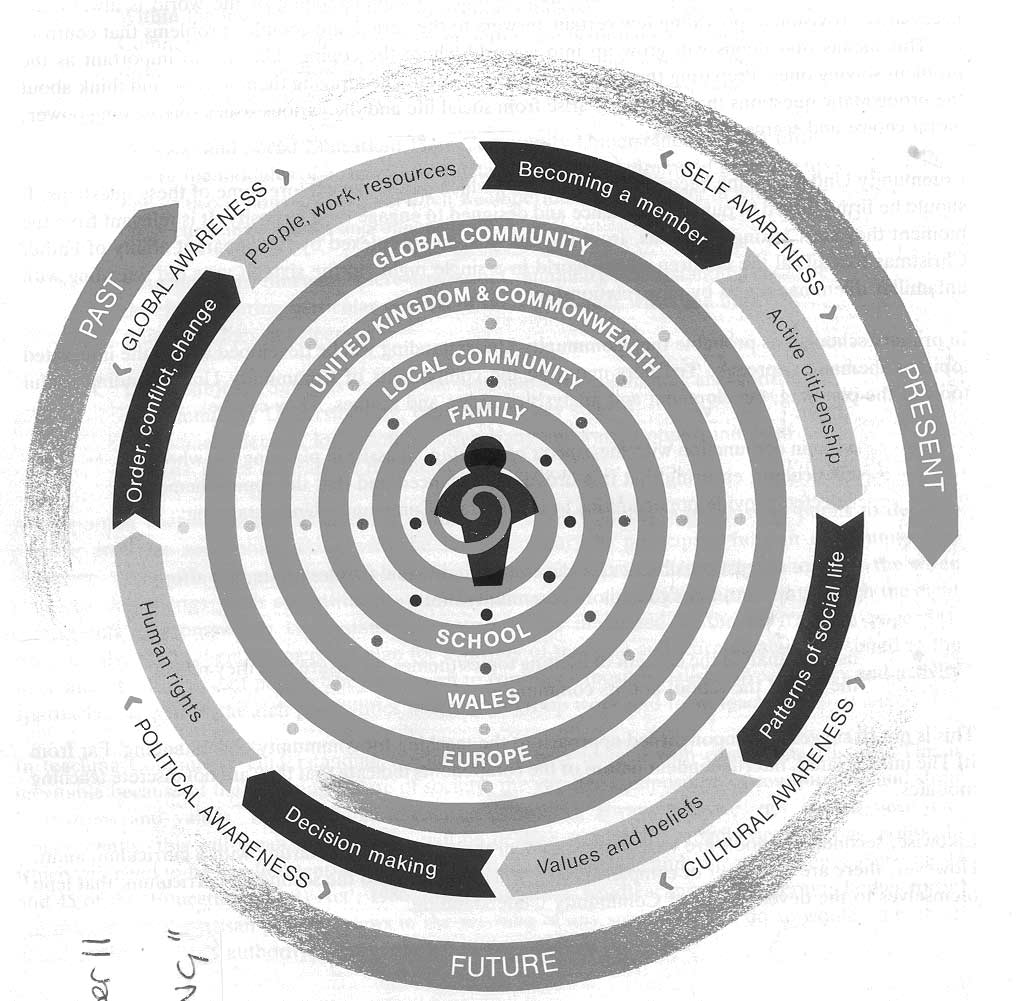
Curriculum Council for Wales, Advisory Paper 11 - Community Understanding (1991)
The model helps dissolve the perception that each culture is closed or separate and that the relationship between two cultures is necessarily one of "otherness", lack of understanding, hostility and conflict. It helps to confound claims made (By, among others, Francis Fukuyama) that the rights of the individual are incompatible with ethnic-minority or religious group identity and that, for example, "being British" conflicts with feeling part of the European Union.
Each one of us is a universe. When we come into contact with one another, our capacity for interculturality should be a source of power. While recognising each others' differences, it is possible to find commonalities - and through this process, to go beyond one's own culture: "to engage in trans-cultural interaction which involves challenging both cultures and negotiating new meanings" (see Michael Byram, "Reflections on Otherness", Times Educational Supplement, 15 March 1991).
Since gender interfaces with all other communities to which an individual belongs, how does this argument relate to the perceived male-female division? In the 1970s Sandra Bem came up with another perspective on identity: the ground-breaking concept of psychological androgyny.
According to Bem, masculinity and femininity are not extremes on the same scale, but constitute two independent scales from which both men and women can draw. It is often the case that an individual with strong (positive) "masculine" characteristics also has strong "feminine" characteristics (a man can be assertive and nurturing - and so can a woman) while the inverse is also true with weak (negative) characteristics (a woman can be unassertive but manipulative - and so can a man!).
Bem's analysis, like the community spiral, opens up so many possibilities for recognising and appreciating a more complex individual identity - and for overcoming the perceived barriers between people. In fact, the external "other" rarely constitutes the real threat but it is that aspect of the other - unreconciled within ourselves - which we are afraid of. Being able (or enabled) to recognise the multiplicity of the self, may perhaps make it easier to find new ways of belonging - or new spheres where we feel we belong.
Reclaiming the self
The real threat of feminism is that it challenges binary logic, which is why it is constantly being undermined itself. The "reclaiming feminisms" conference at the Institute of Development Studies on 9-10 July 2007 aims to rescue the multiplicity of individual women's lives, of women's social movements and also women's scholarship from colonisation by binary thinkers - whose gender-equality programmes have reduced complexity to what can be assessed as in/efficient or non/cost-effective: easy to count and easily classified, and so never making a radical difference.
Naturally I'm a feminist, although that doesn't define me, especially as some of the best feminists I know are men. I'm also a socialist, an existentialist, an optimist and recently, I've even become a journalist. None of these labels explains who I am - even if you pack all that together and call me, at 55, a postmodernist.
Reclaiming feminisms is a necessary start to breaking down some of these long divisions. I'm looking beyond that to a world where everyone can reclaim themselves.

