
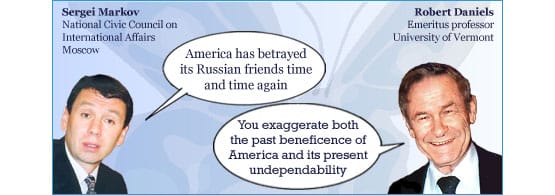
Dear Robert,
As a Russian who supported and appreciated Americas support of freedom in my country and its determination to liberate my people from the tyranny of the Soviet Union, it is only natural that I find much to admire in your country.
Americas success as a system of political, social and economic organisation is unrivalled. Citizens of the United States enjoy the highest standard of personal freedom in the world and have a standard of welfare people in most countries can only dream about. As perhaps the best working democracy in the world, the United States has a strong, dynamic, hi-tech economy that is the motor of the global economy, promoting and aiding the development of many countries. Hundreds of millions of workers and businessmen across the world rely on the strength and stability of the American market.
In the 20th century, the US was the country that carried the torch of freedom. America resolutely resisted the main totalitarian calls of the century: Nazism, communism, Islamic radicalism. The US spent billions of dollars promoting ideas of freedom and democracy, financing numerous programmes across my region. People of my generation cannot imagine life without the Voice of America and Radio Liberty, both financed by the US government.
But despite all these virtues, as a player on the worlds political stage, the US is at best inconsistent, at worst treacherous.
Roughly and selfishly, the US imposes on others its own understandings of democracy, economy and culture. American hegemony so evident in its cultural power is like McDonalds: very harmful, but very popular and very profitable.
America, Im afraid to say, has betrayed its Russian friends time and time again.
First, the US promised the Russian people the equivalent of a Marshall plan of aid if they overthrew the communists. We did overthrow the communists, but as yet we have not received any help from America. Should we consider help the high-interest credit America has imposed on our country? In the early 1990s, America loaned money to Russia, the duties on which are simply unpayable in a transitional country like ours. I consider this a betrayal.
America told us that a market economy would be better for us than our state economy. But, with the active participation of American counsellors, the Russian economy became worse. The Russian people were experimented on like rabbits by American ideologues interested in testing new methods of economic transition from central planning to the free market. As a result, the standard of living in modern Russia after six years of International Monetary Fund-manufactured growth still has not reached the level at which it stood in the last years of communist rule!
The US also deceived Russia over Nato. Americas leaders promised Mikhail Gorbachev that Nato would not incorporate the countries of the Warsaw Pact into its membership. But Nato wasted little time inviting into its club former republics of the Soviet Union. Russian democrats, inspired and encouraged by American leaders, insisted we should give freedom to these peoples. The communists warned that one demagogy would be replaced with another: American troops would occupy the old Soviet bases. The communists were right.
America claims to support democracy. But America counts Latvia and Estonia as its allies. These are not democratic countries but ethnocratic nations where Russians are treated as second-grade citizens. This is apartheid and cultural genocide not democracy. Why should we believe America cares for democracy if it supports the policies of Latvia and Estonia and invites these countries into Nato?
Throughout the 1980s I must have heard hundreds of times on the Voice of America and Radio Liberty how, if Russia became a democratic country without communists, a community of democratic countries would openly embrace it. We were deceived. America and its allies have not welcomed Russia as one of them. They have continued to treat Russia as a threat and an enemy and they have lied to Russia in order to weaken her.
The treatment of Russia in relation to its application for membership of the World Trade Organisation is symptomatic of our post-communist experience. A condition of our joining is the destruction of our aviation industry and the liquidation of our insurance business. Why does America want Russias insurance business? Is the United States so lacking in profits? I very much doubt it.
Meanwhile, for many years America has adhered to a policy of double standards about the problems of terrorism. The American press calls terrorists by any other name: rebels, militants, attackers, partisans. America has granted political asylum to one of the closest collaborators of the terrorist Aslan Maskhadov. America pressures Moscow to hand over control of Chechnya to the terrorists even after we already gave power in Chechnya to separatists and Islamic radicals in 1996. The result has been organised terror, the killing of thousands of people, and the attack on Dagestan in 1999. But the American press abandons any pretence of objectivity and blames Russia for the entire conflict.
Russia is still in a difficult period of transition as it moves from an authoritarian to an open society. America promised Russia its support in this change. But the truth is that America is glad to see Russia lose part of its territory and population. The independence of Lithuania, Latvia, Estonia, Georgia, Turkmenistan, Azerbaijan, is a real independence of former colonial remote areas. But when countries such as Ukraine, Belarus and Kazakhstan claim independence, this is the decision of quasi-authoritarian elites, not the people of these countries, who would choose to stay within Russia. Why does America not support the democratic will of the people of these nations?
Please America, do not deceive us any longer.
Russians like myself are not against US leadership in the global community. But we want this leadership to promote not prevent the development of Russia. To win the support of the worlds people, American foreign policy must not be rigidly selfish.
Following the collapse of the Soviet Union as a superstate in 1990, the United States has been unrivalled as the worlds great power. But in that time, the world has become less safe. As the worlds leader, the US must bear responsibility for this global state of affairs. When I met Colin Powell in Moscow, I put this to him, but, inevitably, he shirked an answer. So I drew the conclusion that America does not recognise nor learn from its mistakes. Because of this, the world will become increasingly less safe.
The whole world is worried and afraid by the inadequacy of Americas global leadership. When Russia warned the United States of the growing threat of terrorism, the US chose to ignore our warnings, in thrall to its own force. In this, as in so many things, the US is increasingly behaving like a drunk cowboy in a saloon, reliant on brute force, egoism, money and violence, ignoring the will of others, and ready at any moment to engage in a drunken shootout. Does America realise how afraid the world is of its behaviour?
But perhaps even more scary is the prospect of the US retreating into isolationism a very possible result of defeat in the Iraq campaign. American isolation would only bring an increase in global chaos, an amplification of terrorism, and an even greater crisis in our international institutions.
America must take responsibility for the development of the modern world, for its peace and its safety. This is the role it has created for itself and this is the role it has an obligation to perform, with the support of its allies, including Russia. The struggle is between civilisation and chaos. America must not undermine the worlds civilised nations. Through the framework of international organisations and international law, America must help build democracy and work with Russia to help make our world safer and fairer.
America must learn that the American way is not the only way, and that countries that are different to America can still be strong allies and good friends.
Yours,

Dear Sergei,
As a professional student of Russian affairs, it is a pleasure for me to have the opportunity to exchange views with you about relations between our two countries. The fact that such an exchange is possible is one measure of the progress that our countries have made in recent years in dealing with each other.
To begin with, I think that you probably exaggerate both the past beneficence of America and its present undependability. And you perhaps reflect Russias tendency to blame others for its own predicament.
I would concede that America is no longer alone as a model of democracy and economic welfare. In recent decades, I fear, it has been retrogressing, back toward 19th century ideology, narrow nationalism, and political irrationality, while it is being economically weakened by a huge burden of internal debt and foreign-trade deficits. American power now rests above all on its military. While the Voice of America and Radio Liberty used to be important influences, Americas greatest attraction is mass culture, not imposed on other populations but eagerly copied by them while it is disdained by intellectuals here as well as abroad. These are not new circumstances; they were simply less apparent when they were subsumed in the cold war confrontation between the west and the Soviet Union.
Since the collapse of communist rule, American attitudes toward Russia have been governed by contradictory reflexes, both of them hard for Russians to understand. For most Americans, Russia has practically ceased to matter. Islamic terrorism is this countrys primary foreign-policy concern. At the same time, residual cold war habits persist in the movement to expand Nato eastward and cater to anti-Russian sentiment in eastern Europe and the Baltic countries.
Naturally, the American people as well as our government welcomed the collapse of communism and the end of the cold war. America has indeed accepted Russia as part of the community of democratic nations. The state of Vermont and the Karelian republic in the Russian Federation are sister states; I have helped administer governmental and scholarly exchange programmes between Vermont and Karelia, and our contacts have been cordial and productive. But America as a country was not responsible either for the breakup of the Soviet Union or for the ruinous economic policies of the Yeltsin regime. These were choices by Russian leaders, whatever foreign advice they might have listened to.
As a nation formed in rebellion against a colonial power, America has naturally welcomed movements of national independence elsewhere. This is one of the reasons for its sympathy with the countries of eastern Europe and the former Soviet Union, a sympathy which includes small peoples like the Chechens who happened to have been left inside the Russian Federation when the union republics were decolonised. The problem for Russia is that since 1991 it has botched its relations with its former colonies, beginning with the Belovezhsk coup dètat when Yeltsin broke up the Union of Soviet Socialist Republics in order to depose Gorbachev.
Historically, Russia has been too quick to resort to threats and force instead of reconciliation and economic inducements. Admittedly, Russia has a difficult task in dealing with its former colonies and its remaining minorities. But most informed Americans would agree that the two Chechen wars, Boris Yeltsins war of 1994 and Vladimir Putins war of 1999, have been political and moral disasters. This does not mean support for terrorists and their methods, and the horrified reaction in this country to the Beslan massacre shows where Americans draw the line. Both our countries have to learn to understand and address the sources of terrorism, be they political, economic, or religious, even if some people might accuse their governments of being irresolute.
Americans may be naïve about the free market economy in Russia, but they are genuinely concerned about the prospects for democracy. Most Americans supported Yeltsin because he promised that Russia would not revert to communist dictatorship. After he lost credibility, Americans hoped that Putin would get the country back on the path to stable democracy. The trend, unfortunately, seems to be in the opposite direction, toward renewed authoritarianism and managed democracy. This is the picture we get from the consolidation of Russian political life into one dominant party, and the series of so-called reforms moving power into Moscows vertical.
We know that international sympathy for the United States has eroded since the initial outpouring of sympathy for the terrorist attacks of 11 September 2001 and particularly since the Bush administrations decision to invade Iraq last year. Perhaps people abroad are not sufficiently aware that these developments have also divided Americans, and that many of us are just as appalled as you are by the image of the drunken cowboy.
The collapse of the Soviet Union left the United States the worlds only superpower. It is pulled two ways in the use of this power. One is towards the narrow pursuit of national security - not exactly isolationism, but a successor to it. The other way is to take the lead - though not to dictate - in multilateral efforts to address world problems, including terrorism and the conditions that encourage it, the norms of democracy and international law, and the poverty and suffering that decency demands we alleviate.
I agree that the American way is not the only way, just as Russias communist way was not the only way. While they differ in many respects, America and Russia have much in common in their goals and principles. Our countries not only can but must be strong allies and good friends.
Sincerely yours,


The Letters to Americans project will run until the US presidential elections on 2 November 2004. Projects like this are challenging to organise and expensive to deliver, but we think it is worth it to bring America into dialogue with the world. If you agree, please support us.
Copyright and Contact All Letters to Americans exchanges are copyright of openDemocracy. For syndication, republishing and other enquiries please e-mail Julian. Kramer@opendemocracy.net

