
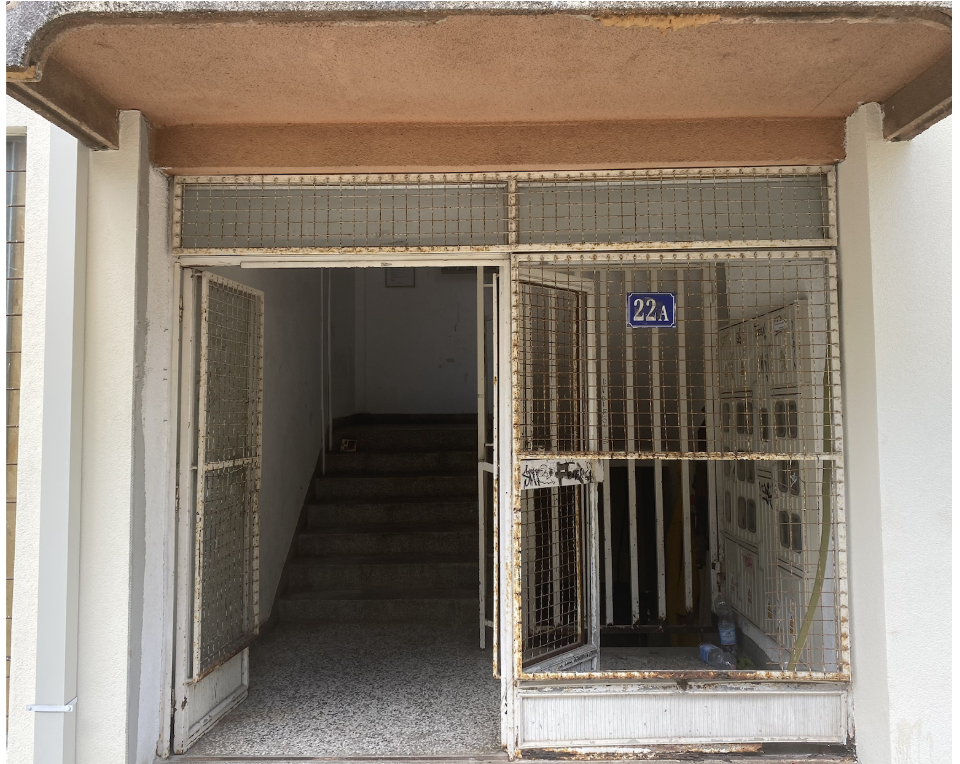
The rusting iron gates and dirty tiled staircase of a nondescript storefront on a quiet, dusty, residential street downtown Tivat, Montenegro, where women hang their laundry out the windows as men drink cold lager and smoke strong cigarettes, offer no clues that its tenants are some of Reform UK’s biggest personalities and backers.
Billionaire crypto investor Christopher Harborne, who has donated £15m to Reform and a £5m “private” gift to party leader Nigel Farage, has his Longevity Biotech Systems firm registered at this address. So do firms belonging to former Brexit Party comms lead Gawain Towler, former Brexit Party treasurer Mehrtash A’zami and Brexit’s digital whizz Samee Bhatti.
The office address that houses their businesses, is registered to Nino Pantovic, the son of a one-time defence lawyer for Posh George, or George Cottrell, a convicted criminal and close associate of Farage’s, who moved to the Balkan country after serving an eight-month prison sentence in the US for wire fraud.
But why are some of Britain’s most controversial Reform-linked figures all operating out of a grubby office in a town of 11,000 people, one awash with Russian – and increasingly US and UK – money? When I knock, the confused-looking woman who answers the door offers few answers.
“We are just an accounting firm,” she says. “They do not live here, they are abroad.”
On Tuesday, increasing scrutiny of Farage’s finances, including revelations published in the Sunday Times that he received undeclared material benefits from Cottrell, prompted the Reform UK leader to angrily resign from his post as MP for Clacton.
“Let me be absolutely clear – I have done nothing wrong,” said Farage, as he announced he would run again for the seat he was vacating. “I have not broken the law in any way at all.”
Yet, months spent combing through company listings, speaking to sources in Montenegro’s gambling industry, crypto industry, business and politics, and a recent visit to Tivat, reveal how, far from the scrutiny of the British public and authorities, some of Reform’s most enthusiastic backers, particularly Cottrell, are spinning themselves a safe haven of shell companies, business interests, crypto, casinos, and property.
The office in downtown Tivat, that establishes just how closely entwined Reform’s many backers are, is just one piece of the puzzle. My investigation also found that both Cottrell and Towler are accused of illegally backing the pro-crypto, pro-EU Montenegrin prime minister Milojko Spajic (allegations Spajic and Cottrell deny); and that a so-called ‘crypto-ATM’ that a Montenegrin minister linked to Cottrell (another allegation he denies) was seized from a casino owned by one of his business associates, while Montenegrin authorities remain tight-lipped about who actually owns the atm and to what end.
As more of Cottrell’s life in the UK and his connections with Reform come to light, our findings show how Cottrell, a convicted criminal, gambler, and financier who calls Farage “daddy”, became the lynchpin of a shadowy network of Reform backers operating out of the Balkans.

Cottrell: from Malvern via Mayfair to Montenegro
Perhaps it was growing up on Mustique, an ultra-exclusive Caribbean island once home to Princess Margaret, that attracted Cottrell to the glamour of Tivat’s marina. The son of Fiona, a former girlfriend of Prince Charles, Cottrell returned to England as a teenager to attend Malvern College, a prestigious school where fees cost up to £59,295 a year, from which he was expelled at 16 for gambling.
Cottrell opted for the City over university, setting up Upsilon Investments to manage the money of Mayfair’s elite, alongside the late Vivian Combs, a resident in the British Virgin Islands tax haven. He worked at A'Zami's Maxim Management Consulting between 2011-14. A’Zami, who has interests in crypto, would later register Maxim Enterprises at the Tivat office.
By 2015, a now-defunct LinkedIn profile stated that Cottrell worked at a private bank as a “Client Manager within a cross-border private banking division, responsible for onboarding HNWI individuals,” or as an “advisor to the Investment Manager of a Cayman-administered fund of funds.”
That same year, he became head of fundraising for UKIP, with Farage saying the 22-year-old was like a “son” to him. Cottrell seemed to be flying high, but he was arrested on charges of money laundering, wire fraud, blackmail and extortion while attending the 2016 Republican National Convention with Farage in the US.
The indictment said: “Beginning in or around March 2014, a user identified as ‘Banker’ advertised money-laundering consultation services on a TOR network black market website. TOR is an acronym for ‘The Onion Router,’ which is a mechanism to anonymize traffic.
“Undercover law agents contacted Banker, posing as drug traffickers seeking money laundering services [...] Banker agreed to help the undercover agents launder their money for a fee, and then proposed that the agents speak with his associate ‘Bill.’”
Bill was Cottrell. He “instructed the undercover agents to send £20,000 in cash of purported drug proceeds to his associate in Colorado, which would then be laundered through Cottrell’s bank account”, according to the indictment.
The charges were serious, and Cottrell faced 20 years in prison. Little wonder, then, that in December 2016 he took a plea deal. The agreement confirmed that Cottrell would “plead guilty to Count 5 of the indictment” for wire fraud. Twenty counts of conspiracy to commit money laundering, money laundering, mail fraud, and other wire fraud allegations were dismissed. In his plea, he used the name “Cotrel”, one of at least two occasions where he used different spellings of his name in formal documents.
Post-prison, Cottrell returned to the UK, catching up with EU-sceptics and right-wing influencers in London pubs and at a party thrown by Arron Banks, co-founder of the Leave.EU campaign and one of the largest donors to UKIP. In late 2018, Cottrell started dating I’m A Celebrity star Georgia Toffolo, later reportedly leveraging the relationship to help get Farage on the same show. Then, in 2019, he moved to Tivat, setting up Private Family Office, a company that says it offers “combined office administrative services”, which, if its accounts are anything to go by, records regular losses.
Where Cottrell went, Reform followed. Farage visited his protege for a “Polo in the Port” event in 2019. Gawain Towler also became a fan of the town, visiting Cottrell in 2020, posting pictures of Tivat on Instagram, and setting up his office in Cottrell’s lawyers’ building.
Having achieved political success in the UK, the Brexit boys appeared to want to replicate their work in Montenegro, albeit this time in the service of a pro-European party, PES.
In August 2024, Montenegrin newspaper Vijesti reported on Towler’s claims that he gave media advice to former finance minister and now prime minister Milojko Spajic’s electoral campaign, while famed political strategist Chris Bruni-Lowe, the author of Brexit party slogan “change politics for good”, claims in his book Eight Words That Changed the World that he worked with Spajic’s PES party too, helping coin his “it’s time” election slogan.
Cottrell was also accused of assisting the party with its political campaigning by Nebojša Medojević, leader of the rival Movement for Change party. Cottrell’s lawyers told us this was a “politically motivated disinformation campaign” and that Medojević’s petition to “the local prosecutor to issue warrants was refused on the ground it was an obvious political game.”
Cottrell “has not made any political donation to Mr Spajic or his party,” they added, nor is he permitted to do so by reason of his citizenship.
Spajic denies that either Towler, Bruni-Lowe or Cottrell were involved in his political career, as does Cottrell. In the report on the funds spent during the campaign for the presidential and parliamentary elections, there is no record or transaction in PES's account statements showing that money was paid to Towler or any foreigner or foreign firm for consulting services. Towler maintains that he gave the advice for free, and had a “small contract” with the party, but the discrepancy raises questions about Towler’s and Bruni-Lowe’s recollections of their involvement in the country’s politics.
More questions were raised when Cottrell launched a political consultancy, Geostrategy, in 2025. The original website featured videos of PES and multiple articles about Montenegrin politics. PES denied cooperating with Geostrategy. The website was redesigned in March this year with all the articles, as well as the shot of a PES meeting, deleted, along with the company’s Montenegrin address.
It seems that Cottrell’s relationship with his adopted country’s politics continues: Geostrategy this year advertised for a Podgorica-based political analyst ahead of a‘’death match’ election in 2027. Cottrell told us through his lawyers that “with regard to the roles for which Geostrategy is hiring, these roles are not specific to any campaign.”

Cottrell’s involvement in UK politics continued, too. In 2024 he flew under the name George Co by private jet to assist Farage as he successfully campaigned to become the MP for Clacton. His mother, Fiona, briefly became Reform UK’s largest donor when she gave three gifts of £250,000 each in 2024/25, while Cottrell himself paid £15,276.72 to fly Farage to a Trump fundraising event last year. A second declared benefit from Cottrell was for the £9,253.60 estimated cost of flights and hotels for him and a staff member, and security, to attend a conference in Belgium in the run-up to the 2024 election.
Labour MP Phil Brickell raised concerns about Cottrell’s activities during a debate on foreign interference in December last year, saying “given that Cottrell has been accused of illegally financing a political party in Montenegro – accusations that he denies – I am deeply concerned about his proximity to Members of this House. It is a great shame that [Farage] is not here to explain the conduct of his right-hand man.”
Brickell also said that during a trip to Montenegro, “several local politicians and officials raised with me their concerns” about Cottrell’s local activities.
This week, the Sunday Times revealed that Cottrell’s financial support for Farage went much further: including “in-kind” benefits ranging from Farage’s back office to his private security, staff, transport and accommodation, recruiting and paying three staff to transform Farage’s social media presence, and letting Farage use a property that Cottrell rents.
The article states that Reform said: “Farage did not need to declare Cottrell’s support as it preceded his announcement he would stand for parliament and so he was not a politician at the time”. The Sunday Times also reported that a Reform source added: “Farage almost always stayed in his own home and did not routinely use the London property.”
The controversies in Cottrell’s life were not confined to politics. The gambling that got him kicked out of school remained a big part of his life. He said he won a six-figure sum shorting the pound ahead of the Brexit vote, but “lost most of it the next day” betting on a horse. More recently, he lost $550,000 betting on the US-Iran war.
Gambling and crypto: A perfect wedding
A five-minute walk away from the office block is Salon Prive, a casino that’s curious for three reasons.
The first is that George Cottrell once boasted of losing $20m at its tables – although his on-off girlfriend Anđela Vukadinović disputes this. The second is that it is owned by a formerly-bankrupt Cottrell associate, and the third is that in June 2023, a crypto ATM, a cash machine that lets users convert cash into crypto and vice versa, disappeared after being seized from the premises.
The casino opened in 2021, with glossy social media posts positioning it as a glamorous destination for Porto Montenegro’s A-list. A promotional video shows women in chic dresses and men in shades and suits striding down the seafront to take their place at the gaming tables. The website boasts that it supports philanthropic endeavours, including the Miss Montenegro pageant – hardly a charitable cause, although it’s notable that Vukadinović was a former winner.
But on a sunny Friday afternoon, the vibe in Salon Prive is far from exciting. The two waitresses gossiping at the entrance seemed disconcerted when I asked for a drink. “We have to see your passport first,” she said, attempting to scan it and then settling for a photo. I later learn this is a new law designed to prevent money-laundering.
Loud 1980s dance music plays in a darkened room, and the only light comes from rows of screens showing football matches and lists of betting odds, the glow of fruit machines and a roulette table. The VIP area is barred to me, located behind a shelving unit decorated with ugly silver skulls. In between songs, a booming voice informs me this is “Salon Prive, real players only.”

According to Montenegrin company records, Salon Prive’s director is British Malaysian businessman Hon Kong Yong, who filed for bankruptcy in the UK in 2016 before reinventing himself as a Montenegrin success story. Swedish entrepreneur Gustav Sander, who was a director of Cottrell’s Private Family Office, was the casino’s operations director.

Salon Prive is ultimately owned by Hon Kong Yong’s Global Trust Limited, the parent company of multiple Montenegrin-based businesses. It shares an address with Cottrell’s Private Family Office. According to its website, it “operates multi-jurisdictional funds actively seeking to acquire established online and land-based gambling licenses and operators with exposure to emerging and non-traditional markets.” It has an office in the notorious tax haven, the British Virgin Islands.
The casino hit the headlines in 2023, when its crypto ATM was seized by law enforcement.
“We have been informed that there is a crypto machine in the municipality of Tivat that is used for the trading of cryptocurrencies,” Montenegro’s then minister of finance, Aleksandar Damjanović told local press at the time of the seizure. “We know that there is no legal basis for the trading of cryptocurrencies in Montenegro and that everything related to possible trade through that machine is illegal.”
Damjanović said that Cottrell was connected to the machine, something Cottrell denies. His lawyers told us that “our client has had no involvement with any “crypto ATM” at the premises.
“We add, in any event, that our client has been informed that a civil regulatory inspection of Salon Privé was carried out by the Games of Chance Administration, a division of the Ministry of Finance that regulates licensed gaming premises. He is not aware of any criminal investigation, let alone charges, having been pursued against any individual in relation to a crypto ATM.”
Journalists, transparency activists and crypto businessmen I spoke to in Montenegro told me that the seizure raised more questions than answers. In the two years since the raid, Montenegrin authorities have failed to share any further information about the machine, including about the users of the machine, the sources of their funds, and whether any transactions conducted on that machine require a criminal investigation.
“We are facing radio silence from the government about who owns the machine, its whereabouts, and its transactions,” said Vuk Maras, a reporter at BIRN, the Balkan Investigative Reporting Network.
While Montenegro has taken tentative steps towards crypto-regulation, much work remains to be done. As one crypto technologist put it to me, “Under which law did they seize it?”
openDemocracy approached the Montenegrin government for a comment on the seized ATM, but did not receive a reply before publication.

One of the first things that hits you in Montenegro is that cash is king. It has adopted the euro as its primary currency, another reason it has become a magnet for people who deal in cash – and more recently, cryptocurrency.
During my stay, I spoke to a range of crypto businessmen who explained that Montenegro has embraced the digital currency due to the curious and entrepreneurial nature of its people, the desire to take hold of new opportunities, and a general distrust of the banking system that remains a legacy of the Balkan wars of the 1990s. High bank charges, slow movement of money, and the fact that Montenegro is not a busy financial hub like London or New York mean crypto offers a new and fast way of investing and doing business.
The byproduct is a near-total opacity of the financial transactions that help drive the country’s economy, and shape its politics. “Despite Montenegro adopting various anti-corruption laws and establishing new institutions, none of these bodies are truly independent from political interference,” says Transparency International in a recent report. It added that the country “needs to reform political party and election financing, particularly concerning foreign funding.”
In the early 2020s, it felt like Montenegro would become the crypto capital of Europe. Prime minister Milojko Spajić, formerly of Goldman Sachs, was keen to embrace the new technology. But crypto enthusiasts kept coming up against a problem: the lack of a regulatory regime. All sources who would speak to me within the crypto industry said regulation would enable them to work with the banks and prevent criminal use of the currency.
“We want regulation so the good guys can come and invest here,” said co-creator of the Montenegrin digital currency Perper Ivan Joličić, who worries that the country has lost momentum on cryptocurrency. “We could be doing work on improving new technologies but without a law we cannot do big projects.”
Of course, some people want to keep things just the way they are. In his book Everybody Loves Our Dollars, journalist Oliver Bullough explained that “analysts estimate that the amount of money being laundered through this new model trade-based money laundering could be in the tens of billions, but in reality they cannot possibly have any idea [...] as with other money laundering techniques, cryptocurrencies have not replaced the older methods, but added to them.”
All the crypto guys I spoke to saw regulation as a way to improve transparency. But in the absence of a robust regulatory regime, traceability is gone – as local investigative journalists have discovered.
Some $2.2bn of crypto transactions passed through crypto wallets linked to Montenegro between November 2021 and 2022 largely without any state oversight or records, according to an investigation by BIRN. The Ministry of Finance told BIRN that it did not have data on transactions related to crypto assets, nor is it obligated to record such data.
Sources in the crypto industry and investigative journalists told me that crypto is used to purchase all sorts of things in Montenegro, including luxury real estate in its booming seafront property market. Everywhere I went, adverts promoted beautiful apartments overlooking the sparkling blue water, where palm-tree-lined towns nestle at the foot of green, wooded mountains – and where getting a residency permit only takes two weeks.

Until recently, a notary managing a real estate deal did not even have to get proof that the crypto had swapped hands. The buyer and seller just had to say it happened. It doesn’t take a bank compliance officer to understand the inherent money-laundering risks in such a transaction.
As the seized ATM’s placement in the casino suggests, crypto has also opened up gambling opportunities.
Cottrell has become a “key player”, the Sunday Times said, with Tether.bet. The crypto gambling platform launched in 2020 and acquired by GT Holdings, based in Curaçao, an island country in the Caribbean known to be a tax haven.
Tether.bet uses Tether, a cryptocurrency company part-owned by Reform mega donor Christopher Harborne, who dined with Cottrell and Farage in Mayfair just before the crypto-betting platform launched in 2020. Tether is a stablecoin that has the symbol USDT, that is pegged to the US dollar, meaning a user can exchange it at any point for a physical dollar at par.
However, in 2021, New York State authorities fined the company for having lied in its public statements and forced it to admit that it did not have sufficient assets to redeem all the USDT it had sold.
An analyst quoted in Bullough’s book said that Tether “spoke a good game” on tackling illicit use of its coins, but that its “actions don’t mirror that in my experience. The vast majority of illicit activity and crypto assets has switched to Tether over the past few years”.
The company also does not have a license to operate in Britain, meaning UK users are restricted from gambling on the site. The Sunday Times reported that the company had an office and bank account in Montenegro, and that it said it had a gambling license from Curaçao, while its payments were processed through Cyprus.
According to the same Sunday Times investigation, two men alongside Cottrell were involved with the platform from an early stage: David Robery, a software expert who lived in the cottage neighbouring Cottrell’s family home in the Worcestershire countryside, and Salon Prive’s Hon Kong Yong.
Montenegrin property records show that Robery purchased an apartment in the Regent, a luxury Tivat apartment tower where Cottrell reportedly lived. The apartment was owned by a company called Sidra 501, later purchased by Hon Kong Yong’s Global Trust Limited. Robery, notably, was the only follower of a Twitter account for Geogar Racing, a business set up by Cottrell in 2011.
Cottrell’s use of Tether.bet has led to questions. Documents filed as part of a lawsuit relating to the Starlizard betting syndicate involving the owner of Brighton & Hove Albion, Tony Bloom, alleged that Cottrell asked professional gambler Ryan Dudfield “whether he could assist in identifying people residing in England and Wales who might be interested in using the ‘tether.bet’ site.”
Dudfield, known as “the Claimant” in the documents, did not do so, “as he was concerned that tether.bet was not licensed by the Gambling Commission in the United Kingdom”. The documents lay out an alleged agreement between Bloom, the syndicate, Cottrell and Dudfield which includes the statement that the syndicate “would cease to place its bets via gambling platforms in which Mr Cottrell had a financial interest, such as tether.bet.”
Lawyers acting for Cottrell told us that he has never been a director, employee or consultant of Tether.bet, never held any management or bank account control of Tether.bet, never solicited any clients for Tether.bet and never had any involvement in the running of its operations.
In the same court documents, Cottrell is described as not being a “very successful gambler.” A source in the gambling industry whom I spoke to on background expressed doubt about Cottrell’s gambling prowess and questioned why he was so keen to put out stories about his large losses. It made them very suspicious of Tether.bet’s money-making ability.
This is another question about Cottrell: just like the cash in the crypto ATM, we don’t know where exactly his money comes from. He once boasted of having access to a £250m trust fund, although his mother, Fiona, said in 2017 that these claims were “ridiculous, absolute rubbish.”
The Sunday Times reported that, despite her large donations to Reform UK, legal documents dated 2023 described Fiona Cottrell as a “retired stylist” and showed that when her husband died, his estate – which she administered – was valued at £1.5m. Now, reports in the Guardian allege a £1 million donation Ms Cottrell made to a company fronted by Reform deputy Richard Tice was flagged to the National Crime Agency over concerns about the source of the funds. Bankers also raised “suspicious activity reports” over two loans made to Tice by George Cottrell.
Crypto and the global far right
If Tether is close to hard-right politics in the UK thanks to Harborne, then across the Atlantic, it is close to hard-right politics through financial giant Cantor Fitzgerald, which provided it with banking services. Donald Trump appointed Cantor Fitzgerald’s CEO, Howard Lutnick, as his commerce secretary in 2025, the same year Tether relocated to El Salvador, another crypto-friendly country.
Like Spajic in Montenegro, both Trump and Farage have positioned themselves as friendly to crypto, as have far-right political figures across Europe. The US president, who has reportedly made $2bn from his crypto activities, gave a keynote speech at the Bitcoin 2024 Conference in Nashville, Tennessee, telling the audience: “When we see attacks on crypto, it’s part of a much larger pattern that’s being carried out by left-wing fascists who weaponise government against any threat to their power.”
Reform, meanwhile, became the first UK political party to accept crypto donations, with allegations that it accepted the digital currency via a third-party permissible donor before it was converted into sterling. (The UK government has now put a temporary ban in place on crypto donations.) The party has also proposed a crypto policy favourable to the industry, including low taxation for crypto (10% capital gains tax), making it legal to pay tax in crypto, and creating a sovereign bitcoin reserve fund. A crypto firm sponsored the 2025 Reform UK party conference, and Farage has invested £215,000 in a bitcoin treasury company named Stack BTC.
Farage is now facing a probe into his crypto lobbying, as his warmth towards the industry seems to benefit his donors.
Throughout all the research and conversations I had in the course of reporting this article, local Montengrins expressed concern at how deeply Cottrell and his circle of Reform backers had embedded themselves in the country’s political economy.
Because here, men like Cottrell are building a social and political infrastructure that welcomes the hard right of UK politics: somewhere the sun shines, the bars are welcoming, the yachts are massive and protection comes cheap.
"We need to expose this,” one source said to me. “Because we don’t want your bad guys coming here.”