
The typical British familys annual carbon emissions are divided three ways - one third for heating and powering the home, a third for transport, commuting and private car use, and a third for food miles . The average meal in Britain travels over 2,000 miles (3,200 kilometres) from farm to dinner-plate.
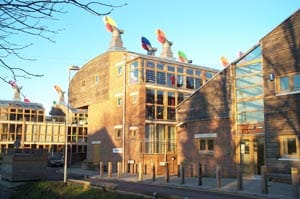
It is near-impossible to live a carbon-neutral lifestyle in Britain wherever you go and whatever you do, there is a cost to the environment. So through my architectural firm BedZED I have tried to take the pressures out of leading a near carbon-neutral lifestyle, by building a holistic solution in the form of zero-carbon housing developments.
The aim of the project is to build in such tight density that it would be possible to meet almost all the new housing requirement by 2016 on existing stocks of brownfield sites (not agricultural or natural land). At the same time most of the new houses have a garden, a south-facing conservatory, and the opportunity to avoid commuting by working on site.
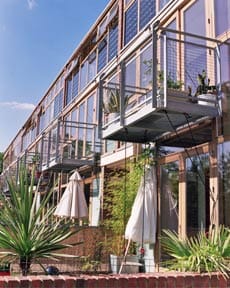
BedZED provides the ingredients for a new kind of solar urbanism, with housing facing south, and commercial space facing north. This creates single-aspect dwellings looking south over their own gardens, with high daylight levels maintained in a deep plan by triple glazed roof lights over stair voids. Wherever possible the housing ground floor level is raised 1,200 mm (47.2 inches) above the pavement and workspace, allowing residents to look down at workers and public passing in the mews streets. Terraces are never longer than six units allowing the development to be porous to pedestrians and cyclists, whilst parking is flung to the perimeter of the site.
Environmentally benign innovation costs more. The money the developer would normally have spent buying land for the office park is invested in the super-green specification. We have set a national precedent for this legally, by expanding a normal Section 106 planning gain agreement with the local authority officially to include reduced environmental impact targets. This is a real breakthrough, because it allows carbon-neutral new mixed-use development to be built without always requiring government grants.
BedZED ended up costing around £1,450 per square metre, which is almost the same as equivalent prefabricated experimental social housing being built at the time. But the difference in specification is notable there is on site water treatment, sports facilities and a power station. Only 3% of the 160,000 homes built in Britain each year need to be built to BedZED standards before sufficient economies of scale are achieved to make the idea carbon- and cost-neutral.
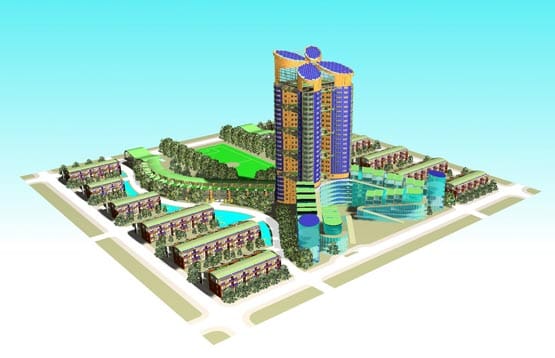
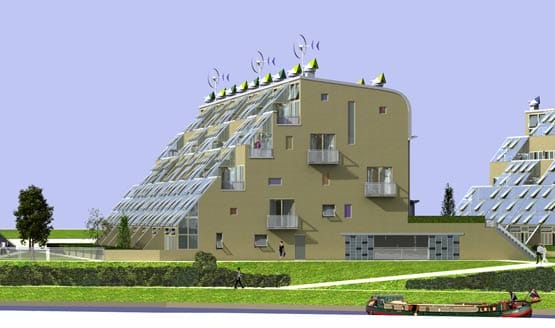
SkyZED Aerodynamic urbanism shapes the layout of these buildings which can actually be carbon negative, even generating a modest surplus of renewable energy over their lifetimes to pay off the embodied carbon invested in their construction.
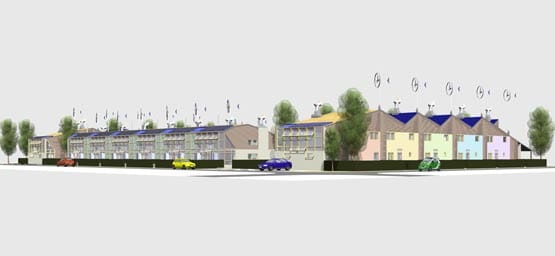
Rural ZED A typical home can be built in about 4 weeks. Powered by solar hot water collectors, wood pellet boilers, solar electric panels and a micro wind turbine, enough renewable energy is harvested to both match the overall annual energy demand and power an electric car for around 5000 km.
Bow ZED This small block of four flats on a tiny urban infill site in East London shows how the same principles can be used within a typical historic London street. A communal clean burn wood pellet boiler, a micro wind turbine, and wind driven heat recovery ventilators have provided a unique architectural form at the same time as providing the potential for zero overall annual carbon emissions.
Leicester Abbey Road Around half of each flats annual energy demand has been met by solar electric panels, with a communal wood pellet boiler providing low carbon heat. This project will meet the UK govt target of a 60 % CO2 reduction by 2050 on the day it is completed.
This article appears as part of openDemocracys online debate on the politics of climate change. The debate was developed in partnership with the British Council as part of their ZeroCarbonCity initiative - a two year global campaign to raise awareness and stimulate debate around the challenges of climate change.

