Striped yellow and black the tiger butterfly flits through the forests of Central America. Darting between the thin rays of light cast through the shadow of the upper canopy, the tiger butterfly seeks the essentials of food, water, and a mate. Its stripes shine bright and heedless on the secrets of the Maya. It moves on thick, warm air whose moisture you taste like perfumed sweat.
Tiger Butterfly is part of Tales of the DeCongested, a monthly reading event in London dedicated to the short story.
My tiger butterfly does not move. I have stripped it from its warm climate and brought it here, to London, to hatch on my cold windowsill. Outside, a light sheen of rain provides a grey backdrop. For weeks the chrysalis has sat forgotten amongst the mugs of moulding tea, the pens, the dead flies and the dust. Now, as it fights its way to the final transformation, past egg, caterpillar and cocoon, I remember.
I was wearing shorts. The guidebook recommended modest clothes for women travellers when visiting villages, but I was too hot. I was in Belize. I wanted to write a feature on the best eco-tourist project in the world. The magazine I was working for arranged the travel and the thought of walking into the luscious hills around Punta Gorda spurred my enthusiasm. I ended up in Laguna.
Laguna was one of the first villages to get involved in the project. I had toured around its parameters for two days. To me, it sounded like an oasis; a cool lake amidst a forest of dense, humid trees. The reality wasnt as idyllic, though not far off. Thirty or so wooden houses clustered around a community centre that had been built with the proceeds from foreign guests like me. The roads were mud paths and the houses were surrounded by plants with bright red and white flowers. There was a waterfall tumbling from the hill that provided a prospect of lush green jungle as far as the eye could see.
I felt confident, standing outside the guesthouse in my shorts. My face was strange enough for a sight of my white legs not to matter so much. At least the shorts didnt go above the knee. After a night spent sweating into the sheets of the guesthouse bed, not being able to see without lighting an oil lamp, I woke with the birds. The hills looked magical, moisture hanging in clouds over the trees as the morning rolled into the valley.
The idea of the programme was that you went to the village and distributed your wealth. Tours around the village and to the local cave, meals, displays of craft making and music playing, were all on offer at a price. Vicente, the manager of the programme in the village, had been keen to remind me that a lot of villagers were relearning past traditions and cultural practices in order to display them to visitors. Soon traditional costumes would hang on hooks behind their doors.
In keeping with tradition, the guesthouse had no electricity. But it did have bunk beds and running water. The villagers slept on hammocks and watched television, but collected their water from the guesthouse taps, or the river. The water pump was broken.
So far, I had paid for a village tour, some music making and a trip to the cave in the hills combined with a lesson on the medicinal properties of jungle plants. The man had walked ahead in black Wellington boots, slicing a way through with his machete.
Today, I was easy. The tiniest of cool breezes caressed my shins and calves. I was waiting for someone to take me to breakfast. At every meal a different village household would take you in. You would pay them of course, but you would also share their meal and talk about cacao prices, slurping the milky brown cacao juice with your stew. You would drink the juice marvelling over its almost total dissimilarity to chocolate.
I was thinking about chocolate and fair trade when Candelabra came barefoot to greet me. She wore a green dress creased with dirt, the stitching loose at one shoulder, and carried a bunch of tiny bananas. She was Vicentes niece and she had been sent to give me breakfast. Unlike several other cousins and siblings, Candelabra did not seem afraid of me. Twisting her head on one side, she looked from my face to my naked legs and smiled.
Come, she said.
Eating bananas on the way, Candelabra led me through the village. We walked past the dead body of a snake that her brothers had killed the day before. They did it to show off. I had stood and watched them beat it to death with sticks. When they had finished, they held it up by its jaw. The snake, its head balanced on the end of a forked branch, was still writhing in mid air. It had reminded me that I was surrounded by bushes teeming with animals, insects and snakes. I held the oil lamp down by the floor so I could see under the bed before I slept. I fell asleep dreaming of scorpions.
Past her cousins house we took the path to the right, leading towards the community centre, the school and eventually the waterfall.
Close to the waterfall a group of westerners had set up camp. They were working for an aid group that was building a forest ranger station up in the hills. They stared at me every time I walked past, but we didnt speak to one another. I was a tourist. As they sat eating breakfasts of hot cereals, their bodies swathed in tie-die, I wished I hadnt worn my shorts.
The plunge pool under the waterfall was deserted. Holding hands, despite the sweat, Candelabra and I walked past the pool on the shaded bank, close to the broken water pump. I wondered where we were going, but I didnt want to spoil the moment. It was pleasant to walk hand in hand with Candelabra. It made me feel as if I was in touch with the people of the village. I plucked a flower from a passing plant and tucked it into Candelabras hair. She looked like a hoola girl.
Very pretty, I said.
Candelabra pulled the flower from her hair and inspected it. She kept it in her left hand, absent-mindedly twisting the stem so that the flower spun between her fingers. I was disappointed. The flower had looked good behind her ear: the image of dressed-up Eden. She was a pretty girl, though her hair hung in wide clumps and her fingernails were cracked with dirt. She was twelve, but she looked younger. Perhaps it was just her size. She didnt look weak, just small.
We walked alongside the stream that ran from the pool until it was shallow enough to cross. We disengaged our hands and balanced on broad, flat stones. Two stones and a leap and we were across. The ground by the stream was soggy and seeped muddy water into my trainers. My white calves were now flecked with dirt. It felt cool and refreshing.
Still uncertain of where we were heading, I could see that we were walking towards a different area of the village, behind the communal buildings and closer to the rainforest. A large house with lots of chickens lay to one side and back behind that, right on the edge of the expanse of trees, was a patch of ground like a wild garden. I could imagine myself on some large English estate at the bottom of a long neglected field. There, in amongst the smaller plants, were tens of tiger butterflies, their thin broad wings making my eyes turn pirouettes. It was like watching a series of coloured spinning tops. We had arrived.
Candelabra was an expert butterfly catcher. I hadnt known before that you could pick up butterflies. I thought that if you touched them you destroyed their wings. Candelabra showed me that if you used the front two, or middle, fingers, your palm facing upwards, you could pinch the backs of their wings shut and lift them up for closer inspection. Of course you couldnt see the colours through your fingers, but you could admire their tiny legs and curling proboscis. They became crawling things, whirring against your skin. They tickled. We kept dropping and catching them, peering at them and marvelling at their darting flight as we set them free. It was like holding sculptures made of tissue paper. You worried their wings might stick to the sweat on your hands or tear if you held them too tight. If you stayed still they landed on you. Candelabra, who could easily stand in silence, was soon covered in butterflies. They were better than flowers. You could see their tiny feet blowing across the hairs of her face as they settled on her forehead and cheeks. She sparkled with the natural brilliance of those moving tiger wings their flickering burning a bright yellow crown around her head.
We could have stayed on long into the morning and afternoon, but her brother came calling. She was meant to be making tamales for the market in the town. She had taken too long over my breakfast.
I walked back to her house with her and was invited in. It was one room. The floor simple swept dirt. Even in the shade it was insufferably hot. The midday heat was wiping the earth clean of shadows and breezes.
Candelabra got straight to work. She rounded out dough onto two large banana leaves, making a pile ready for her cousin to add stew and then fold into tight packages, like fat stuffed vine leaves. The stew sat in a bowl the size of an upturned coffee table. It looked like cabbage and bone with a little red spice marking the edges of floating oil bubbles. The fresh dough was sticky, clinging to Candelabras fingertips. Every time she looked up at me she pulled a hole in the dough.
Eventually I left. It was tiring watching them work as they watched me idle. They wouldnt let me help. As I made moves to leave, Candelabras grandmother smiled at me with her gums and got her daughter to interpret. Sat by the doorway to catch any wisps of breeze, her breasts flat against her chest, the grandmother worked a crude wooden loom. She wanted me to buy some of her cloth, but I didnt have enough money to stay as well as buy. I had planned to buy experience rather than goods. I went back to the guesthouse to try and write about ecological leisure in my hand-bound notebook.
The next morning, despite her duties, Candelabra found time to go back to the butterflies with me. I wore a long pink skirt that got caught in the bushes.
Whilst I played with the butterflies, Candelabra searched amongst the leaves. She was looking for a butterfly egg, round and white. She found one bitten into the upper side of a deep green leaf. She handed it to me.
Grow, she said, Butterfly grow.
She wouldnt let me leave without the egg. She dragged me back to her grandmothers house to find an old glass jar and put the leaf inside.
Take. Grow, she said, Butterfly.
And that was it. I had to take it with me. I covered the jar with some paper and an elastic band and put four holes in the top with my biro. We left it in the guesthouse and went to watch the men of the village play football. They werent very good. If Id been wearing my shorts I might have been tempted to join in.
I left on the market bus the next day. Candelabra sat next to me, a bucket of tamales at her feet.
Butterfly? she asked.
I had to keep reassuring her I had her gift. I still had it. The butterfly catching and the egg were the only things I hadnt paid for.
She waved at me through the misted bus window when I got off. She looked sad. I went back to my air-conditioned hotel and watched cable. I lay on the bed drinking coke in only a nightshirt. I would travel to Belize City the next day.
It didnt take long for the egg to become a caterpillar. The people I was staying with in Belize City had a book on butterflies and I read up on what to feed my tiger, making sure it had enough food and air. When I flew back to England, I took the caterpillar with me.
You arent supposed to transport flora and fauna. The transfer of species from one country to another has unpredictable results, but I didnt want to leave my insect behind. It meant I also had to carry cuttings and seeds of the right kind of plant for the caterpillar and then butterfly to eat. These I hid in my large baggage in tightly sealed containers, which I hoped would survive the journey. I carried the caterpillar in my hand luggage in an old moisturiser pot that I stuffed into my wash bag with toothbrush and deodorant. Somehow, I managed to get it through the x-ray system. Even the Americans, who rechecked my bags on transfer through Miami, didnt pick up on anything.
When I walked out of the UK customs, caterpillar still in my possession, I wanted to whoop and throw my fist in the air. My secret import was safe. Assured of my benign and successful trifle with international law, I went home and transferred the caterpillar to a jar on my windowsill. But being back in London it was easy for my thoughts on eco-tourism, Candelabra and her village, to fade. Like the caterpillar, Belize became wrapped in a chrysalis of distance. Ordinary working life pushed Candelabra and her silently changing butterfly out of my mind.
Back on the windowsill I am distracted by drizzle that falls on uncut hedges and green plastic wheelie bins. Rows of terraces stretch net and blind across the street as I think of Candelabra. Looking down at my butterfly, its wings growing like leaves drying in reverse, I am struck by something strange. A normal tiger butterfly grows to a width of roughly two inches. Mine looks at least five, possibly even six.
Six inches is large for a butterfly, but not unusual. Emperors and Admirals, Owl Eyed Butterflies, could surely reach that width. I look closer. My butterfly is still growing, its wings twitching against the rhythm of the suburban landscape. I cant turn away.
It reaches sixteen inches, its antennae sliding up and down the glass of the window. At twenty-four inches its once delicate legs are thick and hairy like the limbs of a giant spider. When it reaches a metre, each wing thick like a side of ham, I leave the room.
I feel sick but I cant keep away. I pace up and down the corridor, occasionally opening the door to check on its size. It is still balanced on the window ledge, its thorax pressed against the pane. Its wings are filling the window frame, the tips spreading on to the barley white walls. The bright yellow and black stripes look like police hazard tape blowing in the breeze around a crime scene. The proboscis starts to look like a mini-Hoover. Im afraid. What do you do with a giant butterfly?
I call London Zoo. The manager of their insect house is on holiday. They ask if I can secure the specimen until the following Monday when he will return. I hang-up.
Cautiously, I open my bedroom door again. The butterfly is now sitting across my bed. Its body alone is king size. The liquid pumping through its veins is visible under the surface of shimmering coloured hairs that are swelling coarser to the sound of the pulsing growth. It is like hoarse breathing. I go back to the corridor. Perhaps I should call the police?
When I try the door again, I cant get in. Black feathery tendrils are slithering under the door, pressing against the frame.
I move back to the phone, the walls of my bedroom creaking under the strain. I just have time to duck under the side-table as sharp flat pieces of plaster begin to fly across the hall. The mortar in the brickwork is crumbling. The tiger butterfly is bursting from its second chrysalis.
I dont see the collapse, but I feel the air twist as the butterflys body breaks through the wall. The wind from its wings, flexing as they leap into flight, sends a further blast of bricks and plaster around the street. Clouds of dust swirl in my eyes and my ears ring with the reverberation of those six hairy legs pushing off against the ground.
A silence, waiting for the wail of the siren, hangs with the dust and I stay crouched under the table. The floor around me is rubble and dirt. The bath, full of tiles and soap, has fallen from the first floor. The television has been shattered, its screen nothing more than a gaping black hole. In the other direction, through a mess of pipes and floorboards, I can see the street. I decide to risk it and dart in between the ruins and out into the sunlight.
The street seems to have become one watching eye, every neighbour, animal and bird, turned towards my terrace. I ignore them. I search the sky for the butterfly. I want to know where it has gone. I knock on a door across the road and get them to switch the television on.
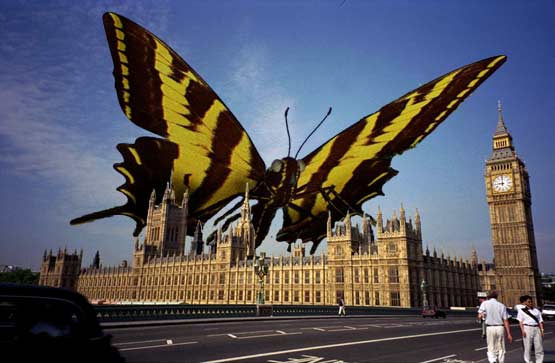
So quickly, the news has spread. Nothing happening today rivals a giant butterfly flying through London. Every station carries variations of the same picture. The butterfly has landed on Westminster Abbey. Helicopters fly around and around its hulking form, aiming their tiny guns at its massive head. They dont look like they are thinking through the trajectory of the butterflys possible descent. They seem to fire at random, missiles pounding into the tiger butterflys thorax, knocking it off balance. Through the smoke, you can see it falling towards the river, its black and yellow stripes shrouding the afternoon glow from the stone of the Houses of Parliament. Gothic baroque flourishes tumble into the Thames. Big Ben leans like the tower of Pisa. London is crowned with burning bright wings.
On the screen the butterfly is sinking. The impact of its fall has sent a huge wave along the Thames, flooding the Saatchi Gallery, the moorings of the London Eye, the Royal Festival Hall, the National Film Theatre, the National Theatre, Somerset House, St Pauls. Untold damage that will take millions to repair.
I blink. I see Candelabra with her sweaty hand and her matted hair, her face flickering with tiger butterfly wings. I see her pleading with me not to forget her, her village, not to forget the cacao workers, the rainforests, the maze of export and import that is the secret forest upon which we build our leisure.