
If governments of rich countries ever decided to act on climate change on a national level by forcing citizens to cut back their energy usage, what would happen? How long would it be before the first revolution? This year I learned what that future would be like while filming a series for BBC Radio 4 called The Energy Gap. Its producer Doreen Walton and I spent a week with the Prices, a typical family from Burton-upon-Trent in Englands midlands, who had agreed to live on the same amount of energy as a family in India, the Trikhas.
Three days into their ordeal the Prices were cold and short-tempered, huddled on the sofa under a duvet, and playing cards by the light of camping lamps. They barely managed to hit their target to cut their energy use by two-thirds. They survived just because they took it all as a bit of a laugh, and they knew they could go back to normal soon.
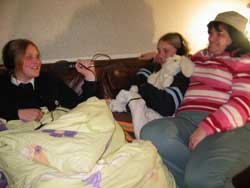
Sally Price, with her daughters Bethany and Briony.
Like most people in so-called developed societies, the Price family had no idea how much energy they consumed. The bills come in, occasionally higher than they expected; they shouted at the kids to turn out the lights for a few days and then forget about it. In response, you might say that its warm in India - so less energy is needed. But the Trikhas live north of Delhi. When I visited them in February, the nightly temperature was hovering around freezing. Vishudeep Trikhas concession to the cold was to let his three daughters (in their teens and 20s) use a blow-heater for a couple of hours to warm up their shared bedroom.
The Trikhas are well-off by Indian standards; all the girls go to school or college and have motor-scooters to get there. Both parents work in insurance and earn good incomes. During our research we were concerned that the Trikhas, as professional people, might be too wealthy for a fair comparison with the Prices, where Paul runs a market café and his wife Sally is a part-time teaching assistant in a primary school.
Also in openDemocracys Zero Carbon City series, British eco-architect Bill Dunster on designing homes fit for people and planet alike
Dont miss the other articles and features in openDemocracys debate on the politics of climate change
So we found another family in the south of Delhi whose status might offer a better comparison with the Prices. But when I visited Sunil an inspector in a security firm with ten years experience and three promotions behind him and his family, I realised it just wouldnt work: the only energy they used was for a television and an iron, plus one fluorescent tube in the living room and an energy-saving bulb in one bedroom. The kitchen had no electricity at all, nor did the family warm their water for washing their clothes or themselves!
So it was back to the Trikhas, who at least have a water-heater and (for the summer) an air-conditioner. And with expert help from the Building Research Establishment (BRE), we calculated how much energy they used, and what we could reasonably expect the Price family to put up with. A cut of two-thirds was the overall answer.
Here are four differences between the Indian and the English family:
The Trikhas have one fluorescent tube in each room. The Prices have fifteen spotlights in wall-fittings in their front room alone, plus nine in their kitchen and a range of table-lamps, wall-lights and uplighters around the house. We asked them to make do with one energy-saving bulb in each room, plus rechargeable lamps. We installed a solar panel in the garden for the recharging.
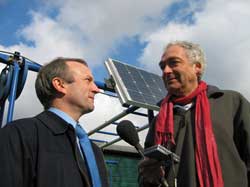
And that's me Dan Damon (looking very ageing hippy) with the solar panel installer
The Trikhas have three freshly cooked meals every day, produced on a double gas ring running on bottled gas. The Prices have a freezer full of pre-packed food and ready-meals. As well as the microwave, they have an electric oven plus a four-ring gas hob, a food-processor, toaster and breadmaker. We asked them to cook only on gas.
The Trikhas cook only fresh food from the local market. It is sourced from no further away than forty kilometres from their home. The Prices are used to Guatemalan peppers, Kenyan beans, Peruvian papaya, strawberries in winter and all the other energy-costly imports. We asked the Prices to try to live on local produce.
The Trikhas have one television with a twenty-inch (fifty-one centimetres) screen, watched almost exclusively by the girls. The Prices have three televisions, one of which is a widescreen. We gave them a twelve-inch portable to recharge on the solar panel.
After a few days of the new regime, Paul Price had exchanged his T-shirt for a thick pullover over his rugby shirt; Sally was wearing hats indoors, and their twin teenage daughters were sniffling over having to get up in the cold to prepare for school. I felt most sorry for Bertie the dog: no one could properly explain why the hallway radiator that had always warmed his back was suddenly a cold lump of steel.
To their credit, the Price family never gave up. Paul even decided he was going to cycle to work at five in the morning, which made him a low-energy hero as far as Im concerned I went with him one day and I know how it hurts.
What did all this experiment prove? First, it did what we hoped, to remind listeners of how comfortable, even profligate, people living in affluent western countries have become in relying on cheap energy. Second, we found out that reducing the amount of energy can be fun (and even a source of modest profit). In making the Radio 4 programme we met Donaghadh McCarthy, who has installed solar panels on the roof of his small terraced house in south London and for some of the year sells his electricity back to the grid. He has planning permission for a windmill on the gable end but cant find a system quiet enough not to annoy the neighbours.
Third, and above all, we showed that as India gets more prosperous (and its GDP growth is currently 7% a year) families like the Trikhas wont be happy with soothing fluorescent tubes and the whole family sharing a bedroom on summer nights so they can all get a blast from the air conditioner. They and equivalent families among Chinas burgeoning middle class will want to live like families in Britain. Soon, those who live in the rich west will discover the real cost of running the freezer and microwave, the dishwasher, the breadmaker, the widescreen television, and the fifteen spotlights in the living room.
This article appears as part of openDemocracys online debate on the politics of climate change. The debate was developed in partnership with the British Council as part of their ZeroCarbonCity initiative a two year global campaign to raise awareness and stimulate debate around the challenges of climate change.

