
Lebohang Pheko is senior policy officer for the Gender and Trade Network in Africa (Genta), a member of the Dignity Forum of Africa and was on the organising committee for the 2007 World Social Forum (WSF), held in Nairobi on 20-25 January 2007. I caught up with the South African activist at the WSF in between several events in which she was involved - feminist dialogues, the platform for dignity, a workshop with market women and campaigns against the European Union's economic partnership agreements with Africa (EPAs).
Patricia Daniel is a senior lecturer in social development at the University of Wolverhampton, England. She is involved in a collaborative study on gender, peace and stability in Mali. Her website is here.
Patricia Daniel blogged the World Social Forum in Nairobi for openDemocracy see "Women at the World Social Forum".
Also by Patricia Daniel in openDemocracy:
" Mali: everyones favourite destination" (11 May 2006)
" Africa: ask the women" (3 August 2006)
Women, violence and empowerment: the world we live in
(23 February 2007)
The EPAs are still under discussion and will be finalised by the end of 2007, to come into force by October 2008. The European Union vision has been to promote deindustrialisation and a return to primary agricultural production in Africa, to redraw the map across existing regional economic alliances in Africa and to include future funding for peace initiatives within this economic framework. (The EU is developing agreements with Caribbean and Pacific countries as well as African ones; collectively, they are termed the ACP countries.)
"What I'm trying to do", Pheko says, "is popularise the message against trade agreements and how they impact on women; the perniciousness of globalisation and how it pushes the already dispossessed even further to the periphery."
Pheko's paper argues that: "It is crucial to be mindful of the geopolitical agenda propelling the Economic Partnership Agreements. The agreement is being punted at a time when European markets are shrinking, production costs are making it difficult for companies to make a significant profit from northern consumers and three successive World Trade Organisation (WTO) ministerial meetings have gone badly for corporate interests. [These gatherings of the WTO were held in Doha [Qatar], in 2001, Cancún [Mexico] in 2003 and Hong Kong in 2005.] The African, Caribbean and the Pacific (ACP) offer the opportunity for the European Union to find an unfettered market.
Many observers thus argue that the intentions are related more to pro-north, market-driven interests than pro-south, development ones. This assertion is evidenced by the intensity of protectionism the EU is permitted while habitually dumping surplus produce on overseas markets. Though 90% of ACP countries' tariffs must be removed to access EU markets, there is no mention of dismantling the Common Agricultural Policy or of stemming the anti-competitive practices arising from dumping."
The gender dimension
Pheko also quotes a study published by the African Women Leaders in Agriculture and the Environment (Awlae) on the devaluation of the CFA franc in Mali. The findings show that "women are participating in greater numbers in agricultural production as the number of households threatened by food insecurity increases".
"Women invest more labour into crop cultivation as an income-generating venture", writes Pheko. "This results in decreased child-care at domestic level. In addition, AWLAE's research also exposed the irony that women's status improved due to their ‘indispensable' financial contributions to the household. In contrast men tended to abandon their social, community and household responsibilities as financial pressures mounted, as an inverse coping strategy."
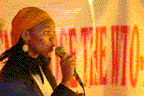
Lebohang Pheko speaks on human rights during the sixth WTO ministerial conference in Hong Kong, 2005
Such arguments were voiced at the Nairobi WSF, and in an environment where the new rules of engagement had clearly been influenced by the feminist movement. As I heard at one of the WSF dialogues between women for peace: "We, who are the custodians of life, are already living another world. We need to deliver that vision to everyone; we want to see a completely different mindset."
At the gathering, Genta ran a "marketplace" event, where women producers were able to talk about the links between food and trade, how fluctuating prices on the world market have an adverse effect on the prices they can get for their produce in the local market, what they can afford to buy - and how this impacts on their livelihoods.
The Gender and Trade Network in Africa (Genta) is one of the African civil-society partners of One World Action, and a member of the International Gender and Trade Network (IGTN).
The ACP-EU joint parliamentary assembly meets in Brussels on 20-21 March 2007. The African Union and the European Union have set up an online consultation website.
Among Lebohang Phekos articles are:
Friend or foe: the EPAs unmasked
Gender review of the Economic Partnership Agreements
A feminist critique of President Mbeki
A different philosophy
On 14 February 2007, Pheko and other African feminists sent an open letter to South Africa's president, Thabo Mbeki, criticising state-of-the-nation address on 9 February which ignored the question of gender issues in economic development (women received just one mention in the speech). Pheko elaborates by invoking the idea of ubuntu (a Bantu word connoting the idea of "being a person through other people") to argue that: "Poverty eradication requires a radical and consistent realignment and redistribution of resources - and a complete shift in thinking."
In this context, the failings of national governments and international organisations are connected, for Pheko also notes that WTO rules reduce the role of the state: "multilateralism has created a supra-state which is accountable to no one." There is then a real need for new strategies to encourage a politics of democratic governance, as discussed at the One World Action seminar in London on 1-2 March 2007; there, activists from the global south discussed how policymakers might be led to focus their efforts on supporting and strengthening genuine participatory democracy, with women at the centre - instead of giving money directly to governments who have shown themselves incapable of addressing the needs of the poor.
On 12-13 March, the informal meeting of European Union development ministers and the ACP-EU dialogue take place in Bonn, chaired by Germany's development minister Heidemarie Wieczorek-Zeul. Lebohang Pheko's message to those taking part is clear: "The era of EPAs speaks of a brutal new chapter, announcing muffled voices, stolen lives, stillborn futures and nationhood laid down at the altar of free trade. It must be resisted by a south which has the right to assert and decide on the best models of development for itself."

