
Buy now: US, UK, Worldwide
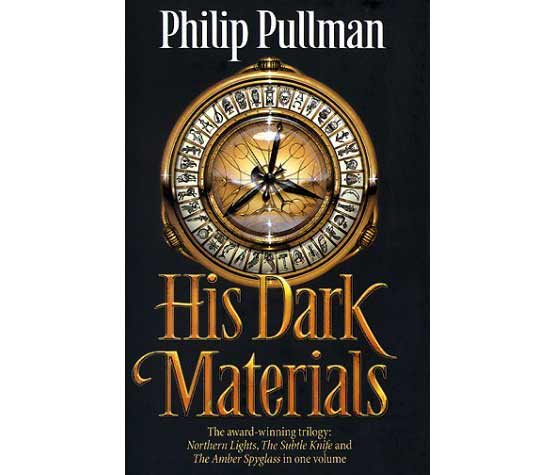
His Dark Materials
by Philip Pullman
Scholastic Press | November 2001 | ISBN 0439994349
Recommended by Grace Davies:
Much has been written about Philip Pullmans trilogy His Dark Materials, so it was with some trepidation that I decided to add my own thoughts on a modern childrens classic. Since their publication, the books have been successfully adapted into a two-part stage play, and are soon to be doing battle at the box-office with those other heavyweights of childrens writing, The Chronicles of Narnia and Harry Potter. However, having been captivated by the adventures of Will Parry and Lyra Belacqua, in a way that I had not reading both CS Lewis & JK Rowling, I decided to give it a try.
Reading Pullmans trilogy has become something of a guilty pleasure for me. After my first reading, I started distributing the books widely, posting them to friends with evangelical delight. Such was the success of this miniature lending library, that at one point in my university lodgings, the three volumes were being circulated on a rota basis a welcome distraction from academic studies. I have since returned to all three books on numerous occasions, and have found them remarkably resilient to multiple readings.
The story focuses on the adventures of Will and Lyra, innocents in a universe of armoured bears, witches, spectres, good and bad angels, and suspect emissaries of the church. They travel to the world of the dead, learn to identify their daemons (an outward incarnation of the soul) and even encounter God as a weak, and senile old man. Miltons Paradise Lost is a strong point of reference, and this is evident in Pullmans reworking of the Christian Fall of Man and the concept of original sin.
Of course, much childrens writing inevitably carries an intrinsic narrative of good vs evil, but it is the overt references to the Church that have led to accusations of blasphemy, and His Dark Materials occupying a literary space in direct opposition to Lewiss strongly Christian series The Chronicles of Narnia. Indeed, Pullman himself has not shied away from criticising Lewiss work, branding it ...a peevish blend of racist, misogynistic and reactionary prejudice.
For myself however, and for my recommendation, such arguments are a detraction from the enjoyment of these books simply as a greatly imaginative and well told story. I have witnessed His Dark Materials act as a catalyst for people to start reading who have not picked up a book in years, and for this, if nothing else, they are to be valued. For as Philip Pullman himself argues: stories are the most important thing in the world. Without stories, we wouldnt be human beings at all.
* * *
About the author:
(from the Publisher's website)
Philip Pullman first published novel was for adults, but he began writing for children when he was a teacher. Some of his novels were based on plays he wrote for his school pupils, such as The Ruby In The Smoke.
Philip still lives in Oxford, and he writes in a shed at the bottom of his garden. The shed contains two comfortable chairs (one for writing in, one for sitting at the computer in), several hundred books, a six-foot-long stuffed rat which took a part in his play Sherlock Holmes and the Limehouse Horror, a guitar, a saxophone, as well as the computer, decorated with dozens of brightly coloured artificial flowers attached to it by Blu-Tack.
Philip Pullman believes firmly in the virtues of healthy exercise and a moderate diet for other people. It makes them feel virtuous, and makes them feel good if not happy. The most exercise he normally takes is unscrewing the top of the whisky bottle. If he liked the taste of tobacco, he would smoke vigorously. He is fond of sport, and plays it by watching television. He is a big fan of Neighbours, but that is the only soap he watches, as Neighbours gives him quite enough to think about.
As far as he can tell, Philip Pullman is moderately harmless and useful. He would like to carry on doing what he's doing now, and there seems no reason why he shouldn't, but if it suddenly became against the law to write stories, he would break the law without a second's hesitation.

