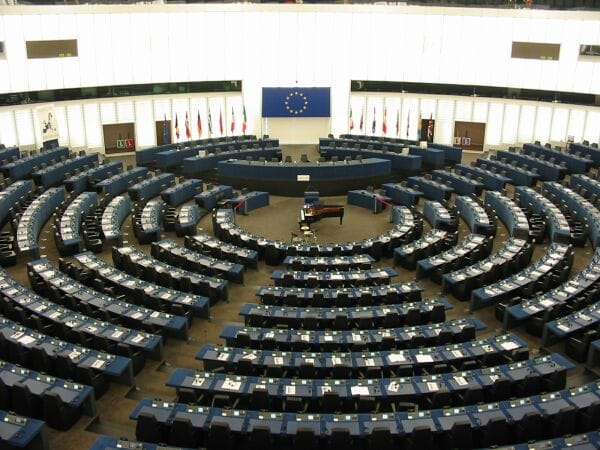
In an attempt to give strength to a peace process which appears stalled, the European Parliament approved on Wednesday a resolution in support of the Spanish peace talks. After a vote on a People's Party led resolution arguing that ETA had not met pre-conditions for peace talks was rejected, the European Parliament backed the resolution put forward by the socialists, liberals, greens and the leftist GUE/NGL. This motion defended "the fight against terrorism and the peace initiative in the Basque Country undertaken by the Spanish democratic institutions", and was adopted by a small majority of 321 votes in favour, 311 against with 24 abstentions. This narrow support comes after recent reports point to ETA as responsible for the theft of 350 firearms from a warehouse in France earlier this week.
ETA splits the European Parliament by Ivan Briscoe
Searching for an international seal of approval to a peace process that he has made his own, Spanish Prime Minister José Luis RodrÃguez Zapatero instead found on Wednesday that just 10 votes separated him from the calamitous warnings of the right. The European Parliament narrowly backed his plan for peace talks with ETA, doubtless mindful of the 350 guns stolen the day before from a warehouse in France by alleged Basque interlopers.
In Spain, the ETA cause - if cause there is - has long the boiled the tempers of the vast majority of Spaniards. Purposeless violence and the brutal targeting of elected officials draw on a philosophy that is at heart nihilist and hate-driven. One book-length apology for ETA that I read in the French Basque city of Bayonne (and said to have been banned in Spain by those who purveyed it), declared that violent action was not different from the operations of prisons, schools or employees. "Society is violence," it said. This is now the problem in bringing peace. Those first generations of fighters, who pioneered in the 1960s armed fight against Franco at the time where all other Spaniards waited submissively for the dictator's death, gave way, over the years, to a young, reckless and thoughtless band of vandals, overseen by mafia-style bosses who have perfected the art of blackmailing business (the "revolutionary tax" it is called). Before the summer, the Spanish Congress gave its approval to the start of peace talks. Prime Minister Zapatero made clear at the time that these negotiations, at least at the beginning, would take place outside the public view. If indeed the talks have started, then it seems highly probable that the sporadic judicial offensive on leaders of Batasuna (ETA's banned political wing), outbreaks of street violence, warnings from hooded men of a return to arms, prisoners' hunger strikes and robberies of arms stashes are all gambits in a diplomatic tussle that is ongoing, or about to resume. But the impression given to the world outside the negotiating hotline, and particularly to the European Parliament, is one of an illegitimate and discredited faction playing its very last cards - a criminal rump that deserves a final police assault rather than soothing words from Madrid. Total "surrender" by ETA is certainly what Spain's Popular Party would prefer. The conservative party's worldview, which grows each day closer to a bitter Francoist paranoia, refuses to believe that the Basque radicals had no part in the March 11 bomb attacks, in which 191 people were killed. Slight gaps in what is otherwise an imposing wall of evidence against Islamists are used to introduce the possibility that homegrown terrorists were involved. It is nonsense, but for small minds fed daily by right-wing media an apocalyptic diet of Catalan secession, gay power, Chávez on a roll and Africans clogging up the Canaries, it does make a kind of reassuring sense. The European vote now translates this very domestic opposition onto a wider front. It also lends Spain's internal feud over ETA a legitimacy which it perhaps should never have, for the truth is that the Popular Party (PP) itself tentatively discussed peace terms with ETA for 14 months from 1998 to 1999, while it is obvious that terrorists who have not killed since May 2003 are ready and willing to return within the bounds of normal democratic society. None of that means the negotiated path to peace will be tidy. ETA is criminal and cruel. Its political programme is supported by a minority of Basques, and no one in Zapatero's government has explained how its calls for an independent state will be accommodated in any future roundtable. But there are ways to start. Prisoners can be brought back to the Basque Country. Batasuna can be made legal. And maybe, but by bit, the rightful vitriol of ETA´s victims, so carefully manipulated by the Popular Party, can be assuaged by the prospect of a lasting peace. At each and every stage, however, the demands for total ETA surrender will multiply. The impression is given that certain conservatives would like to see the Basque Country cleansed rather than pacified. It is not certain that the European Parliament, split into two through the persuasion of the PP and the errors of the Socialists, has helped bring light to a process now mired in Spain's battle for power.
Ivan Briscoe is senior researcher at FRIDE. Previously, he was editor of the English edition of El PaÃs newspaper in Madrid and also worked for the Buenos Aires Herald, the UNESCO Courier and in the field of development research.