
The boy became fascinated by water when he learned its age, that it had passed through the bodies of dinosaurs and Christ. The same water that flowed between the banks of the Nile, he pondered, had seeped through the body of Shaka Zulu, and quenched the thirst of Hitler. He was fascinated by ice and thought it the most beautiful thing. By far the most beautiful form of ice was hail, in his opinion. Hail was ice moulded by nature at its wildest. Unthinkable forces converged first to make and then to shape hail: temperature, friction of air and wind, vicissitudes of impact and melt. Water never died. It turned into steam, into gas, into ice or hail, but came back the same, as everlasting water.
He was terrified of shadows on his bedroom wall. He was told about Hitler, dead in the ruins of Berlin, but knew Hitler lived on in forgotten dust in forgotten corners, or the space between the two surfaces of a wall. He grew older, read about Hitler, commanded facts. No shadow hung in his cupboard. He had facts. He was free.
In his room, his bed lay along a wall with a window that looked out across a small strip of neglected garden to the street. On one wall were pictures of hurricanes, hailstorms, tidal waves, wind-swept forests and chain lightning. Grouped near the door were pictures hed torn from magazines and books. These showed the burning of the Reichstag, Adolph Hitler as a boy, Adolph with his mother, Klara, the Eagles Lair, and also Joseph Goebbels saluting.
Above this historical rogues gallery, fixed by tape, blue tack and pins, was a display showing the rise of the Alfa Romeo sports car, its racing history and its recent incarnation in the form of the desirable Guiletta Veloce and even more desirable open-topped Spyder.
Directly opposite the boys bed on the far wall was his favourite, an extended poster he loved to gaze at as he drifted towards sleep, before turning off his bedside lamp. On the horizon a series of pinpoint-accurate storms emanated from purple thunderheads. As sleep came to him the clouds became lifted skirts and he saw women furious and serene urinating threads of silk into the sea.
His name was Matthew Vincent. His house was in a suburb of Eastern Johannesburg under which the central artery of the citys storm-water drain ran to the outlet.
* * *
You must, must rest, said his mother. Look at you, untidy like that, why dont you brush your hair, do you think youre Sid Vicious?
He was on the stoep or front veranda of the house looking out over the back gardens peach trees and vines, the two towering firs, the beds of agapanthus and cannas, and the lawns, whose kikuya grass tunnelled and came up angrily where it had no right to be.
Brush your own hair, he said, leave mine alone.
He looked at the sky for signs of the late afternoon storms common at that time of the year.
Dont speak to me like that. I spent the whole of yesterday afternoon at the hairdressers. Youre such a nice boy, but you always fight me, why will you fight me, you must rest.
He had to give in and they went to rest as usual on her bed. As usual she asked him to do the thing, and she lay there crooning with satisfaction as he caressed her feet and ankles with his fingertips, and then went up her legs to the hem of her rucked-up petticoat, then her shoulders and back following the outline of her bra and finally, with a knitting needle, her face and her hands, paying special attention to the web sections between her fingers; and then he played the tip around the outside of her lips.
As usual, she wanted to do the same to him and tried to take the needle out of his hand.
Mom, Im ten.
Oh, dont be so silly, youre a lovely boy; you were when you were younger, you were much more cuddly.
Resistance was a matter of gradations. Like, he imagined, weaning a baby, perhaps. He threw the needle aside. It missed the battered leopard skin with its snarling head and blind eyes and clicked on the wooden floor before rolling just under his fathers bed.
In exchange for this rebellion, he allowed the cuddle, his mind both involved and wincingly withheld. He then tactically allowed the cuddle to progress to the easing of his body over hers, sideways on, and hated himself for the warm pleasure he experienced, particularly when she put her hand under his shirt and ran her fingertips up and down his spine. He smelt cold cream and prayed it wouldnt cling to him.
Without hearing anything Matthew understood the danger, as though a sound too high pitched to register had been fired through his skull at close range. He jumped upright onto the floor in a bounce. It was nothing really, only the faintest of creaks.
Now where are you going; youve gone, youre so perverse, come back.
There was a creak and after a moment another. Someone was coming down the passage.
Matthew ran to the carpeted passageway off which the various rooms of the house were set. Coming from the kitchen at the far end in slow and timorous forward movements was the most extraordinary sight. It was the houseboy George, whom Matthews father called Zuluboy and whose real name was only pronounceable hundreds of miles away, among huts in the cane fields of Natal. What was extraordinary was that, for an unknown reason, George had inserted into the loops of flesh that pended from his ears, the beaded roundels that were usually only worn on ceremonial occasions. His ears stood out away from his head. The light in the passage highlighted the tribal scars that decorated his cheeks. He wore his Boys pants bought by Matthews mother from OK Bazaars, hardwearing shorts that ended below his knees, and on his feet were the sandals he had made himself out of car tyres. He was trying to say something.
Carlo, he come, he said. Carlo, he come now-now.
Matthews friend, Carlos dos Santos, emerged from the kitchen at the far end of the passage, behind George.
Carlos said, One hell of a big storm coming, man, we must find where the drain comes out.
Matthew ignored his mothers call. In the kitchen, stiff and silent like petrified trespassers, were his other friends, Boris Meskin and Hector Pretorius.
* * *
Ask someone, come on, said Carlos. Well never find it unless we ask, ask that bloke. They were in Hunter Street. A man had walked out of a small house towards his car, a dirty white Volkswagen, on the other side of the street. He was short and squat and wore a safari suit and soft shoes.
You, said Hector Pretorius.
No you, said Carlos to Matthew. Hey, whyd you take so long to come out when the Boy called you? You were in your Mas bedroom.
Nothing man, shut up said Matthew, and walked boldly to the man who was about to climb into his car.
Matthew said, Where does the storm drain come out?
What you say?
Where does the storm drain come out?
The man saw the boys direct gaze. He looked closer with a practiced assessment. Big blue eyes like a girl, he saw, small ears like a cat, bare feet like a picannie. He thought: Here stands the son of a communist rooinek that cannot speak a word of Afrikaans, and he felt an impulse to break the boy.
The boy said, We want to find where the storm drain comes out.
The man barked in Afrikaans: There is no bloody storm drain!
There is, the boy said in Afrikaans, it runs under here.
Dont come around here, the man said in English, Talking about drains. You deaf? He filled his chest and bellowed: There isnt any drain. Bugger off.
Matthew walked back to the others who were edging back. They turned to hurry away.
But behind them, the man called in a more amenable voice, Hey you, long tall sally.
Carlos dos Santos walked faster and said, Lets run. Then, oddly, turned to face the man.
Not you, bobbejaan, the skinnymalinger, the man called.
Without turning, Hector Pretorius said, Hes a cop, Special Branch, like the one that came for my Dad.
When Matthew turned, the man fixed him with a look. The Volkswagen door was open and the man rested one hand on the top of it. He shouted, You go in there in the bloody drain it rains you get washed down, water goes out a long way, ends in the Limpopo you get eaten by a croc.
He hopped into the car and slammed the door but did not start the engine. He seemed to be laughing.
They looked up at the sky as one. The storm clouds had passed away.
* * *
The next day hail came late in the afternoon. The noise on the tin roof of his house was deafening and Matthew could not hear a word his mother yelled at him. He yelled horrible things at her. The storm abruptly ceased and he ran out to see it moving off to the north, the clouds, the veils of rain, the lightning. He ran to where he could hear the drain, and followed the underground echoes.
Heavy hail lay everywhere. The storm was unusually late in the afternoon and the sky was reddening. Fallen hail reflected the sky. Standing at the corner of Steyn and Regent Streets, Matthew looked out over the local golf course, which was white as though with snow. He picked up a cake of ice and then another in his other hand. It was like holding two books. He watched the light from the sunset glint in the ice. It reminded him of fire. He threw aside the burning books and again tried to pick up the trail of sound under the pavement.
The man in the red car saw the boy and slowed. The wipers, he realised, were no longer necessary, squeaking on the windscreen, and he killed them. Storm-junk splattered off the tyres and rattled inside the fenders. The kid was barefoot! No, he wore tennis shoes. And white shirt and shorts. Odd, walking like that with his head down. Hed pass him with the clutch in, no car sounds, only a hissing sound.
He parked around the next corner and got out.
Lost something?
The boy stopped.
Lost something? The man eyed him comically. This is you. The man crouch-walked allowing his suit jacket to ride up so his bum waved in the air. What you looking for? Lost a marble?
Where does the drain come out? The drain with the storm water.
Its not storm water, its your mothers piss. It comes out a hole. He paused, gazing ironically at the boy. When everyone in Johannesburg pulls the chain at the same time the big drain under here floods. Got it?
Its storm water, not sewerage.
I like you, said the man. Youre a man I can do business with. It comes out bottom of the golf course where the veldt begins. Come I take you, I got a Alfa Spyder, but the roofs up cause of the rain.
Matthew sensed inside the Alfa the same blue aftershave his father used. Hed expected a tang of leather, even wildly imagined the zest of high-octane racing fuel. The man revved the wasp-like engine. Later he made as if to jump a red light, but changed gear theatrically and braked. Im driving like a queer, he said. Matthew felt the mans hand touch his thigh.
The light was going fast; redness had left the sky. Matthew saw a shadow crossing the road, like the shadow of Hitler. It was his mother, flat as a shadow. He left the passenger door wagging, ran, shouting the shadows name.
A woman turned in amazement and she heard the wild cry of the boy: she saw an under-dressed child standing, almost dancing, there, with hair on end. Whats the matter, what is the matter? she cried. Matthew, recognised the face as not his mothers face. Its concern stunned him and he wanted to call out in horror, Whats the matter? What is the matter? He stared about wildly as though something lived on the outskirts of his vision, but was moving closer. Half paralysed, he painfully turned to look back.
The lights had changed. The Alfa was gone.
* * *
The following day the sky was clear and Matthew went to the end of the golf course where the veldt began.
The tunnel was there, its entrance rimmed at the top with hanging grass. Inside it smelt of dead rain and was blocky and square, big as a living room, and endless, and endlessly quiet, but with the hint of voices a long way away. Even the tiny rivulet in the floor flowed silently but carried the ghost of something that could have at one time been heard. It smelt of mud leached of nutriment.
The afternoon was even hotter than usual and the sky clear. A mile and a half from the drain, Matthews mother was on the stoep and noted the clarity of the sky. She missed Matthew and wanted him there. She was angry that he had again gone out without telling her. Would he come home late? Yesterdays hail had ruined the peaches. They lay in wild plenitude under the trees and rotted. She noticed a single cloud. These late summer storms blew up out of nothing, absolutely nothing.
How intricate the drain was. There were huge downward stairs that were so slippery they had to be negotiated on all fours. There were tributary tunnels big enough to walk in and others that nothing bigger than a dog could have climbed through. And alcoves for storm water to back up before the main artery turned. But no light when the torch was off.
Now there were clear sounds ahead like an aviary or elves playing flutes or, Matthew thought with horror, ground-up voices, or stretched voices blown down a blowpipe. The sounds came from beyond an upward flight of stairs, before a place of weak ambient light.
This was an underground hall. Its magnificence undermined his caution. Faint light came from a small pipe set in the ceiling, accessible by way of metal rungs. He heard wind blowing across the mouth of the pipe outside and thought he heard voices carried on that wind.
The voices might have come from further up the drain. The voices, like a tattered rabble, did come from further up the drain. He shone his torch into an offshoot tunnel, but it was another alcove. The approaching sound was like rain. He stepped into the alcove. A man in tatters passed. Matthew pressed his body against the most obscure wall of the alcove.
It wasnt Hitler, he felt. It wasnt a mistake of the senses. It was an old black man. It was real. He wasnt a baby, afraid of ghosts and shadows. All the tunnels then became alive with a chorus of runnels, trickles, rivulets, drips, small fountains, baby waterfalls, hectic splashes, muted sprays. The air carried a tang of lime.
In the main tunnel water covered his ankles. Soon a wall of water would arrive. His only hindrance would be the huge flights of stairs, otherwise he could reach the exit in three minutes.
The water was deep and fast. In the hall it moved in a persuasive circular manner. He resisted and climbed the metal rungs and crawled into the high, narrow pipe, like a chimney sweep. Mud, rain and hail came down the pipe and, to avoid drowning, he had to lie on his back and work his way upwards in minute forward movements. He held his breath as water and congealed hail covered his face entirely, but then he found he could lift his head a little. His forehead was bloodily scuffed on the ceiling of the pipe. He shouted Mommy and got a mouthful of hail.
Before he emerged, voices occurred, as though from inside his brain.
So what we go on the fairway we smack a few balls?
Theres lying water, man, and look at the bloody hail again. I tell you, its a bugger: guy wants to play a bit of golf no way with these storms.
Within six feet of where they stood at a bench near the clubhouse with its roof of hail a filthy head was born in a caul of blood, hail and soil.
* * *
The boy was in trouble.
He wasnt.
His mothers face was alight. The police have been, she said, theyve taken George. Youre drenched! They had a tip-off. He was brewing beer and then they saw he didnt have the right stamps in his Passbook. You idiot, getting caught in the storm.
What will they do with George? Matthew said that evening.
How the hell you got that scuff on your head Ill never know, unless in a fight, his father said and forked mashed potatoes into his mouth.
What will they do with him?
Theyll put him in jail for the night, kick his arse, send him back to his Bantu Homeland free of charge, hell see his Mom and Dad and hell come back to Joburg looking for work, itll all happen again.
Why cant he just live here, like us?
Look, man, his father said, pained, read the Group Areas Act, section 10. Tell you what, I pay your swimming lessons, swim out to Robben Island ask the guys there, the commies, what the solution is. But Ill tell you something for nothing. Mr. Mandela wont have a solution. He stared piercingly at Matthew. He wont have a solution because there is no solution. There is no solution.
Matthews father ate silently.
Matthew was crying. His father said, Look, theres nothing you can do, forget it.
He wasnt convinced hed got through to the kid, guy carried the weight of the world on his shoulders sometimes, you could see it. He said, Life is beautiful. That didnt work either, so he said, gently, Boy, forget it. Dont try to live other peoples lives for them.
* * *
That night Matthew fell abruptly into an exhausted sleep and woke up just as abruptly. The room was full of light. It frightened him. Something was terribly wrong. He got up. Outside, the moon had cast a bony light on the world. A man was watching the house. Or was he? He was standing against the hedge with his hands clasped in front of him and his head down. At first, Matthew thought it was the man with the Alfa. It wasnt. Perhaps the man was urinating into the hedge.
With the most severe alarm Matthew had ever experienced he recognised the mans posture a mourner at a grave.
Perhaps he was the son of the old black man who had run down the storm drain, Matthew thought. He touched the wound on his forehead and for a moment wondered if he himself was dead, and mourned by the man at the hedge. Hitler, he now knew, lived; Hitler was in the drains where people ran forever from a wall of water that was Hitler.
He did not wake up after going back to sleep.
Next day he remembered what his father had said. It was easy to remember that. His head became clear.
He forgot about the drain. He forgot about Hitler and took down the pictures of rain, storms and Alfa Romeos. He no longer handed in work on the geography of a region that dealt exclusively with rainfall. He didnt any longer drag references to Hitler into the history of the Great Trek. His marks shot up.
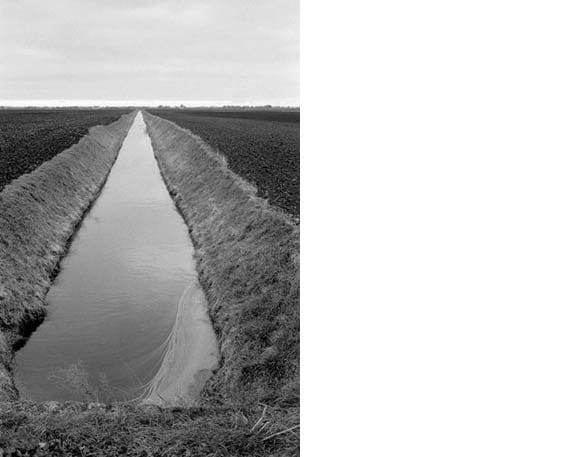
Drain flow, Peter Goldfield

