
Zhang Zhaoan, his wife and younger brother are in the lobby of a Tianjin hospital. He sits in his wheelchair, a sign behind him proclaiming that Health is a persons greatest wealth. The saying itself and the robust golden characters in which it is written are somewhat lacking in sensitivity for a place which by its very nature contains people who are devoid of this particular wealth.
The hypocrisy of the statement runs deeper still when considered in relation to Zhang Zhaoan himself since a traffic accident in 2002 left him paralysed from the chest down. Since his money ran out in the course of 2005, he is being refused medical treatment by this very hospital, leaving his health in a critical condition. Zhangs experience has been a clear lesson in the strong links between wealth and power in the Peoples Republic of China, and has left him pitifully poor not just in his health and finances but also with regard to the faith he holds in his countrys ability to provide justice and care for those to whom it should be granted.
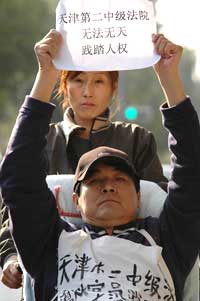
Zhang Zhao'an, partially paralyzed due to a traffic accident in Tianjin city in March 2002, protests along the embassy district in Beijing, China, Tuesday 18 Oct 2005. (Photo Credit: Danfung Dennis)
Before Zhang could come to terms with the accident and the implications it would have on his life, he discovered that he had become the victim of Tianjins widespread web of corruption, involving the traffic bureau, the public-security bureau and the law courts, which had collaborated to protect the party responsibility for his accident. With all these powerful forces working against him, an impartial investigation and verdict, related compensation and adequate medical care have all been unobtainable for Zhang and his family. As a consequence, not only have they spent almost four years waging a fruitless battle for justice, but with no more money and no more medicine for Zhang, they have been forced into more extreme measures, such as travelling the 120 kilometres to Beijings embassy district to hold protests.
Despite potentially severe penal consequences, an increasing number of Chinese citizens are starting to take such actions as they begin to realise that Chinas legal system is a farce and rarely delivers to the poor and unconnected. Despite often having good cases and enough evidence to prove that miscarriages of justice have occurred, the high level of corruption means that these people are often left banging their head against the brick wall of the legal system until, in their desperation and with no other outlet, they finally decide to take their grievances to the streets.
The accident
Zhang Zhaoan, 48, was born in Hebei province and has lived most of his life in Tianjin. Around the time of the accident, he was a worker for a government subsidiary company producing electric wire and had just married his second wife, Miao Suying. They had no children but they were financially secure and happy.
On 21 March 2002, Zhang was made to work overtime, until after 10.30pm. Riding his motorcycle home, he had a slight brush with Yang, a man who was on a lightweight motorcycle. Neither was affected and they both went normally on their way. A few moments later, a third man, Wang, driving a Volkswagen Santana, collided into Zhangs motorcycle from behind, causing Zhangs head to crash heavily onto the motorbikes luggage-box and his bike to fall down to the right, trapping his leg underneath.
Yang said that after his lightweight motorcycle had brushed with Zhangs, he had been forced to brake very quickly to avoid being hit by the Santana, and in so doing, he and the bike had both fallen to the ground. He had got straight up, picked up his bike and gone over to help Zhang. After the traffic police had been called, he had left the scene of the accident because he was still on work duty and was anxious as his work unit was strict. Also, as far as he was concerned, the accident did not really involve him. He left his vehicle behind so as not to affect the investigation.
The traffic police arrived on the scene. They called Zhangs family and an ambulance to take him to the hospital. One of the policemen said to Zhang: The driver of the Santana is definitely the responsible party. He wont get away. I will go and get the money for you. The officer then left, and returned a little while later with a sum of 5,000 renminbi (RMB), which was used to pay the initial medical costs.
Zhang arrived at the hospital, where he received lifesaving treatment. He was told that during the accident he had received serious neck injuries and was paralysed from the chest down.
The transport department said they would carry out a thorough investigation and issue an accident responsibility verdict certificate within twenty days.
The verdict
A standard investigation and verdict would have stated that Wangs vehicle had crashed into Zhangs motorbike from behind, making Wang the legally and financially responsible party. Wang was driving a vehicle for his work unit and either he or it should have been made to pay compensation of a couple of million RMB to Zhang, which would have provided the family adequate funds to live off and buy medicine with. However, Wangs work unit was a government subsidiary company and had close links with the public-security bureau. There were abnormalities from the beginning in the way that the accident was investigated and handled.
The day after the accident, lying in his hospital bed, Zhang was tricked into signing a statement completely different from the one he gave orally to the officer handling the investigation. Yang was taken into custody, where he was beaten into making a statement matching Wangs version of events, which he later refuted saying it was obtained through coercion and therefore unreliable.
When the responsibility verdict was announced at the beginning of April 2002, Yang was identified as the wholly responsible party. The traffic bureau said that Zhang and Yang had a head-on collision at the intersection and both their bikes had fallen to the ground; and that Zhang and his bike had skidded 6.9 metres into the middle of the road, where he had then been hit by Wangs Santana which happened to be passing at the time.
The verdict stated that Yang was responsible for the accident because he did not hold a driving license and his vehicle was overdue a routine inspection, factors which had apparently affected his driving and led to the accident. Because he had picked up his bike after the accident, he had disturbed the scene and made it impossible to determine responsibility. Leaving his vehicle and the scene of the accident also made him automatically responsible. Despite the fact that the traffic bureau admitted Wangs cars handbrake, steering system and headlights were found to be below the required standard and in violation of the traffic regulations, the verdict stated that these factors were not the cause of the accident and that therefore Wang not to be the responsible party. The verdict did not use any factual evidence to justify or explain the decision.
Yang and Zhang both raised separate appeals immediately and have been fighting for justice ever since, in each case with little success. Yang has been in and out of custody. The authorities do not have enough evidence to charge him, but stick to the version of events which blames him for the accident. As a result Zhang has not received any of the compensation settlement that he should have been entitled to.
The money
The 5,000 RMB that Wang provided was quickly used up. The family raised more money to pay for the hospital fees, but it was not enough. Miao and Zhang sold their house to provide more funds for the medical costs and Miao moved into a camp bed in Zhangs hospital ward. By October 2002, Zhangs health was stable but there was no more money. Zhang was going to have to discontinue his medicine.
He decided to pay a personal visit to the traffic-management bureau, to pressure them into taking responsibility. He was initially ignored, but he refused to leave and they finally agreed to provide his medical treatment. A policeman accompanied him back to the hospital and met with the hospital head to explain the arrangement. Zhang tried to make the traffic bureau sign an agreement to seal this, but it refused. Zhang remained at the hospital and sure enough was given medical treatment. However after a month, Zhang was told that the traffic-management bureau was no longer going to pay for his treatment.
Since then the government have only been providing the family with 100 RMB a week to live off, hardly enough to feed them, let alone enough to pay for Zhangs medical treatment, which costs 8,000 RMB per week. The arrangement with the traffic management bureau has never been clarified and for nearly three years, Zhang has been receiving absolutely no financial support apart from the meagre 100 RMB.
The courts corruption
Zhang made an appeal against the traffic management bureaus verdict and how it conducted its investigation. However, the extent of the corruption in dealing with Zhangs case revealed the law courts to be as corrupt as the traffic bureau.
Zhangs brother handed over a set of photographs to the traffic bureau. These photos showed quite clearly the damage incurred to both Zhang and Wangs vehicles, in complete accordance with their story. However when the case got to court, the bureau had provided an alternative set of photographs to use in their place. Photographs he provided which showed the bumper of the Santana to have obvious marks where it crashed into the back of the motorbike were rejected in court and a set of photographs that Zhang says were false and that must have been taken at a much later date were presented for inspection.
Damage to vehicles described by witnesses who saw the post-accident scene tally with Zhang and Yangs version of events. However, the courts say that such statements dont count as all come from Zhangs friends or relatives. Zhang denies this, and says that in any case there is nothing in the law that says that family and friends cannot bear testimony. He has challenged the court to show him where such a clause appears in the law, but did not get any response.
Zhangs brother showed pictures of the set of clothes that Zhang was wearing when he had the accident, devoid of any kind of marking or tears. This is quite hard to believe for someone who was meant to have skidded 6.9 metres along the ground, as the traffic-bureau claims, he says. Once more, his comment was ignored.
Zhang and family claim that only two of the four police who signed the investigation report were actually at the scene as they were reported to have been and the two who were present were unqualified to make such a report.
The medical reports from the emergency services and the hospital all say that Zhangs injuries were sustained by being crashed into by a car from behind and not from skidding and then being hit from behind.
However, it is unlikely that any evidence or facts that Zhang and his family provide in court are going to make any difference. The scenes in the courtroom are merely a case of going through the motions; anyone in any place of authority is tied into the web of people and power which is going to ensure that the verdict does not change under any circumstances.
The system
Because in Chinese law there is no separation of power, law courts lack the ability to make independent decisions and maintain impartiality. Critics suggest that Chinese law was actually established as a tool for the ruling elite to rule over the masses and maintain their social advantage rather than a way of ensuring justice. This is certainly the view that Miao, Zhangs wife, takes:
The law has been created for high officials, not for common people. If you have money and connections then the law belongs to you. If we had money, there is no way we would be in this situation. If Zhangs brother knew the mayor, all it would take is one phone call and this whole thing would be sorted out.
At the start, Zhang hired a lawyer to represent him, but the lawyer was too scared to present Zhangs evidence in court. Zhang sacked the lawyer and his brother started to represent him instead. His brother left his job and began to spend all his time studying the law, writing letters and appeals and making weekly trips to Beijing to petition and raise appeals on behalf of his brother.
Like most Chinese people, Zhangs brother says he was previously completely unaware of the great flaws in his countrys justice system:
I didnt have any idea that our country was run like this. Before this we were just normal people living normal lives, we werent to know. Only when something like this happens to you do you get to know the real situation. Then you just feel like you are just living in darkness.
The appeals
For more than three years, Zhang and his family have been sent back and forwards between different government departments in pursuit of their case. As their appeals have been raised higher and higher up the legal system with no result, they have started to realise just how widespread Tianjins corruption actually is. However, even at the central government level they have got little joy.
The Beijing central government tells Zhang that his case is a Tianjin-related issue and needs to be dealt with locally. Despite requests from Beijing law courts, the Beijing China Disabled Persons Federation and the Labour Bureau that the Tianjin government settles this case in accordance with the law, Tianjin continues to refuse to act and Zhangs case gets repeatedly pushed aside.
Zhang is currently awaiting a verdict from the Second Intermediate Peoples Court. However, he has already been waiting for seven months for this verdict, which should have been released after a month. The courts claim that they are under too much administrative pressure. There seems to be little that anyone outside of Tianjin can do to force them to take action. Even the central government appears to have lost control over the way the local government is behaving.
The lawyers opinion
The situation that Zhang is in is all too familiar to Zhiqiang, a lawyer from Sichuan province, southwest China, who lives and works in Beijing. He does not think that Zhang has much chance of success in the courtroom:
What he has here is a second level intermediate court verdict. Typically the second level courts will stick with the verdict delivered by the first level. Law isnt always the best way of solving disputes. If theyve been fighting this case for over three years now, then the likelihood of them getting the verdict changed now is very slim.
The kind of situation that Zhang and family are in is becoming more and more common in China where the move from a state to a market economy and the ensuing massive economic growth have lead to an increasing divide between rich and poor. The wealthy ruling class are in the position where it can use its power, money and connections to its own benefit, often at the expense of, or certainly with little regard for, the more vulnerable social groups. Ruoshi qunti (the weak or vulnerable masses) generally refers to the poor, rural, uneducated, disabled and ethnic-minority groups, who are all at a much greater risk of having their rights abused, partly because they often lack knowledge about how to protect themselves and where to turn when experiencing such difficulties.
Zhiqiang is not the typical Chinese lawyer. He only represents vulnerable groups, in particular migrant workers. His clients are generally in disputes with their employers relating to wages they are owed or work injuries that they have not been appropriately compensated for. Zhiqiang works for a Beijing-based NGO which provides free employment training and legal advice to migrants. He is not afraid to represent his migrant clients in court, regardless of whom he is fighting:
It does not concern me who I am against; what is important is obtaining justice. It doesnt matter to me whether I am dealing with a Chinese government work unit, a state owned enterprise or a private enterprise, they should all be made to abide by the relevant laws laid down in Chinas legal system.
While he is prepared to take on legal cases against powerful and intimidating opponents, Zhiqiang does not hold idealistic views. He is aware of his limitations and maintains a pragmatic attitude to work. Even when he considers a verdict to have come out seriously flawed and suspects foul play, he will not waste time and energy making appeals if he thinks the outcome is unchangeable. On occasions he has managed to settle issues satisfactorily outside of court, by appealing to his opponents conscience and settling with his client being awarded enough money to get by. Often even this is not possible and in dire circumstances he and his NGO will think of practical ways to help clients, through activities such as fundraising.
Zhiqiangs advice to Zhang and the family was for them to abandon their legal battle and their protests and put their energy and resources into mobilising funds for the future instead.
The implications
However, Zhangs family feel that they have no choice but to continue to fight the system in the way they have been doing up to now. Their situation is so dire that perhaps their fight is the only thing that keeps them going from day to day.
Zhang is no longer able to afford medical treatment at the hospital. The family managed to scrape together enough money to pay for the medicine which relieves the urinary and faecal incontinence he suffers from, but he cannot afford other drugs which he should be taking to alleviate his condition.
Zhang relies on physiotherapeutic massages to keep the blood circulating in his legs, his muscles exercised and to prevent thrombosis. Young male hospital workers used to perform this task, but since the familys money ran out, it has become Miaos responsibility to administer Zhangs physiotherapy sessions, three times every day. These exercises are vigorous and require a huge amount of strength and one session can take Miao up to three hours. Over time, her hands have become crooked, from all the massaging she says. The family do not have enough money to eat properly and very rarely feel full. Miaos health is deteriorating along with her husbands, from a combination of stress, malnutrition and physical exhaustion.
They are no longer able to pay for the bed space in the hospital, and while for the moment are still being allowed to remain there, they dont know how long this will last. Miao says:
We have sold our house. We dont have anywhere else to go to. They cant throw us out onto the street, but they have tried to intimidate us into leaving by putting people with infectious diseases in our ward. People with those kinds of illnesses should be kept in isolation, not with other patients. My husbands body is already so weak, just think about how easy it would be for him to catch an infection. This is a hospital and when you have money they treat you, but when your money runs out, they just leave you to die.
And waiting to die is exactly what Zhang would be doing if he wasnt so actively seeking justice. As a result of his condition, without certain drugs Zhang Zhaoans body is unable to carry out its natural temperature-regulating function. He has, however, had no choice but to discontinue taking those medicines. He sounds quite matter-of-fact as he says:
If I got a fever one day, I would probably die as my body has no way of bringing down its temperature. This hasnt happened yet, but it could happen at any time. So you could well say that my life is in serious danger.
The protests
Zhangs family have identified three other accident-victim patients on their floor of the Tianjin hospital alone whose investigations and justice procedures have been interfered with. These people have found themselves in similarly desperate situations.
They just sit in their wards every day, crying. They just cant see how they are going to survive, says Miao. They dont dare stand up to the government in the way that we do. We keep telling them to come with us to Beijing to protest, that if we join forces, we will have strength! But they are just too scared.
In China the kind of actions undertaken by Zhang and Miao are extreme, and risky. While an increasing number of Chinese are starting to petition the government with their grievances, and rural protests (particularly over land seizures) are increasing, individual protest campaigns are still fairly rare. But every week, the two of them take the train from Tianjin to Beijing and make their way from the railway station to Guanghua Road, where many of the foreign embassies are located.
Bearing cloth banners and signs, the couple walk defiantly down the road, Miao pushing the wheelchair and Zhang holding a sign above his head, on which is written the message Tianjin Intermediate Peoples Court tramples lawlessly on human rights. They head for the American embassy, as they understand the United States to be a country which values human rights and honours its citizens with dignity and respect a far cry from the treatment they have received in their own country.
Since April 2005 they have made more than twenty trips to Beijings Guanhua Road. They usually dont get very far before the paramilitary and police swarm around and cut them off. The officials detain them, and call public-security officers from Tianjin to take them away.
The future
The last time Zhang and Miao went to Beijing to protest, the procedure was a little different. Miao was handcuffed and thrown to the ground outside the embassy. A policeman said to her: If you come here to do this again, I will see to it that you are locked up for fifteen years. You wont be coming back after that!
The Tianjin public-security bureau waited a day before coming to collect Zhang and Miao, who were forced to stay in detention overnight. They were away from the hospital for more than twenty-four hours, longer than Zhang had ever had to endure being without his incontinence medicines and physiotherapy. In detention, Zhang became very ill and needed urgent medical attention. The public-security officers were unhelpful and unsympathetic, leaving Zhang a long time before eventually calling the emergency services.
Miao had been absolutely terrified for Zhang during the time in detention and remains very shaken by the experience. The implications of what people who treat a man in Zhang Zhaoans condition with so little mercy and consideration are capable of are just beginning to dawn on her. Zhang, for his own part, remains resolute in his quest for justice and speaks for the family:
Without money or background, you are just a common person and the only choice you have is to accept it and bear it. We are common people, but we dare to speak out. Unless they destroy our entire family, we will fight to the end, we are not scared. Even if they kill our family members off one by one, we will still continue to fight until the last one of us is dead. This is what it means to defend ones rights.

