
Buy now: UK, US, Worldwide
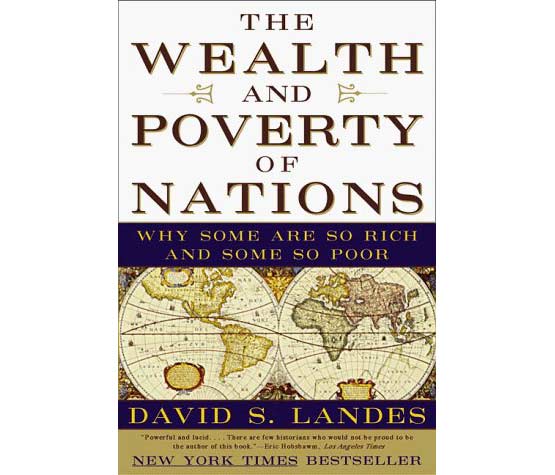
The wealth and poverty of nations: why some are so rich and some so poor
by David S Landes
Abacus | April 1998 | ISBN 0349111669
Recommended by Douglas Robinson:
A new year, and once again a whole set of new resolutions? One that always pushes its way up the list is to finish reading half-read books. I started reading The wealth and poverty of nations a few years ago as part of my Masters course and never quite got to the end. I picked it up recently because, well, of the aforementioned reason, and also I thought I should at least attempt to finish a book which has received such high critical acclaim.
Ive now forced a target upon myself of reading a chapter a night because I know I wont finish it otherwise and unfortunately this pretty much sums up my attitude to the book. Its a piece that Im ploughing through with fairly little enjoyment, but with glimmers of curiosity to keep me going.
The wealth and poverty of nations is littered with pithy one-liners which sum up, very neatly (a bit too neatly), the reason why Europe developed economically while the rest of the world stagnated. Very punchy and forceful stuff, but is it solidly backed up with strong historical evidence? In some cases yes, but surprisingly for such an eminent academic as David Landes, quite often not. Many of Landess statements ask more questions than they attempt to answer.
Various academics have levelled a whole host of criticisms at Landes, including eurocentricism (which Landes concedes), and why his essentially neo-classical argument of successful economic development is wrong (but thats a whole other book). What I dont admire about Landess book, can summed up in the following words by Donald Sutherland of the University of Maryland:
He has little or no patience with the foggy multiculturalism that sees the west as ubiquitously oppressive, exceptionally cruel, responsible for the enslavement of millions around the world, and the premature deaths from poverty and starvation of millions of others. Indeed, to cope with his question at all, Professor Landes must take on the multiculturalists and the book seldom misses a chance to show his scorn for those who make excuses for the rest of the world, for those who scapegoat the West for their own, or their rulers failures.
It is this aggressive style that Landes adopts which irks me intensely. I would hope that Landess methodology is solid enough that he would not have to resort to bullying tactics to put his point across. Unfortunately, I have seen little to suggest that he uses any other method to persuade the reader to his point of view.
* * *
What the publisher says: The wealth and poverty of nations is David S. Landess acclaimed, best-selling exploration of one of the most contentious and hotly debated questions of our time: why do some nations achieve economic success while others remain mired in poverty? The answer, as Landes definitively illustrates, is a complex interplay of cultural mores and historical circumstance. Rich with anecdotal evidence, piercing analysis, and a truly astonishing range of erudition, The wealth and poverty of nations is one of the most audaciously ambitious works of history in decades.

About the author: David S Landes is professor emeritus at Harvard University and author of Bankers and Pashas, The Unbound Prometheus, and Revolution in time.

