
The town of Kargopol, in Russia's neglected far north, was once an important trade centre between Novgorod and Byzantium. Famous for its mediaeval monastic tradition, and latterly its prison camps, Marina Birukova finds its past is very much in evidence.
Kargopol smells of freshly chopped wood. Logs already chopped, waiting to be sawn, soft piles of wood chips are stacked up alongside every fence. The town uses wood for heating. Gas comes only in canisters. There are a handful of two- or three-storey apartment buildings in the town. A lucky few got flats in these buildings back in the 1970s, with all the modern conveniences, that is to say, with cold water, plumbing and central heating. But the heaters were not much help in the northern climate. People called in workmen to install stoves with pipes in their apartments, often even two, one in the kitchen and another in the sitting room. And they stack wood neatly in the building entrances.
They might have taps, but they still carry buckets and go to the spring for water. They might have bathtubs, but they still take their linen out to the washhouse, a wooden shack by the stream, to wash. Linen washed in the stream becomes amazingly white and soft, much better than if washed in the bathtub.
That's the way life goes in Kargopol.
When the holiday season comes, most normal people try to head for warm waters in the south, but I head north. Last autumn, I saw a clay sculpture from Kargopol in the Vologda Museum. Clay toys these sculptures are, and one of the examples on display was called ‘netel', a word that city dwellers might not know, but that means a young cow expecting her first calf. This little sculpture was simply charming and it only made me more eager than ever to get up to Arkhangelsk Region and visit old Kargopol.
So, here I am in the Moscow-Severodvinsk train, fifteen hours heading north from Moscow. I read the list of stations we will stop at: Shozhma, Lepsha, Ivaksha, Lelma, Shalakusha, Puksa, Sheleksa. I have to get out at Nyandoma.
They say that back in the reign of Nicholas II, the rich merchants of Kargopol pooled their money and gave a big bribe to some official or other to make sure the railway was not built through their town. The staid and respectable northern folks' did not like the idea of a railway, with all it promised of noise and decadence. So today, to get to Kargopol you have to take the bus from Nyandoma, or hail one of the hungry local taxi drivers.
What struck me first about the Onega River was how amazingly blue it is. Kargopol is on the Onega, which flows from Lake Lache into the White Sea. Seagulls' mournful cries greet the little town every morning and welcome the approaching night every evening.
I got a good tan while in Kargopol, but only on my face - there was no taking off jacket or jersey. The northern sun is harsh, but the wind from the White Sea keeps a chill in the air.
It is the time of the white nights on the northern coast. As local writer Boris Shergin puts it, the sun settles on the water like a duck and dives down only after midnight. The white nights only really begin after midnight. Before that is just a very long evening.
In winter the people of Kargopol see the northern lights.
*
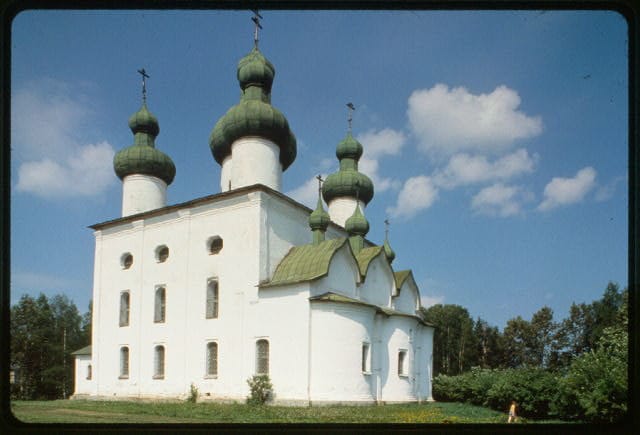
During the white night, I visit the Resurrection Church. I wander for a long time, fascinated by the 400-year-old building. On a nearby column a notice announces that some public council is calling on the townspeople to come out and help clean up the land around the church. The land around the church looks quite tidy, but the church itself is in a dilapidated state. Its wooden doors are bolted, but I manage to pull the bolt back and get a look inside at the sad picture of neglect.
There are a dozen churches in the town, and each is of interest in its way, but only two are now active. The Church of John the Baptist, probably the most beautiful of them all, is only now beginning to revive, and the Church of the Birth of the Holy Mother of God has been open for a long time now and is the only one that is properly maintained. A notice on the door forbids visitors from photographing the icons. The icons in the church building are not of the modern mass-produced kind. Each of them is at least 150 years old and most likely survived all this time hidden away in people's homes and sheds.
I find myself all a shiver and cannot figure out what is going on when I first enter the church. It's the choir that is different. The dozen-odd local grannies cannot read music and sing just as people sang in the White Sea villages in olden times. They sing the church songs in a folk manner, and along with the darkened and unfamiliar icons it all combines to produce an unforgettable impression.
"What a disgrace!" fumes my new Kargopol acquaintance, Sergei, head doctor at the local hospital. "Rather than listening to these grannies, you should listen to Svetilen, a choir made up of our local intelligentsia. They perform church music professionally".
But I like this singing just as much.
*
People in the north are amazingly simple, open and goodhearted. You immediately feel at home among them. They are also great patriots, and in their case it is not just an empty word.
I met Sergei in the middle of the town. He saw me taking photos of the Church of John the Baptist, came over and started telling me about the building. "If you have time, I'll give you a tour of the town", he offered. He spent three whole hours showing me the ruins of the old wooden fortress, what remains of the foundations of the now demolished Entry to Jerusalem Church, the ruins of the Holy Spirit Monastery and more. I was sure he must be a specialist in local history. Who else would remember so many names, figures and facts? But in the end it turned out he was a doctor and knows all about Kargopol simply because it is his hometown. I set out with Sergei and his mother Valentina Ivanovna next day to visit Maya Alexeyevna. "Maya, I've brought you a visitor", Valentina Ivanovna announced when we arrived, and turning to me asked "What's your name again?" Maya Alexeyevna, who lives in one of the high-rise apartments, showed not the slightest surprise and proposed first finishing watching a programme on TV and then eating a fish pie. This kind of pie has a whole fish inside, in this case a large bream, and it is supposed to take the form of the fish it contains. In the old days this fish pie was a wedding dish, but today people usually serve it to guests. "Maya, when did you find the time to bake a fish pie?" Valentina Ivanovna asks. "I only told you 20 minutes ago that we were coming".
"Today is Sunday", Maya Alexeyevna replied. "Someone was bound to drop by".
*
I go with Sergei to the Red Hill, on the territory of the Holy Assumption Convent that was demolished in 1925. It became the site of the Kargopol labour camp. A small blackened memorial bears the brief phrase ‘to the victims of repression'.
The convent's church was torn down but the rest remains. The convent superior's house still stands. It became the labour camp's office. Other small buildings housed the nuns' cells and the refectory before serving as offices for the labour camp bosses.
Today, these buildings are filled with unhappy, wretched, drunken people. An inebriated woman of around thirty weeps in the middle of the street, her sobs desperate and searing like the gulls' cries. "Don't cry, you'll find it", an old woman attempts to comfort her.
"Where will I find her, I've looked everywhere and she's nowhere to be found..." It turns out the woman has lost her dog.
Sergei points out a rusting roof with a crumbling brick chimney.
"Those were the old convent stables. Later they were turned into a prison for the people sentenced to death. I don't want to go there. You can still feel it - there's a bad aura there".
A few hours later, I go over to the old stables without Sergei. The building is abandoned and filled with junk. I enter. There is a corridor and wooden doors. Gradually it dawns on me that people lived here after the labour camp and prison were closed. You can tell by the strips of lining on the doors and all the bits and pieces of household life, like the rusty basin and the old frame of a child's bicycle.
All the doors have the same little square boards covering the spy holes. When the prison became a place where people made their homes, they covered the spy holes with these little boards. I can't help crossing myself. These little boards nailed to the doors are like a cross, a symbol of suffering.
Suddenly I hear a familiar sound from behind one of the doors - the scrape of a spoon on a frying pan, and music! I knock. A worn-looking fellow opens the door. "What do you want?" he asks.
"My home got burned down", he goes on to explain. "They gave me this place here after the fire. Yes, this used to be a prison". The little ‘flat' is in miserable shape, but there's a little TV set.
A little further down from the Kargopol labour camp is the spring of John the Hairy. Legend has it that John the Hairy was a hermit and the founder of the convent. The nuns used to come to this spring every morning and wash in the holy water.
I fish a few battered old beer bottles and some kind of plastic bag out of the spring and then fill my own bottle with water. The water tastes way better than any mineral water ever could. A local drunk lies snoring on the grass nearby.
As for the clay sculpted Kargopol toys, they are still made today. There is a special workshop in the town making them. They are brighter in colour these days, painted with a mixture of poster paints and PVA glue, and then sold as souvenirs. Old-style ladies, gentlemen, bears, hares... all bring in some money to this depressed region. But for the real White Sea toys made according to the old traditions, you need to go to the Shevelev family museum in a little log house on Semenkovskaya Street.
The Shevelevs are master toymakers from one generation to the next. The second generation revived the craft in the 1960s, and the third and fourth generations decided to turn their parents' home into a museum. Like all the Kargopol houses, theirs has a traditional Russian stove, and they also have old utensils, bowls and pitchers, a real samovar, and a corner where the icons hang. The owner, Vladimir Dmitriyevich Shevelev, is a professional artist, as are his two brothers. He tells me about his grandfather, grandmother, father and uncle, all of whom sat at the potter's wheel from childhood and made the traditional toys.
"At first it was just something to amuse the children, and later we began to sell them, sometimes out of hunger, when the potato crop was no good" (No one grows anything much except potatoes in these parts).
The genuine Kargopol clay toy is not painted. It is baked and then dipped in a flour mix so that it does not crack and dampen later. The same process was used for clay dishes. The figures all reddish-blackened from the baking process are full of imagination. There's a crow feeding pies to her little crow, stolen pies to judge by the expression on the crow's face, and there's a deer standing on her hind legs and holding a little girl with her forelegs.
"Either here or at the beehive..." Vladimir Dmitriyevich tells someone how to find him. He has an amazingly kind and open face.
"You northerners are lucky people", I say. "You're fortunate to live here".
He agrees with a sigh, like almost all of my Kargopol acquaintances. But it is luck that comes with a bitter tinge. The Russian north is a unique region, rich in all respects, rich in history, culture, religion, and nature, but today it is abandoned and neglected. It lives on its past, but what is its future? This is a hard question to answer. Sometimes it feels like time has come to a standstill in these places, like the sun on the horizon. The sunset, filled with a melancholy beauty, lingers on and on, but in the north, it is dawn and not darkness that follows the sunset.

