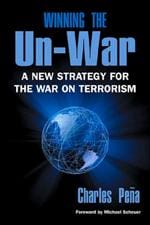
In an interview with Madrid11.net, Charles Peña – a senior fellow at the Independent Institute and author of Winning the Un-War: A New Strategy for the War on Terrorism – explains what has gone wrong with the US-led ‘War on Terror’, and what impact US policies are likely to have on nuclear non-proliferation.
In your book you argue that the mere notion of “a war on terrorismâ€, not only is overused but also wrong. Why? What we call the “war on terrorismâ€, which has become the short hand phrase that everyone uses, is really about dealing with the Al-Qaeda terrorist threat to America and the larger radical terrorist threat that Al-Qaeda is representative of. As with any conflict you have to focus on who the real enemy is. So it is not about terrorism, it is not irregular warfare, it is not about all the terrorists groups that exist in the world - and there are many. It is specifically about Al-Qaeda or any other terrorist group that is a direct threat to the US. That is, in my opinion, where the focus of the ‘war on terrorism’ or what I call ‘the Un-War’ should be. By invading Iraq, aren't the US giving the impression that the US really leads a war against Islam? The Iraq war was a very large strategic mistake on the part of the Bush Administration because, first and foremost, Saddam Hussein was not a direct threat to the US either militarily or via his relationships with terrorists groups. That is not to say that Saddam was not a dictator and, certainly, was not an oppressive dictator. But he did not represent a direct or imminent threat to US or a threat that we could not otherwise contain or deter. The result of the US led invasion is that it has given ammunition to both to Al-Qaeda and to the larger Islamic movement in the world. No doubt, the US invaded an Islamic country. Some Muslims would extend that to say that US has engaged in a war on Islam, and certainly it can be perceived and used in that way rhetorically by enemies of the US. Ultimately we have created a training ground for terrorists that did not exist beforehand and, ironically, topples the regime that Bin Laden would have been happy to have toppled himself if he had had the ability. In a perverse way we have done some of Al-Qaeda’s work for them. Iraq is a rallying cry for the radicals, and that is why it is such a strategic mistake for the US. In your book, you also highlight the fact that there were insufficient troops deployed to Iraq. I am not a supporter of the Bush Administration and the Iraq invasion. But having done it, from a military operational perspective – and if you look at the history of dealing with insurgencies – you needed more troops to have a hope of success. You had to be willing to be there for a very long time. And you had to be willing to engage in harsh, if not ruthless, tactics. A good example for this are the British putting down the Mau Mau rebellion in Kenya in the 1950s. At the same time, if we put more troops into Iraq, that will fuel the insurgency, because more Iraqis will resent having a foreign military occupier. It will widen the call for Jihad throughout the Muslim world, and it would give them one more reason for hating the US, which is the first step towards becoming a terrorist. Much like the recent Israeli incursion into Lebanon, at most the Israelis can claim some sort of technical military success, but ultimately I believe that, strategically, it was a defeat because Hezbollah ended up strengthened. That is a lesson that we need to learn but unfortunately, this administration does not want to accept that lesson. What is your recipe to put an end to anti-American feelings in the Arab world and to defeat Al-Qaeda? It is not going to be an easy task and is not going to happen overnight. One thing is certain. For people like Bin Laden, Al Zawahiri and the hard core Islamic radicals, we are not going to change their minds. One tactic of the Un-war is that we go after those people, to capture or kill them. And that may involve very precise military operations, but it would largely involve unprecedented intelligence and law enforcement cooperation. But it is the rest of the Muslim world that the US needs to worry about. Their opinion of the US is not terribly high. And it has little to do with whether we are a democracy or a very different culture from Islam. It has much more to do with US policies in the Muslim world. Before trying to change how Muslims see the US, we need to reassess our policies. In your view, how are the invasion of Iraq and the operation in Afghanistan affecting American foreign policy in relation to Iran and North Korea? Iraq was strictly a war of choice – a war of pre-emptive regime change against a country that pretty much was defenceless against US military power. The lesson that North Korea and many other countries, including Iran, are drawing from that is that if you want to avoid pre-emptive regime change your only hope is to have a nuclear weapon because that would give pause to any US President attacking your country. There are other reasons why countries would want to acquire nuclear weapons but it is hard to ignore that the Bush Administration policy of pre-emptive regime change is influencing both North Korea and Iran. Afghanistan is less a motivator, only because even countries that may be hostile towards us can understand that Afghanistan was primarily about Al-Qaeda and the Taliban regime that was giving their support to Al-Qaeda. In that respect, Afghanistan was a legitimate military operation on the part of the US. Most countries around the world, whether they like the US or not, are able to see that difference. In light of this, shouldn't we reconsider our non-proliferation strategies? It is too late to disarm. There are nuclear countries around the world and they have reasons for wanting nuclear weapons. In a utopian vision, you might be able to see a world without nuclear weapons. The reality is that governments regardless of who is in power are unlikely to give up those weapons. The problem with the Nuclear Non-Proliferation Treaty is that it provides a false bargain. One of the main rationales of the treaty is that non-nuclear powers agree to remain non-nuclear in exchange for the nuclear powers giving up their weapons and disarming, and it is just not realistic to expect that nuclear powers will eventually disarm. We need to rethink non-proliferation policy but we have to be willing to break out of the current mould of how we think about non-proliferation. It’s about not giving up on trying to dissuade countries from becoming nuclear powers, but also understanding that there maybe times when we are not able to. North Korea is a perfect example, and Iran may be. We have to think also of what you do and what would be the responses when countries do become nuclear powers. You cannot be left with only two choices: to convince them to give up, or go to war. There are more options that we need to consider. A large part of non-proliferation is ‘what are the motivations for countries to become nuclear powers’. If one of the reasons is fear of US foreign policy, then these countries are going to have a very powerful reason to become one.
Charles Peña is a senior fellow with the Independent Institute and author of Winning the Un-War: A New Strategy for the War on Terrorism (Potomac Books, 256 pages).