

Buy now: UK, US, Worldwide
"Selected short stories"
by Rabindranath Tagore, translated by William Radice
Penguin Classics | ISBN 0140449833
Housewife
When we were two years or so below the scholarship class, our teacher was Shibanath. He was clean-shaven, with closely cropped hair except for a short pigtail. The very sight of him scared boys out of their wits. In the animal world, creatures that sting do not bite. Our teacher did both. His blows and slaps were like hailstones pounding saplings, and his sarcasm too, burnt us to the core.
He complained that the relationship between pupil and teacher was not what it was in times past; that pupils no longer revered their teacher like a god. Then he would hurl his power down on to our heads, like a slighted god, roaring thunderously; but his roaring was mixed with so many coarse words that no one could have taken it for a thunderbolt. His ordinary Bengali appearance, too, belied the noise he made, so no one confused this god of the second stream of the third year with Indra, Chandra, Varuna or Kartik. There was only one god like him: Yama, god of death; and after all these years there is no harm in admitting that we often wished he would go, there and then, to Yamas home. But clearly no god can be more malevolent than a man-god. The immortal gods cause nowhere near so much trouble. If we pick a flower and offer it to them, they are pleased; but they do not harass us if we dont offer it. Human gods demand far more; if we fall the slightest bit short, they swoop, red-eyed with fury, not at all godlike to look at.
Our teacher had a weapon for torturing boys that sounds trivial but which was actually terribly cruel. He would give us new names. Although a name is nothing but a word, people generally love their names more than their own selves; they will go to tremendous lengths to further their names; they are willing to die for them. If you distort a mans name, you strike at something more precious than life itself. Even if you change someones ugly name to a pretty one Lord of ghosts, say to Lotus-lover its unbearable. From this we derive a principle: that the abstract is worth more to us than the material, fees to the goldsmith seem dearer than gold, honour means more than life, ones name more than ones self.
Because of this deep law of human nature, Shashishekar (Moon-crown) was intensely distressed when Shibanath gave him the name of Bhetaki (Flat-fish). His misery was doubled by the knowledge that the name was precisely pointed at his looks; yet all he could do was sit quietly and suffer silently.
Ashu was given the name Ginni (Housewife), but there was a story behind this.
Ashu was the goody-goody of the class. He never complained to anyone: he was shy maybe he was younger than the others. He smiled gently at anything that was said to him; he studied hard; many were keen to make friends with him, but he never played with any other boy, and as soon as we were released from class he would go straight home. At one oclock every day, a servant-girl would bring him a few sweets wrapped up in a leaf, and a little bell-metal pot of water. Ashu was very embarrassed by this; he could not wait for her to go home again. He did not want his classmates to think of him as anything more than a schoolboy. The people at home his parents, brothers and sisters everything about them was very much a private matter, which he did his utmost to conceal from the boys at school.
So far as his studies were concerned he could not be faulted in any way, but every now and then he was late to school and could give no good answer when Shibanath questioned him. His disgrace on these occasions was appalling: the teacher made him stand by the steps to the building, bent double with his hands on his knees. His misery and shame were thus displayed to four whole classes of boys.
A days holiday came (to mark an eclipse). The next day Shibanath took his place on his stool as usual and, looking towards the door, saw Ashu entering the class with his slate and school-books wrapped in an ink-stained cloth. He was even more hesitant than usual.
Here comes the Housewife! said Shibanath, laughing drily. Later when the class was over, just before he dismissed the boys, he called out. Listen to this, everyone.
It was as if the whole of Earths gravity were dragging young Ashu down, but all he could do was sit with his legs and the end of his dhoti dangling down from the bench, while all the boys stared at him. There were many years to come in Ashus life, many days of joy and shame more significant than this but none could compare with what his young heart suffered on this occasion. Yet the background to it was very ordinary, and can be explained in a very few words.
Ashu had a little sister. She had no friend or cousin of her own age, so Ashu was her only playmate. Ashus home had a covered porch, with a gate and railings in front. The holiday had been cloudy and very wet. The few people who continued to pass by, shoes in their hands, umbrellas over their heads, were in too much of a hurry to look round. Ashu played all day with his sister, seated on the steps of the porch, while clouds darkened the sky, and the rain pattered.
It was the wedding-day of his sisters doll. Ashu was giving solemn and scrupulous instructions to his sister about preparations for the wedding. A problem then arose about who would be the priest. The little girl suddenly jumped up, and Ashu heard her ask someone, Please, will you be the priest at my dolls wedding? Turning round, he saw a bedraggled Shibanath standing under the porch, folding his wet umbrella. He had been walking along the road, and had taken shelter from the rain there. It was Shibanath whom the little girl had asked to be priest at her dolls wedding.
Ashu dashed straight into the house when he saw him, abandoning the game and his sister. His holiday had been utterly ruined.
This was what Shibanath described with withering amusement the following day, to account for his calling Ashu Housewife in front of everyone. At first the boy smiled gently, as he did to everything he heard, and tried to join in a little with the merriment all around him. But then one oclock struck, the classes were dismissed, the servant-girl from home was standing at the gate with two sweets in a śāl-leaf and some water in a shining bell-metal pot, and Ashus smile gave way to a deep red blush around his face and ears. The veins in his aching forehead began to throb; he could no longer hold back the flood of tears in his eyes.
Shibanath took a light meal in his rest-room, and settled down for a smoke. The boys danced around Ashu, boisterously chanting, Housewife, housewife! he realised that to play with your little sister on a school holiday was the most shameful thing in the world, and he could not believe that people would ever forget what he had done.
* * *
About the author:
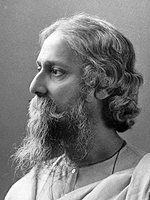
Rabindranath Tagore (1861 1941) was a poet, writer, musician, painter, educator, philosopher, and Asias first Nobel Laureate. He was the fourteenth child of Debendranath Tagore, who headed the Brahmo Samaj, a Hindu reform movement. Tagore started writing at an early age, and his talent was recognised by Bankimchandra Chatterjee, the leading writer of the day. His first volume of poetry, Manasi, was published in 1890. From 1891 to 1895 he was the chief contributor to Sadhana, a prominent Bengali literary journal.
During this decade Tagore lived mainly in rural East Bengal (now Bangladesh) managing family estates, a project which brought him into close touch with common humanity and increased his interest in social reforms. In the early 1900s he was involved in the Swadesh movement against the British, but withdrew when the movement turned violent. In 1912 he came to England with an English translation of Gitanjali (1909), his most celebrated collection of lyrics. It was acclaimed by W.B. Yeats and later published by Macmillan, leading directly to his winning the Nobel Prize for Literature in 1913.
Tagore was given a knighthood in 1915, but within a few years returned it as a protest against British policies in India, notably the Amritsar Massacre in 1919. Tagore was a controversial figure at home and abroad: at home because of his ceaseless innovations in literature and music; abroad because of the stand he took against militarism and nationalism. He was close to Mahatma Gandhi, who called him the "Great Sentinel" of modern India. His songs, which include over 2,000 compositions, have become the national music of Bengal, and include the national anthems of both India and Bangladesh. Tagore spent much of the latter half of his life in travel, and visited the United States and nearly every country in Europe and Asia.
Sources: Penguin, Nobel Prize, Calcutta Web, and Wikipedia.

William Radice has pursued a double career as a poet and as a scholar and translator of Bengali, and has written or edited nearly thirty books. In addition to his translations of Tagore, his publications include Myths and Legends of India (2001), and A Hundred Letters from England (2003). He has also translated from German (Martin Kämpchens The Honey-seller and Other Stories, 1995, and Sigfrid Gauchs autobiographical novel Traces of my Father, 2002) and Italian (Puccinis Turandot for the English National Opera). He has contributed regularly to BBC radio, has lectured widely in South Asia, North America and Europe, and has been given literary prizes in both India and Bangladesh. He is currently Senior Lecturer in Bengali at SOAS, University of London, and from 1999 2002 was head of the Department of South and South East Asia. His website is at www.williamradice.com.


