
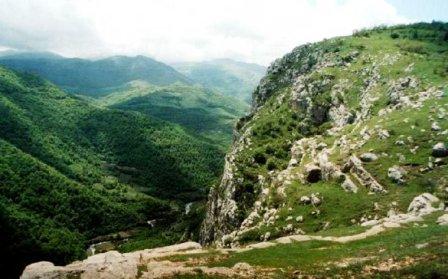
Azerbaijan and Armenia have been the subject of discussion and commentary more frequently than usual since the beginning of this year. Observers have once again decided that a conclusion to the Karabakh conflict is close: there is already a regulatory "road map", and the American co-chairman of the "Minsk Group" has hinted that the presidents of Armenia and Azerbaijan are considering "imminent
Shusha, Nagorno-Karabakh. Tourists can only dream to visit now those spectacular sites.
exchanges", and that both sides are prepared to make "painful concessions".
However, I would risk saying that, once again, nothing will happen. Wayne Merry, an expert on the region, is correct in his sceptical assessment of the "Minsk Group". He simply excludes the "road map" from his analysis. True, it's difficult to agree with his claim that Azerbaijan and Armenia are once more on the brink of war. Each party is too aware of the horrific risks and costs of that course of action. It is also impossible to imagine that the Azeris seriously considered the Metsamor nuclear power station in Armenia a target.
The current proposals for solving the Nagorno-Karabakh problem are unworkable. There is a solution, but we are too immersed in the detail to be able to see it. What's needed is a "bird's eye view", so let's go back to the origins of the conflict, which many people have forgotten.
Background
There were no ethnic borders in the Russian empire. Immediately after the three Transcaucasian nations declared independence in May 1918, a war broke out between Azerbaijan and Armenia over disputed territory. Tens of thousands perished. When a third party became involved, it was no accident that Nagorno-Karabakh was entrusted to Azerbaijan. It wasn't only the Turks that did this in 1918 (which is understandable); the English behaved similarly in 1919 and the Bolsheviks in 1921.
The Bolsheviks defined the borders as best they could: they put a stop to the mutual extermination of ethnic groups living side by side and for 70 years they inculcated the idea of the "friendship of peoples". This had results. Censorship eliminated memories of past strife, hatred was driven deep underground, Armenians occupied the best positions in all spheres of life in Azerbaijan and there were many mixed marriages.
Gorbachev's glasnost revived the discussion of forbidden topics. The press had no democratic experience and immediately began printing arrant nonsense about "bad" neighbours. Armenian authors used especially intolerant language, full of hatred for the "Turks". They aroused primeval passions by digging into the bloody pages of the past. When ordinary Armenians read all this, they clenched their fists. The prevailing opinion was unanimous: there was no problem more important than reunification with Nagorno-Karabakh at any cost, and Armenia had no more hated enemy than the Azeris.
Words quickly turned into actions. The end of 1987 saw the beginnings of ethnic cleansing in Armenia. "Enthusiasts" went from house to house warning local "hated Azeris": "If you don't leave of your own accord, we'll kill you!"
The Azerbaijan authorities housed refugees in the town of Sumgait, where the situation immediately began to heat up. On 27 February 1988 there was a pogrom against local Armenians. 32 people died, over 100 were injured and dozens of women were raped.
Azeris continued to leave Armenia throughout 1988. The greatest exodus took place at the beginning of winter. People made their way through icy passes, and there were many fatalities on the journey. A similar ethnic cleansing was taking place in Azerbaijan: of the 215,000 Armenians living in Baku before perestroika, less than a third were left on 1 January 1990, and the Armenian quarters of Ganja and other cities were empty.
At that time the Popular Front of Azerbaijan (PFA) pressed for the republic to secede from the USSR. On 31 December 1989 PFA activists destroyed a large section of the infrastructure on the Iranian-Soviet border. They hoped for assistance from brother Azeris in Northern Iran, but there was no way Iran would sanction that. Gorbachev's patience ran out, and a military force began moving towards Baku.
On 13 January 1990 there was a bloody Armenian pogrom in Baku. 56 Armenian civilians were killed, though Armenian statistics give the figure as 150. After this, Moscow sent troops to the city, with orders to shoot to kill. The Azerbaijan health ministry counted 106 killed and 737 injured, most of them Azeris. Over 800 people were arrested and the PFA went underground temporarily.
Soon an undeclared war had broken out between these two republics, which were both still part of the Soviet Union. For the time being it was a partisan war. The Moscow press called the Azeris "insurgents" and the Armenians "militia".
This was the background for the referendum on the fate of the USSR, which took place on 17 March 1991. 75.1% Azeri voters took part and 93.3% of them voted to preserve it. Even in Russia this share of the vote was only 71.3%. Azeris believed against all the odds that Moscow would still be able to restore order. Armenia refused to take part in the referendum. In the summer it announced the creation of its own army in the still united USSR. The Azerbaijani army was only formed after the dissolution of the USSR in December 1991.
On 6 January 1992, the Nagorno-Karabakh republic (Republic of Artsakh) declared independence. This was when the real war began. It lasted until 12 May 1994, when the "Permanent Cease-Fire Agreement" came into effect. The result was that Nagorno-Karabakh remained almost completely in the hands of the Armenians, and seven other regions of Azerbaijan were occupied (five completely, two partially).
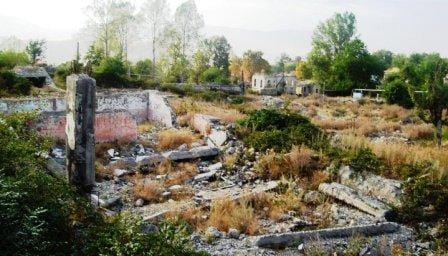
Shusha, Nagorno-Karabakh. The traces of war can be seen everywhere.
Summing up the ensuing 15 years of stalemate, Wayne Merry concludes: "Azerbaijan must accept the consequences of defeat in war... Azeri hopes that outside diplomacy will compel Armenia to give up its wartime victory as a chimera. The Azeri people need to taste this bitter cup". When you are in Baku, such a thought does not enter your head - regardless of whose side your sympathies are on.
As long as Azeris and Armenians can allow themselves to stand their ground without flinching, there can be no way out of the impasse. So the main question is: how long will each side be able to do this?
Situation in Armenia
The winning side in the war would appear to be Armenia, although it has always denied it was fighting Azerbaijan. But with a balance of forces of 1:50 the Karabakh Armenians would never have managed this war on their own. "In the case of Karabakh, independence is really a sleight of hand which barely covers the reality that it is a region of Armenia... Karabakh's independence allows Armenia to avoid the international stigma of aggression, despite the fact that Armenian troops fought in the war between 1991-94", - says Dov Lynch from the Parisian Institut d'Études de Sécurité.
Strangely enough, Armenia has been led up a blind alley by its victory. But for this, a compromise would have been found long ago which would have been to the benefit of all.
The 350,000 Armenians who left Azerbaijan probably have nothing good to say about the leaders of the battle for Karabakh. Serving an ideal cost the exiles dearly: they abandoned or sold their properties for a song and their losses (economic, administrative, cultural and status) are incalculable. Around 50,000 Armenians even left Nagorno-Karabakh (at least a third of the population). Not everyone likes living on the front line.
Even more Armenians left Armenia itself. The reasons were many:
- 22 years of problems and wars
- the catastrophic Spitak earthquake
- plunging the former Armenian SSR into a state of poverty to which they had not been accustomed in the Soviet period
- unemployment
- reluctance to send sons to serve in the army
- the blockade and the countless hardships connected with it
All these things reduced the population by at least 1 million people (although this also includes the 230,000 Azeris who lived there). Around 150,000 Armenians moved to Armenia from Azerbaijan. Of course some of the new diaspora successfully settled abroad - in the Krasnodar and Stavropol regions of Russia, in Moscow, in Western countries, but it is unlikely these people will ever return home.
Today, there are 2,967,000 people in Armenia (the source for most of the figures in this article is The CIA World Factbook 2009). An extrapolation of the 1980s figures shows that 4 million people would be living there today, if the country were developing peacefully. 33% more! Depopulation on this scale means that a nation becomes unable to sustain the development of its culture, information systems, literature, specialised education and science.
The "erosion" of the intelligentsia and active youth continues. According to Gallup, in July 2008 23% of people in Armenia were prepared to leave the country. This is what the battle for Karabakh has done for Armenia.
The number of people in work dropped from 1.4 million in 2001 to 1.2 million in 2007. In 2001 42% of those employed worked in industry, but by 2007 this figure had fallen - an unprecedented event! - to 16%. But the number of people employed in agriculture increased (from 44% to 46%) - this only happens, and then very rarely, in the Third World.
People who have been there say that militant feelings in Armenia have died down and almost everyone is sick of the very subject of Karabakh. Typical of the kind of comment you hear: "This issue needs to be solved as soon as possible, so we can do away with it. Young people flee the country to avoid being sent to Karabakh. Armenians need a private life, and not Karabakh. The Armenians have lost everything because of Karabakh and the country is unable to develop."
Armenia's other problems are less noticeable against this background, though they are numerous. They are primarily ecological: the water and soil are polluted to a critical degree, and the lack of fuel in the 1990s led to significant felling of trees, which were anyway in short supply.
Is there any good news? There is. In 2008 Armenia's GDP grew by 6.8%. In the period 2001-2009 per capita GDP increased from $3,350 to $6,400. Unemployment fell from 20% to 7%, chiefly because the numbers of people of working age declined.
Poverty is the mother of invention and the Armenians are a stubborn and talented people, who will undoubtedly continue to find new reserves. They will complete the construction of the Yerevan heat and power plant, and the Armenian economy will grow. But next to Azerbaijan it has no chance. As far as we are concerned, only this fact has any significance.
Do they realize in Yerevan that it will become increasingly difficult for Armenia to reach an agreement with Azerbaijan? Azerbaijan is becoming stronger and will soon start tightening the screws with the conditions it demands.
Situation in Azerbaijan
Azerbaijan moved into a different weight category several years ago. Its wealth, economic power and mobilization potential put it far beyond Armenia, though it still lacks social cohesion. Recognition of this shortcoming will restrain the leadership of Azerbaijan from attempting a military solution.
The refugee problem has been a considerable burden for Azerbaijan since 1988. The expulsion of Azeris from Armenia, Nagorno-Karabakh and the surrounding regions has put the number of homeless people up to 600-900,000. Many of them have gone to work in Russia, but it's not only refugees that have left: the chaos and unemployment of the 1990s drove tens of thousands of permanent residents away. But Azerbaijan now has an external reserve of workers. These are people planning to return home when life becomes easier there, whereas Armenian emigration is often whole family with children. This kind of migrant rarely returns.
Those who are not well-disposed towards Azerbaijan comfort themselves with the fairytale that there's almost no one left there. We need to make sense of this. There are said to be three or even five million Azeris in Russia. Even the Embassy of Azerbaijan in Moscow has said that there are 2 million Azerbaijan citizens living permanently in Russia. In Russia alone! In fact many Azeris went to other countries of the former USSR, and to Turkey. Moscow officials like to claim too that in Moscow alone there are 1.5 million Azeris. The Centre for the Study Problems of Forced Migration in the CIS considers these "statistics" simply ridiculous. They can be explained by counting the same people several times, political games or incompetence.
Common sense supports these conclusions. In Azerbaijan today there are 8.2 million "registered" inhabitants i.e. the present population plus the absent population. This figure is pretty convincing: according to the last Soviet census there were 6.8 million Azeris living in the USSR in 1989, 5.9 million of them in Azerbaijan itself. So figures of 15, or even 10 million today are just not possible.
Azeri migrants in Russia are mainly men. In 2009 the figure for men of working age (from 15 to 65) in Azerbaijan, both present and absent, was 2,808,000. Could 2 million of them (71%) be absent? If so, it would be a catastrophe for the demography, economy, society, work force and spirit of the country, but there is no sign of this.
In August 2008 I drove from Baku to the south of Azerbaijan and everywhere I saw an abundance of young men. There is no shortage of labour in Baku, which has become a gigantic construction site. In the villages there are always groups of men standing around with nothing to do.
One may conclude that the departure of hundreds of thousands of people, primarily refugees, did not harm Azerbaijan (unlike Armenia). It reduced tension within the country and helped to resolve a difficult economic situation in the period before the long-awaited growth. Money sent home by people working outside the country also helped.
Azerbaijan's economic boom is astounding. In 2005 GDP grew by 26.4%, in 2006 by 30.5%, in 2007 23.4%. It was only in 2008 that it fell to the "Chinese" level of 11.6%.
Overall Azerbaijan's economy has grown by 2.6 times over the last five years, and budget expenditure by 10 times. The present crisis has affected Azerbaijan less than almost any other country. Azerbaijan GDP has reached $9,000 per capita annually. By comparison in Turkey this figure is $12,000, in Iran it is $12,800, in Russia $15,800, in Poland $17,300 and in Portugal $22,000. But Azerbaijan has the prospect of overtaking these countries between 2020 and 2025 (and they will not be standing still). Then there will be hope that the Karabakh impasse might be resolved.
There is a solution
Karabakh is the heart of the Azeri motherland, as Kosovo is for the Serbs. It's an article of faith that has nothing to do with the disputes of historians. There is no question that Azerbaijan will ever recognize the loss of Nagorno-Karabakh. It even seems unlikely that they will lift the blockade on Armenia.
People say that with the trump card of occupied Azerbaijani territories, the Armenians can hold out for decades, in spite of economic imperatives. Israel also refuses to leave occupied territories and the world seems to have got used to it.
These two countries have a great deal in common. Both Armenia and Israel were recreated centuries after the historical destruction of these states. In many ways Jews and Armenians shared similar historical fates and occupations during their centuries of statelessness. Professor Samuel Huntington called Armenia the "Israel of the Caucasus" for good reason.
When they were recreating their statehood neither Israel nor Armenia had undisputed borders. In the case of Armenia, the Georgians and Azeris point to the configuration of their principalities and khanates at the beginning of the 19th century to demonstrate that Armenia has no place in the South Caucasus at all. The borders were carved out by bayonet. Then Armenia's borders were recognized de jure, and Israel's de facto, but the international community will not countenance any new acquisitions of territory. Israel returned the Sinai peninsula to Egypt, although the majority of Israelis would not entertain this thought for a long time. The Golan heights will also be returned - despite the 1981 Knesset decision to annex them. The annexation has not been recognized by a single country, although Israel has more advocates around the world than Armenia does. The need for guaranteed and secure borders will lead Israel to make this concession too.
It is inconceivable that the Armenians, who are an ambitious and enterprising people, do not look back with regret at their former status in Azerbaijan, where they were the richest ethnic group. They were successful when there was no private property, enterprise was forbidden and freedom to take any initiative was extremely limited. So what could they not achieve in the new capitalism?
The contradiction between the principle of territorial integrity and the right to self-determination is not just an empty phrase. But there is already a consensus that if an ethnic group living in a close-knit community in another nation's country is deprived of national and cultural autonomy and/or put in unequal conditions, then it can demand to secede from that country. This was not the case of Armenians in the Nagorno-Karabakh autonomous oblast in the Azerbaijan SSR. They were the unquestioned masters in the oblast.
Almost all Armenian refugees over 35 will say that they had Azeri friends. Educated people will remind you that all previous wars between Armenians and Azeris were followed by reconciliation, for example in 1905 and March and September 1918. No one could make the Azeris and Armenians become enemies forever. Why should things be different now? These feelings will increase as Azerbaijan's economy becomes more dynamic.
It's true that Armenia will not agree to concessions if they mean a loss of face. But it will, if this is not the case. There has to be a consolation prize. It can't be territory, as that would be out of the question for Azerbaijan. What will it be then?
Baku Armenians might possibly return to Baku, when everything has been settled - the agreements on mutual restitutions, compensations, a solution to the problem of refugees and the (obligatory!) ceremonial act of reconciliation between the two peoples. Formally this would not be a unilateral concession by Azerbaijan: where refugees are concerned, the settlement should be completely symmetrical. But in fact it would not be quite symmetrical - simply because the return of Armenians to Baku is not absolutely the same as Azeris returning to the mountains around Spitak. There will not be large movements in either direction, as people will be unable to overcome their fear and feeling of strangeness. The places that were abandoned will seem alien to the younger generation. But in spite of these reservations, it will be very important for the Armenians. They won't regain their former status, but even a limited "restoration of the past" would be a great comfort for them.
As for re-incorporating Nagorno-Karabakh into Azerbaijan, it is difficult to think of anything better than the Aland model. The Aland Islands are inhabited by the Swedes; they were under Russian rule for 110 years and are now part of Finland. In 1917-1921 the Aland islanders demanded to be united with Sweden. Their leaders were tried for treason, but then the Finns proposed a form of autonomy that suited everyone. The very fact that both Nagorno-Karabakh and the Aland Islands are parts of the former Russian empire gives cause for hope: if it was possible in one place, it will be possible in another.
However, there is one important reservation. Only democratic nations capable of free internal consensus and mutual trust can use such a model to come to an agreement. This may seem fantastic now, but we should not despair. Let us not forget that Azerbaijan was the first democratic republic in the Islamic world. In its two years of independence (1918-1920) it was the first nation in the East to give women equal rights with men, separate religion from the state, introduce a model electoral law and proclaim basic rights and freedoms. This is an extremely important moral guideline for modern-day Azerbaijan.
As for Armenia, this is a country with over 20 political parties, where there has been a transfer of power as a result of democratic elections on two occasions (in 1998 and 2008). Not every country in the CIS has such impressive showings.
I believe that the historical reconciliation of the two peoples and a solution to the Karabakh conflict will not take place before 2025. It is unlikely that economic imperatives, the overcoming of hatred and processes of democratic development will come together before then.
Photo: eurasianet.org

