
On a Manhattan train last month, I overheard an impersonation of Werner Herzog. Herzogs voice is well worth imitating, and the subway rider did a good job in catching its eerie and insistent lugubriousness. But here, its less the doing well than the doing at all; this tiny incident seemed above all to confirm the continued revival of interest in the legendary German filmmaker.
Where even a few years ago, his work struggled to find its way to the public, this summer three of his recent documentaries Wheel of Time, The White Diamond and Grizzly Man received theatrical releases in New York. A fourth film, Wild Blue Yonder, was warmly received at the Venice Film Festival, and screens this week in London as part of a Herzog season at the Goethe Institut, as well as on BBC Four.
It is largely as a director of documentaries that Herzog is now discussed and celebrated, at first glance something of a shift in emphasis from his previous celebrity. In the 1970s and early 1980s, Herzog was, along with Rainer Werner Fassbinder and Wim Wenders, the biggest of the director-stars of New German Cinema, arguably then the most vital national cinema in the world. His feature films, mostly centring on driven and solitary obsessives who struggle to exert their will against the incomprehension of society and the limitless hostility of nature, seemed not only to represent the sublime experience of their subjects, but to transmit it to their audiences. His expressive use of landscape photography was deemed the greatest since John Ford.
This first Herzogian heyday coincided almost exactly with that of New German Cinema itself, from 1968 to 1982: from his winning, at age 25, the Berlinales Silver Bear for Signs of Life, through the completion of Fitzcarraldo, the second Amazonian epic starring his favourite actor, the icily handsome and vastly egocentric Klaus Kinski.
The documentarian
But with the exception of Invincible (2001), Herzog has not made a feature film since Scream of Stone in 1991, concentrating instead on documentaries, or rather on documentaries, since their marrying of non-fiction subject matter with highly poeticised form seem to blur the boundaries of the genre. But in at least two senses, his work as a documentarian is not new.
First, even at the height of his early fame, Herzog was making as many non-fiction as fiction films. To cite one example of many: between Aguirre: the Wrath of God, a study in megalomania starring Kinski as a doomed conquistador, and The Enigma of Kaspar Hauser, in which the foundling was played by Bruno S, a non-professional actor himself raised in institutions, Herzog made The Ecstasy of the Woodcarver Steiner, a highly unconventional portrait of the champion ski-jumper Walter Steiner.
This films combination of slow-motion images with hypnotic music looks forward to later films such as Lessons of Darkness, whose controversially aestheticised images document the burning oil wells of Kuwait. His preoccupation with documentary is not a recent one and has changed little in substance; it predates and foreshadows the current general renaissance of the form. If his star is again in the ascendant, it is perhaps because the world of cinema has turned.
Secondly, the line between fiction and documentary has in any case never been a particularly important one for Herzog. This is not simply a matter of thematic continuity. It is also that Herzogs insistence on authenticity and intensity rendered many of his fiction films documentaries of their own making.
This was never more the case than with Fitzcarraldo, the story of a man driven to bring opera to a remote jungle settlement. To cash in on the Peruvian rubber boom and build an opera house grand enough to tempt Caruso, his boat must be hauled over a jungle mountaintop. Such a quest could easily be read as an allegory of filmmaking itself, but Herzog seemed determined to make the allegory the other way round, embarking on a legendary shoot so complex and difficult as to make Francis Ford Coppolas troubles on Apocalypse Now seem sedate.
Scorning mock-ups and special effects, Herzog went upriver with a crew and hundreds of extras, shrugging off the assaults of hostile tribes, the loss of actors, the assorted plane and boat crashes, the death of crew-members, and so on. As if this were not enough, Kinskis behaviour reached such an intolerable pitch of egotism that the Indians allegedly offered to kill him to make life easier for all involved. The making of the film is the subject of two documentaries, Les Blanks Burden of Dreams and Herzogs own My Best Fiend, a portrait of his relationship with Kinski, in which he returns to Amazonia to speak with survivors of the shoot, musing cheerfully about the difficulty and intensity of it all.
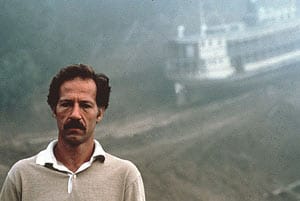
Werner Herzog. © Photograph: Beat Presser
Separating myth from reality
These stories form only a part of the remarkable corpus of Herzogian myth and fable. Mostly dating from the 1960s and 1970s, the accumulated tales polymorphously repeated and embellished, and occasionally clarified, denied or corrected by Herzog himself have since become a fabulously entertaining and baroque phenomenon in their own right.. A brief selection of highlights:
- Werner Herzog crosses Alps on foot to make a marriage proposal (possibly true)
- Werner Herzog walks spontaneously from Munich to Paris as a way of willing a friend out of a serious illness (possibly true, some grounds for scepticism)
- Werner Herzog contracts malaria while in jail in Central African Republic, having been mistaken for a German mercenary (almost entirely true)
- Werner Herzog smuggles arms across United States-Mexican border (true, but in a technical and trivial sense)
- Werner Herzog shoots films for Nasa in the late 1960s (ditto)
- Werner Herzog eats own shoe in front of paying audience after losing bet with fellow filmmaker (true, documented in the film Werner Herzog Eats His Shoe)
- Werner Herzog leaps face-first onto cactus after losing bet with midget crew of Even Dwarves Started Small (true)
- Werner Herzog directs Kinski at riflepoint in final scenes of Fitzcarraldo (false)
But there is more to these myths than a mere compendium of semi-fictional eccentricities. Herzog has been accused by critics of carefully crafting a persona of romantic hero-director in order to deflect critical analysis of his films and their conditions of production. The persona, they claim, is that of a heroic figure working on an infinitely higher plane than that of their quibblings and carpings. As one put it in the 1970s, even the best-intentioned critic is left suspecting himself of an act of bad faith or blasphemy.
In a recent interview Herzog acknowledged that he feels protected behind these things (the swirl of myth and rumour). But he has had need of protection: criticisms of his films have been serious and frequently highly personal. He has been accused of colonialism in both thought and deed, the former as the objectifier of non-white faces and the misrepresenter of non-European dreams, the latter as modern-day colonial boss on set, exploiting cheap native labour and heedlessly endangering the lives of crew and extras. Herzog has always vehemently denied these charges.
Also on openDemocracy about German cinema:
Reinhard Hesse, Turkish honey under a German moon
Ines Geisler, Domesticating East German communism through celluloid and bricks
Julian Kramer, Goodbye Lenin: the uses of nostalgia (August 2003)
If you find this material valuable please consider supporting openDemocracy by sending us a donation so that we can continue our work and keep it free for all
BOX ENDS
The criticism has been particularly intense in his native Germany, where, at least on the left, distrust at the slightest whiff of irrationalism was and is considerably stronger than elsewhere. The reasons for this are obvious and understandable, but this inevitably clashes with Herzogs unabashed belief in the transcendent power of images. Herzog has little in common with the cooler, essayistic aesthetic of Alexander Kluge or Haroun Farocki, the other great German artists of the documentary form.
Appropriately enough, given his later acting role as the impossible, irascible father in Harmony Korines American Dogme film julien donkey-boy, Herzog issued his own cinematic manifesto in 1999. In this, the at least partially serious Minnesota Declaration, he dismisses cinema verité as peddling the banal truth of accountants, its superficial images no better than tourist snaps of reality. Against and below this lie the deeper strata of truth in cinema ... poetic, ecstatic truth. It is mysterious and elusive, and can be reached only through fabrication and imagination and stylization.
In reaching for abstractions, Herzog unavoidably runs the risk of triteness. However, it is not easy to dismiss such pleas for a deeper, poetic realism, for a higher documentary form, if one recalls the undeniable power of many of his films, of their individual sequences and images.
Many remain indelibly in the mind: an inexplicably haunting image of wheat-fields blowing in the wind (Kaspar Hauser), the shattered remains of satellite dishes in the desert (Lessons of Darkness), Aguirre, the mad conquistador, adrift on his raft, alone but for a plague of monkeys. My Best Fiend finishes like this: we see a close-up of Kinskis face, grinning beatifically. Suddenly, a red butterfly the size of a mans fist floats into shot, before coming to rest on Kinskis brow. Kinski smiles on, one eye on the camera, one on the butterfly. This, surely among the most beautiful images in all of cinema, is strictly speaking a documentary image, Herzogs camera recording an event of extraordinary, unplanned serendipity, which is then elevated into a kind of transfiguration. Who else would have such luck, or use it so shrewdly?

