
With the Communist Party’s invitation to the Four Freedoms movement to form China’s next government and hold elections, the biggest democratic transformation in history is under way. The Communist Party is abdicating, just as its Polish counterpart did 61 years ago. That started a democratic landslide, though one that involved far fewer people than the current epochal event.
China’s path to democratization has been unique, though with parallels to previous events. Early this century China embarked on the development path that led much smaller societies such as (former South) Korea and Taiwan, first to wealth and then to democracy, with the people demanding that authoritarian leaders stop treating them like retarded children. The steady refinement of communications technology made an important contribution. Where once technological dinosaurs like Google and Cisco (remember them?) could enable a government to control what its people saw and heard, today’s technology allows every individual to connect directly to every other through the Orbital Web, 36,000 kilometers up, making censorship a thing of the past.
What doomed China’s Communist Party was China’s demographic transition. By 2035 it was clear that China’s meteoric economic growth was over, as the pension and health costs of an aging population ate up investment resources. As with Eastern Europe in the 1980s and Southern Europe in the 2020s, economic crisis fostered systemic political crisis. The Four Freedoms movement offers aging Chinese a significant, though reduced proportion of the national product in return for eliminating the hukou system and equalizing economic opportunity for those still able to work.
Indirectly, China’s democratization was promoted by reform in the United States and Northern Europe. Early this century the electorates of the traditional democracies embarked on policies of fiscal, social, and, perforce, foreign-policy retrenchment. They lost their dominant position in global affairs but were rewarded with decades of strong, long-term growth. They preserved the idea of democracy, governed by a prudent and conservative electorate, as a viable and attractive social model. Its influence on the Four Freedoms movement is clear.
After the “authoritarian scare” of the first part of this century the Chinese transition tips the global balance decisively in favor of liberty. But perhaps one should be careful about making sweeping predictions; people were making them in the 1990s too.
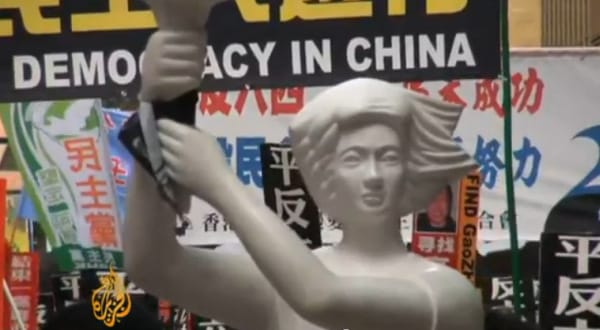
Postcard image info
June 4th 2011: Screen grab by DailyQi from Al Jazeera English's video 'Remembering Tiananmen'
Author: Yitzhak Klein

