
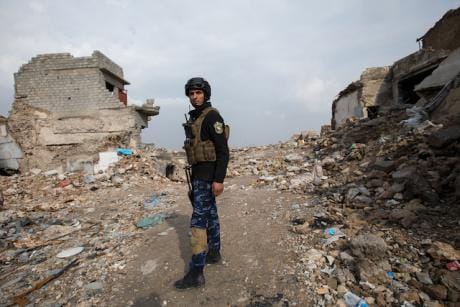
A soldier of a special unit of the Iraqi Interior Ministry in the ruins of the old town of Mosul,Iraq. February 2018. NurPhoto/Press Association. All rights reserved.
What are the prospects for stability in the Iraqi and Syrian territories where ISIS's "caliphate" ruled for four years? A United States-led aerial bombardment, allied to Baghdad's own reconstituted army and Shi'a militias on the ground, succeeded in driving ISIS forces out of their urban strongholds, Iraq's Mosul and Syria's Raqqa, in the second half of 2017. The cost, both to civilians and infrastructure, was immense. Compounding the damage is that the anti-ISIS campaign now appears more of a phase in the war than a means to end it (see "The myth of the 'clean war'", 24 November 2017).
True to form, President Trump's view is that ISIS has been defeated, a stance that suits his "bring our boys home” rhetoric. Such triumphalism can be discounted, though even serious journals report that ISIS now controls just a small parcel of eastern Syria's Euphrates valley – and predict the movement will lose that in the coming weeks (see Kyle Rempfer, "US in ‘early stages’ of withdrawal, as ISIS squeezed into a few square miles", Military Times, 30 January 2019).
