

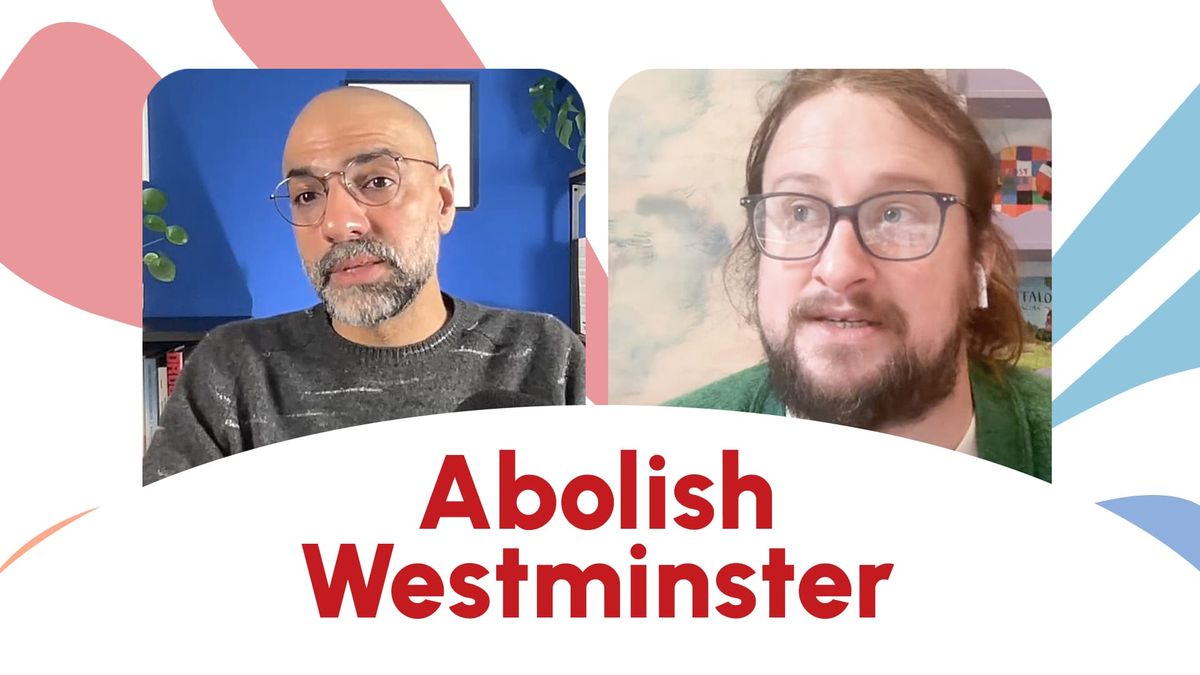
Is it time to break up the UK? In his new book, “Abolish Westminster”, long time openDemocracy writer and editor, Adam Ramsay makes just that case.
The following is an edited excerpt of an interview between Ramsay and openDemocracy’s Editor-in-Chief Aman Sethi openDemocracy’s In Solidarity podcast. Click here to listen to the podcast in full.
Adam, let’s just start with the title: What is Westminster?
When I say Westminster, what I mean is the whole British political constitutional system. Westminster is actually just the name of a place. It's the name of the physical place that has that big building that was built in the 19th century, but it's also a metonym to refer to what I mean by the whole political system.
I mean the parliamentary system, but also in the executive, which is called Whitehall. I mean the judicial system. I mean the way we organize money in Britain. So I mean the whole of the British constitution needs to be replaced.
You've been a journalist for many years. Give us a sense of the journey that led you to this conclusion. What was the question that was animating you that you were like, “The answer is ‘Abolish Westminster’.”
I'm Scottish. People wouldn't guess that from my accent, but I am. And so in Scotland, this isn't really an original analysis. In the Scottish left, people have been saying for, you know, you could argue two centuries, but certainly for many decades, that achieving social justice or democratic socialism or a more progressive world or whatever you want to call it, through the old imperial British state is almost impossible.
The great Scottish writer, who's a long-term friend of openDemocracy, Neil Ascherson, famously said in the 1980s that trying to get democratic socialism through the British state is like trying to get milk from a vulture. And so in that sense, the argument, the broad argument isn't new in Scotland, but when I was first at openDemocracy more than a decade ago, suddenly there was a Scottish independence referendum, and so I found myself trying to explain to oD readers and also just other people in England and outside the UK, you know, why is it that the Scottish left, who don't really care much about flags or nations, are in favor of independence? You know, which is not an obvious position the left might take.
In some places, that's seen as a more conservative position. To which the answer was always, "Well, look at the British state. Why would anyone with progressive politics want to be governed by this institution?
So the great Scottish writer Tom Nairn wrote for us occasionally and I got to know him. And so I was very influenced by that kind of intellectual world that made the case that, you know, this is a system that's built to run an empire. It's not very good at democratically managing the affairs of an archipelago in the North Atlantic.
What you do in your book, which I enjoy, is you break it down into a set of components. Could you give us a sense of why you chose the components you did?
The traditional way to write a book about the constitution of a country would be to say, well, there's three bits of it. There's the legislature, so Westminster. There's the exesecutive, so in Britain wthat's Whitehall, and there's the judiciary. And that's how the American Founding Fathers or the original French constitutionalists thought about it.
But people who've written about the British constitution have often said, "Well, it doesn't really work like that. There's a whole other bit to it." Which — he's a terrible man, but very interesting thinker — Walter Bagehotsaid that there's the efficient bit of the constitution, by which he means all those bits we just talked about, and then there's the dignified, which he kind of meant was the monarchy and the House of Lords, and all of these bits of the constitution, which as he saw it, were kind of designed to secure consent from the masses so you didn't have to give them actual democracy.
 Aman Sethi
He talked about the power of the princes, , and making people feel romantically attached to it through the monarchy so that they didn't get, so that we don't get, a proper say in how it's run.
And then also the sort of sense of national identity fits in there as well, right? Like what does it mean to be British or Scottish or English or Welsh, and why do those things butt against each other? Where does Ireland fit in?
And that, that kind of leads to the final section of the book, which is about the union.
Where I found myself in lingering disagreement through parts of the book was your sense that this is unique to Britain. Because if you, if you look around you, there seems to be a broader sense that politics is broken everywhere, that the state form itself seems to be creaking. What makes you feel like there is something very specifically a British problem here, as opposed to a general problem with the kind of post-war nation state?
I think these things are both true, right? So I have stood on street corners in almost every country in Europe, from Ukraine to Spain, and asked people how they feel about politics. And I can tell you that in almost all of them, they will tell you they don't like it very much. So, yes, absolutely, this is a structure of feeling that goes right certainly towards the Western world.
But what's also true is that polling consistently shows that Britain has the lowest level of trust in politics in the Western world, alongside maybe Italy.
I just do think it's kind of objectively true that we have a worse state system than others. And I go through in a lot of detail what I think is so bad about it in Britain.
Now, that doesn't mean to say that you're wrong. There's a general crisis of representative democracy. You could say that's been caused by neoliberalism. If you privatize all the decisions to the market, then people suddenly say, "Well, why does politics have no power?"
But I do think that Britain has a particularly bad form because we have the world's oldest constitutional system, the kind of only layover from the medieval era. And I think that also had terrible consequences around the world because of our overseas territories and the way they kind of provide the plumbing for liquid finance globally.
Reading your book, I was consoled that I'm not the only one who conflates Englishness and Britishness, and it seems to be a general problem, at least in your eyes. Talk me through this.
Being Scottish, or for that matter Welsh, often feels a bit like you're sitting in the passenger seat of a car with a driver who's having a nervous breakdown. England kind of controls the direction of the British state and has found it very, very hard to get over losing the empire. Scotland also lost its empire, I don't want to imply Scotland was a colony. The UK came together when the Scottish and English ruling classes united to go and conquer the world and do terrible things. But for various reasons, which we can get into in detail if you like, Scotland has generally been a bit better at getting over that loss.
England is still kind of totally losing its mind over the fact that it used to run the world, and now it doesn't anymore. That's a big problem if you're Scottish in particular, 'cause you keep watching the English do totally bizarre things electorally, and it's very upsetting 'cause they're done to you, too.
From the very apt metaphor of, you know, being in a passenger seat and watching the driver have a nervous breakdown, how does that actually translate into, let's say, the nuts and bolts of being Welsh or Scottish? And while you're answering that, I think one of the things I'm also really interested in, is that it's also not working for the English. The English are perhaps the primary hostages of Westminster.
The really obvious point is that the most remarkable fact about British electoral politics is that England has consistently voted Tory for 200 years.
The Tories are obviously not in government now, but they've been in government and elected by England,more consistently over 200 years than any other political party in the world. Scotland in that period has, with a couple of exceptions when there were moments of governance of national unity, essentially never voted for the Conservative Party.
Wales has almost never voted for the Conservative Party. Scotland and Wales for 200 years consistently voted first for Liberals and then the Lib- dems then the Labour Party, and now in Scotland, mostly the SNP. Um, and so what it feels like is you keep voting for broadly center-left governments and you keep getting Conservative governments.
So if you're sat by the North Sea and you kind of, obviously not literally but metaphorically, look across to Nordic countries, which spent the 20th century consistently voting for center-left governments and as a result got proper social democracies, and in Scotland you voted the same way for the same thing, and instead what you got was neoliberalism.
That's pretty upsetting.
So then the question is, well, why does England consistently vote Tory? Because if you look at opinion polls on individual issues, English people are almost as left-wing as Scottish and Welsh people. They want to tax the rich more. They want more equality. They're broadly as socially liberal as we are on most issues. But the big exceptions to that are monarchy and empire.
So, you know, what's the difference? English people are more prone to monarchy worship. They're more prone to longing for Empire.
Devolution is quite part of the zeitgeist at the moment with the new prime minister. What is your take on Burnham and devolution?
I think the most important thing to understand about devolution is that it's always temporary. That's a lending of power. And as soon as the core finds it politically expedient to interfere, it will.
Devolution constitutionally is about retaining the legal right, [00:16:10] the constitutional power at the core, but lending power down. And obviously, I think Andy Burnham's right that, you know, I think it's true when he says in theory he wants to devolve more power, but obviously he's always going to be tempted, and anyone after him is gonna be tempted when it's politically expedient, as he has done himself, to interfere with that.
In a normal grown-up constitutional system, it works the other way. You know, local government has its own power granted by the Constitution, and the central government can't interfere.
I want to end with your analysis of where British politics is going now. We've seen the rise of Reform and Restore. What I understand from talking to people around me is that this is not a kind of periodic eruption that one sees, but this seems to be something new and different.
A significant amount of your book talks about how the establishment and the Tory establishment, to a sense, has retained a vice-like grip, do you see this as the grip loosening? How do you read this current moment of political flux and, and everything that emerges from it?
On the question of how to understand Reform and restore, I do think it's a new phenomenon. I said earlier that the most remarkable fact about English electoral politics is how consistently people voted Tory. You know, the Tories were and are the party of the institutions, the party of the establishment.
You go right back hundreds of years, they are the party of the monarchy and so people voting Tory, fundamentally what they were saying was, "We basically have faith in the institutions of the British state to get us through the current crisis.We have- we trust the ruling class to carry on governing us."
And so shifting from voting Tory to voting Reform is a kind of complex way of saying, "We don't quite trust the institutions anymore."
Now, you look at what Reform are actually saying, they're not saying, "We are gonna have, you know, we're gonna put working-class people in power."
What they are saying is all of these kind of semi-democratic reforms that have happened since the 1970s, you know, since the end of empire, have been terrible., And we're gonna go back to, basically British state as it was some point, you know, maybe the end of the 1960s, 1950s.
It's not kind of people losing faith in the institutions as a whole, but it's people saying, "We don't like them as they are now, and we want to go back to an imagined version of what they were like probably before anyone alive now can really remember or, or very many people alive now can remember."
This is an imagined era. And of course, that era, the reason people liked the state at the time, people in Britain liked the states, is it was accruing vast wealth from the empire. You know, of course, it's great being at the imperial court. You get lots of plunder. And so a vote for Reform, in a sense, is saying, "We don't like what the institutions become, so we don't trust the Tories anymore 'cause they're the party of the institutions as they are now.
There's a younger generation who might have been on the right historically, who look at all of this and think it's a bit mad, and they probably are quite against institutions. You know, there is a new common sense in the country that basically the whole political system's broken. And some of those people are drawn to Reform because they see them as anti-system.
The other thing that's true right now is that as we speak, the Tories have just re-overtaken Reform in the polls, and Labour's back up in the polls.
Now the polls are showing a kind of reemergence of two-party politics for now.
The kind of establishment breathing its sigh of relief has made a mistake because the fundamental problems of the system are still there. Andy Burnham is not going to achieve what he wants to achieve. And I don't think that 'cause he's dishonest, I think it's because the British state is set up to stop him from achieving it.
The final section of your book is called Break Up the UK, where you suggest a radical rewiring, restructuring, breakup of theUK into its constituent parts.
If you're in England, the idea that you would abolish Westminster sounds kind of absurd, and it's a kind of ridiculous radical slogan. And sure, you might like it in theory, but what does it mean in practice? Like, you know, when can you, how can you tangibly achieve that?
If you're here in Scotland, we've literally had a government that's in favor of ending Westminster rule over Scotland for most of this century. Like, the SNP has been repeatedly reelected because about half the population wants independence, and that number is growing as generations unfold. Um, if, you know, a majority of young people now in Wales also want independence.
Similarly, Northern Ireland. I think Northern Ireland is a particular situation because people there feel very trapped.The Good Friday Agreement was a [00:28:55] necessary way out of civil war. But I spent a lot of time there talking to voters about how they feel about politics, and what they always say is, "We need to get beyond the politics of them and us, but I have to go and vote for us.”
And Britain has no capacity to constitutionally innovate out of that situation in Northern Ireland, where I think the Republic does. In each of these cases, there's a very good reason for each of the other nations, by which I mean Scotland, Wales, and Northern Ireland, and I talk a bit about Cornwall, to want to leave.
And where does that leave England? Well, England can either choose to carry on with its absurd empire state system, or it could say, "Well, this is an opportunity for a democratic revolution here too, and we could also write our new constitution."
I think the most likely way that England is going to achieve serious, deep constitutional change is when the rest of us leave you on your own.


