
Dear Irwin,
You and I have often been on the same side of the argument over media regulation, as critics of overprivileged state broadcasters and unwieldy European Union protectionism. We have jointly deplored kneejerk antiAmericanism, not least because it flies in the face of consumer choice and the demonstrable quality of so much United Statesproduced television.
In politics, despite growing up in the age of demonstrations against US policy on Cuba and Vietnam, I had no illusions about the Soviet empire and no sympathy for Campaign for Nuclear Disarmamentstyle unilateralism. It would not have needed the DDay anniversary or the death of Ronald Reagan to remind me how many west and eastcentral Europeans owe their freedom to the sacrifice of blood and treasure by America.
Of course, US postsecond world war foreign policy has been open to criticism most of its interventions in Central and South America, as well as its support for dubious causes and regimes in tactical pursuit of US global objectives elsewhere, have shown that any commitment to democracy is honoured as much in the breach as in the observance.
But for the most part, and certainly to the end of the cold war, the US tried to act in concert with allies anywhere outside its direct sphere of influence. One of the key differentiating characteristics of the Iraq war has been the chosen divisiveness of its original course. The coalition of the willing (or coerced) has gone out of its way to abuse the unwilling. Doubters (witness Hans Blix) have been demonised and whole nations (witness the French) accused of cowardice, treachery and worse.
One of the reasons why Iraq has become such a polarising issue has been the selective amnesia of the United States (and United Kingdom) government. Its longterm support for Saddam Hussein through the decades of expunging political opposition, gassing his own citizens, invading Iran has been airbrushed from history. This, even though the misery of Iraqis after 1991 was attributable at least as much to ruthlessly applied United Nations (but USled) sanctions as to Saddams iniquity.
Meanwhile, the orchestrated furore over weapons of mass destruction (WMD) was dismaying in its dishonesty. If the Israeli air force could wipe out any potential Iraqi nuclear threat with a single sortie (as in Osirak in 1981), and if the Israeli chief of staff could say that he lost not a minutes sleep worrying about Iraq as a source of danger, why should the worlds only superpower publicly speculate about mushroom clouds emanating from Iraq? The baying chorus of certainty about Iraqi WMD was rooted in deception and misrepresentation.
The invasion of Iraq foolish, wicked or counterproductive, according to ones viewpoint will eventually be resolved, but it is likely to leave an enduring legacy of lingering antiAmericanism in large parts of Europe and the Muslim world. The image of America will be fixed as one of a rampant, unaccountable superpower listening to no outside voices as it pursues its own agenda.
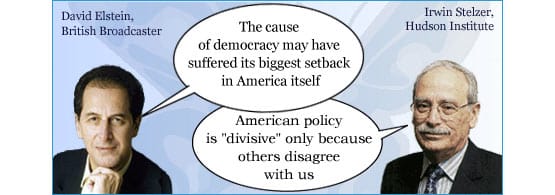
Even more damaging for the United States, and for those who most admire it, is the possibility that the backlash against the Iraq adventure will make the US more hesitant about interventions that it might really need to make in the future. In addition, the impact of domestic legislation (like the Patriot Act) as repressive as anything since the early days of the postwar communist scare, intensifies concern that the cause of democracy may have suffered its biggest setback in America itself.
At one level, Americas institutional selfbalancing mechanisms seem already to be exerting themselves. The official 9/11 commission has exposed the incompetence and complacency that allowed the conspirators to accomplish their ghastly mission, despite repeated and explicit warnings of what they were planning. David Kay, of the Iraq Survey Group, pressed the administration to acknowledge its WMD errors, even to the point of contemplating that the entire affair was an elaborate Iranian intelligence sting. It was Sixty Minutes and the Washington Post that illuminated the horrors of Abu Ghraib (not the many vocal media critics of US policy overseas). It was a US army general, not the Red Cross, who most completely catalogued the torture regime tolerated by his senior officers.
But even if the Bush administration rediscovers the virtues of diplomacy, can it learn the lessons of Iraq? For all the denunciations of rogue elements betraying the honour of US arms, Bagram and Guantanamo will remain standing after Abu Ghraib has been flattened. The hundreds of stored digital photographs, showing such consistent patterns of abusive behaviour, surely demonstrate official tolerance or sanction for what happened.
Few, inside or outside Iraq, can regret the deposing of Saddam. But even the best of causes require legal sanction, international consent, a clear balance of advantage and orderly implementation if they are to achieve their optimum effect. It is a bitter irony of the invasion that Iraq has now become as it never was before a fruitful recruiting ground for alQaida. Worse still would be if it left America resentful, frustrated, mistrusted and divided unsure if it is a society that endorses torture or abhors it. That is the legacy I fear.
Best wishes,

Dear David,
Because of my admiration for the intelligent positions you have taken in the battles over media policy, I was doubly distressed at your letter, and the absence from it of the cool logic with which I associate you.
Let me start with what you call the chosen divisiveness of United States policy. American policy is divisive only because others disagree with us. Since America cannot coerce other nations to abandon their interests in favour of ours, any position we take will be divisive in the same sense as Britains insistence on its red lines over European integration is divisive.
The Bush administration has returned control of American security policy to its constitutional home, the Oval Office and Capitol Hill. This quite naturally upsets those countries who, lacking power of their own, would enmesh America in the coils of the United Nations an organisation dominated by governments that do not deem it ludicrous to eject the United States from its human rights commission, and to place Libya in the chair of that organisation; that can call Palestinians who blow up Israeli teenagers in pizza parlours freedom fighters (I believe that the BBC term is militants) while condemning as assassins Israelis who confine their retaliation to leaders of terrorist organisations.
It is this antiUS, proUN tilt of your letter that I find so surprising. Do you really believe, now that we have discovered mass graves, seen first hand the plight of the marsh Arabs, learned the details of the entertainmentsofchoice of Saddam and his sons, that the misery of Iraqis since 1991 was attributable at least as much to ruthlessly applied United Nations (but USled) sanctions as to Saddams iniquity?
But it was not just the UN that was responsible for what you term the ruthless application of sanctions; it was UN bureaucrats who misappropriated oilforfood money that might have been used to feed the Iraqi people, all the while depositing the massive funds from the sale of oil into accounts in France to buy that nations silence.
This brings me to the question that so troubles you weapons of mass destruction (WMD). We do not know that Saddam did not have such weapons; all we know with certainty is that (a) he used them with devastating effect against the Iranians, the Kurds, and his own people; and (b) he evicted inspectors in 1998 when they were hot on the trail of such weapons. Surely you dont contend that Saddam fully cooperated with inspectors, which he would have done if he had nothing to hide?
President Bush indeed had more than one reason for believing that it was in Americas security interests to depose Saddam. Given that conviction, it would have been irresponsible for an American president to grant a veto to the UN: France refused to accept such a constraint when its interests in Africa were threatened, as did the Europeans when the Balkans erupted in genocide and a Russian veto was in the offing. Why should the United States alone be required to get approval of the UN to protect its national security? In short, I would ask you to reexamine your view that even the best of causes require international consent . America was attacked, and is now at war. Surely it does not need international consent to protect itself.
There are three other issues to which I hope you will give further thought. First, you write: the backlash against the Iraq adventure will make the US more hesitant about interventions that it might really need to make in the future. But this was an intervention that America really needed to make, lest terrorists evicted from Afghanistan find a new home, and the collapse of sanctions under pressure from France and Russia allow Saddam to increase his weapons arsenal and realise his ambition to control Kuwait (to which he never surrendered his claim) and eventually Saudi Arabia.
Moreover, if American behaviour is so offensive, why are you so eager to preserve its willingness to intervene in future events that threaten world order?
Second, you refer to domestic legislation (like the Patriot Act) as repressive as anything since the early days of the postwar communist scare. I fear that you have not read the Patriot Act. Do you really believe, in this age of disposable cell phones, that judicially authorised wiretaps should be confined to a single telephone number, as the acts critics demand? Do you really believe, with those who oppose its renewal, that the FBI should be barred from sharing information on suspected terrorists with the CIA?
Third, I do hope that you have not been watching so much BBC news that you really believe that America is unsure if it is a society that endorses torture or abhors it.
Sincerely,

Last week: Antara Dev Sen wrote to Dinesh DSouza.
Next week: Ramin Jahanbegloo writes to Richard Rorty.

The Letters to Americans project will run until the US presidential elections on 2 November 2004. Projects like this are challenging to organise and expensive to deliver, but we think it is worth it to bring America into dialogue with the world. If you agree, please support us.
Copyright and Contact All Letters to Americans exchanges are copyright openDemocracy. For syndication, republishing and other enquiries please e-mail Julian Kramer@opendemocracy.net


