
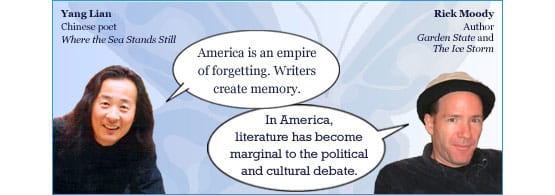
Dear Rick,
We first met in 1992 at the beautifully green Yaddo arts colony in upstate New York: a boyish American writer, and a Chinese poet in the third year of exile. In very poor Yanglish, I explained why I wrote the poem 1989.
The massacre of advocates of democracy in Beijings Tiananmen Square on 4 June 1989 is the formative event of my life. It is also one that links me to the Chinese past, for the event was hardly without precedent. Thirty million people in China died of hunger in 1959-1961, many millions more died in 1966-1976 during the cultural revolution.
Indeed, what shocked me in the west was peoples surprise that the Chinese state would go to such lengths to keep its power. It was as if the memory even of the recent past had dissolved if it had ever existed at all. The United States of America, like the rest of the world, professed shock at what happened in Tiananmen Square. But that shock was quickly forgotten when the Chinese government needed to be placated. In this, America helped and continues to help the world to forget the plight of Chinas people.
The struggle of man against power is the struggle of memory against forgetting, wrote your fellow-novelist Milan Kundera. Forgetting can be more terrifying even than death itself. Empty tears, as much as state or media power, can wash memory away, and thus serve to prepare us for the next surprise. The Tiananmen massacre here becomes not an event, but part of a forgotten history one that we Chinese continue to live inside.
I am writing to you from London, where I recently co-organised a conference on the fifteenth anniversary of the massacre. I recalled the complex feelings I had when seeing the fall of the Berlin wall at the end of 1989. The chain of pro-democracy struggles started in Beijing and ended in east-central Europe, but with totally different results. As exiled European writers returned home, my exile began. History ran in opposite directions in front of my eyes.
The then American president hailed 1989 as the dawn of a new age of freedom, but his great nation quietly forgot the fate of the Chinese who had campaigned for freedom during that momentous year. Instead it gazed with awe, and concern for its own living standards, at Chinas economic miracle one that, a new book, Survey of Chinas Peasants, shows to be built on cruel exploitation and inequality.
Now, every western government is running to China as though in a competition to shake its governments bloody hand. The United States and its British ally, who recently waged a war in Iraq fought partly in the name of human rights, are in the vanguard. Even as they adopt the symbol of justice as their own, they are trapped in the same forgetting that consumes China itself.
Are these double standards? To my mind, no. This is about interests, not standards. The United States had an interest in forcing Saddam from power, and it has an interest in maintaining the status quo in China by securing its future markets, and giving multinational companies the protection of the Chinese government for their huge investments.
Saddam was bad for business. China is good for business. The big western companies fear social instability in China even more than the Chinese government does. So they keep their mouths shut, despite knowing what the government does to Falun Gong, people with HIV/Aids and peasants. The Chinese Communist Party has become part of the international capitalist system!
Reality, belittles the madness of poets again. This line from my poem Where the Sea Stands Still seems to describe a world even weirder than in my imaginings. The hopelessness of the situation seems like an ever-present ghost, always haunting and always around me.
The United States of America was founded in opposition to cynicism. But in practice, the US employs a deeply cynical attitude towards a nations political responsibilities. Many others, including ordinary people, are complicit in its empire of forgetting.
My poem 1989 ended: This is no doubt a perfectly ordinary year. This is the real meeting-point between you and me. As writers, we share the responsibility to make memory from forgetting, to imaginatively transform the perfectly ordinary into the raw, the exceptional, the memorable. Our shared territory is borderless between space and time, no matter whether one is in China or the United States, living during the cold war or the world of pre-emptive war.
Reality belittles the madness of poets and novelists. But this reality is the deep root of our thinking and writing. We all have to start every day from where we are, no matter how hopeless it is or seems.
Do you agree?
Your friend,

Dear Lian,
By coincidence, Im writing to you from the spot where we first met, twelve years ago. Saratoga Springs, New York. Im teaching this week at Skidmore College, just a mile or so from Yaddo. Ive often found myself thinking of people Ive spent time with here over the years.
I remember that when you came to Yaddo in 1992 you demonstrated Chinese fortune-telling for a bunch of us. (My fortune: that I would die young but that my work would live on). I remember you saying that this rather rudimentary entertainment was a popular way of passing time during the Cultural Revolution, when you were living in the countryside. Thirty-six to a room, or thats how I recall the story. You said that if one guy rolled over in his sleep, then everybody else had to as well.
I remember being amazed that Id met someone whose life was affected so utterly by the course of history.
What I couldnt have predicted at that time - the first term of Bill Clintons presidency - was that issues of power and political control would become as manifest in the American political landscape as elsewhere in the world. Now the drift of history is becoming transparent to citizens of the United States. The question your letter raises in my mind is whether the kind of power exerted by the Chinese government over the people of China is significantly different from the type of power presently being exerted over the American people (and arguably over the people of the rest of the world) by the government of the United States.
The later difficulties of the Clinton administration are well documented. The campaign to remove the president was embarrassing and, in a way, unsurprising, since the opposition was so crass and desperate. Still, I was completely unprepared for what a dramatic political shift would begin to take place with the contested election outcome of 2000 and the attacks of 11 September 2001.
The George W Bush administration that came to office with the first of these events, and reinforced its power after the second, continued to overlook Chinas exploitation of its peasants and migrant workers, its Uighur minority, and the people of Tibet. It continued to ignore repression (and worse) in Zimbabwe, Congo, Sudan, Israel/Palestine, and Uzbekistan. But it also began enacting at home laws that seemed dissimilar to those of dictatorial regimes only in degree, if at all.
Now that the government has codified (as, for example, in the USA Patriot Act) the notion that it is appropriate, without a warrant, to keep a file on our reading habits, we understand more about Chinese attempts to filter the internet for its citizens. Now that an American citizen can be held indefinitely without charge as an enemy combatant, with only minimal legal rights, we know more about Chinese repression of political dissidents. Now that congressional voices from the party in power suggest that gay people do not possess equal rights before the law, we perceive more about repressive dictatorships worldwide.
My supposition is that power does corrupt powerfully.
My supposition is that American rhetoric about freedom is hollow, and that the repetition of it is meant only to persuade those who, by dint of insufficient education or interest, are ill-equipped to evaluate the terms by which power is exercised over them.
My supposition is that American capital (the very source of our fascination with Chinese state capitalism, which rightly distresses you in your letter) has now become the state, trumped the state, eliminated the state, rendered the state unimportant, or simply become a secondary arm of its project.
My supposition is that multinational corporations are the city-states of the new unilateralist imperium.
My supposition is that the nation-states of old merely provide the military muscle, in case of trouble, for their business cronies.
My supposition is that to be an imaginative writer in a time like this is to feel that the lie has become the fervent rhetorical gesture of the age. Lying is routine, lying is human, lying is practical, lying is unavoidable, lying is smart, lying is apparently even noble and generous (at least according to those now in power in the United States).
That doesnt make it right or true. But how does literature define its project when the ontology of the moment is so bound up with a daily diet of imaginative corruption and malfeasance? To be a literary writer in a time like this is to beckon with a tiny shrill voice that has become apparently irrelevant, as recent National Endowment for the Arts studies of American reading habits disclose: less than 50% of Americans in 2003 consumed a single book - any book - of fiction or poetry.
Americans have become a nation of people used to being treated by our rulers like we dont care, and in turn surrendering through inertia to such treatment. And yet we are also the nation that believes it rightly controls the world. How to write of this terrifying moment without despairing about the marginality of literature to the cultural debate? I can only hope that these dark days somehow spark a revolution of dissent from the corruption of American power. It happened in eastern and central Europe in the 1960s and 1970s and it happened in China in 1989, spinning fine literature in the process - your own poems being a case in point. Perhaps it can happen here too.
Love,


Last week in the series: Czech Eurosceptic and presidential adviser, Petr Mach, writes to Jeremy Rifkin, US author of The European Dream.
The Letters to Americans project will run until the US presidential elections on 2 November 2004. Projects like this are challenging to organise and expensive to deliver, but we think it is worth it to bring America into dialogue with the world. If you agree, please support us.
Copyright and Contact All Letters to Americans exchanges are copyright of openDemocracy. For syndication, republishing and other enquiries please e-mail Julian Kramer@opendemocracy.net

