
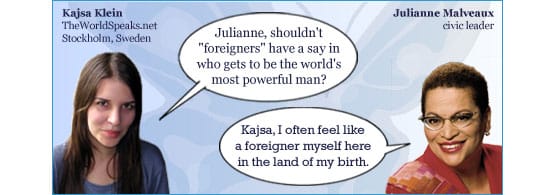
Dear Julianne,
Land of the free, home of the brave. August 1981. I was 7 years old, and we were headed to an island off the coast of Maine where for one semester I would go to second grade, my dad do his cancer research, and my mother take care of my younger brother. My parents had bought me a diary, the first entry is from the plane I was very impressed with the hot, wet towels. On the ground, a coffee shop, where I felt sick, and the sight of the Bronx at night from our car window. Homeless people. Fire. Coming from the protected welfare-state Sweden, Reagans America offered me a first meeting with poverty. I was frightened.
Of course, Maine turned out to be different from the Bronx. I remember sandy beaches, beavers, lobsters, and chipmunks. At school, I was treated very well. The kids were curious about the new girl from Sweden, and happily traded my fruit for candy at the morning break. Math was my favourite subject, for the simple reason that it didnt require much English. Great! Excellent! Terrific!
A positive attitude, thats something many people associate with America. Clarity, I would add. Just think of the accent, so much easier for the rest of us to understand, and mimic, than that restrained and complicated British. American - straightforward, confident, and loud. However, there is also a darker side of simplification.
After I returned to Sweden, my perception of America changed. I watched Fame, Ghostbusters, Dallas, Wall Street, but most of all, the cold war. Julianne, to us in the Swedish audience, it wasnt Good vs Evil; it was more like pest and cholera. American and Soviet leaders, how could they be so incredibly stupid and destructive?
The fall of the Berlin wall made my late teens aah, the sense of freedom, excitement and discovery! It also eventually brought me back to America. After a series of rendezvous in Prague, Stockholm, Reykjavik, Lisbon, Copenhagen, I finally decided to visit the American writer I had met in 1992 in his home.
New York City, June 1995. It was not what I expected or remembered. Gone was the black and white. The street violence, I just didnt see it. The hundreds of thousands of Aids victims? Invisible to me. Rambo, Bruce Willis, Arnold Schwarzenegger? Nope. My impression of New York in 1995 was that it was just so much more colourful and human than I expected from the movies. In Georges Greenwich Village garden stood a natural size, unpainted wooden giraffe sculptured by an artist friend. For a young woman from Sweden, the city was lovely and quite liveable.
The pleasures of fire-escapes and rooftops. Supermarket Baba Ganousch with 500 spices, brainy seminars at Columbia University, saxophone music, chocolate fudge brownie, Hal Willners celebrations in St Anns church, dim-sum Sundays. Since that summer, I have been a regular visitor, and probably the most pro-American of my friends, with the exception of my Democracy Aid 04 cofounder Hanna.
We started Democracy Aid 04 because we could, and because we were genuinely concerned with the Bush administrations sabotage of international law. Why should we silently watch when the future of the whole world appeared to be at the mercy of a small number of voters in a few swing states? Shouldnt a political campaign that has such obvious global consequences invite the participation of the majority of people whom it will affect?
American friends have long argued that if you want to change the world start with the imperial centre. Want to affect the situation in Israel? Go to Washington. Congo? Washington. This is something that I have always been ambivalent about. That and the nostalgic and inward-looking attitude of many otherwise sympathetic American liberals. How can they have failed to notice the treasures of global culture? Could it be because of the media climate in the United States? Because of the supremacist and self-sufficient regime?
Democracy Aid 04 was an attempt to aid democracy where it matters. We also wanted to put democracy aid hypocrisies on the agenda. Why shouldnt we, as world citizens, have the right to give our money to a good cause? When we first launched our campaign in fall 2003 we used the internet to direct small contributions from non-Americans to MoveOn.org. Like many Europeans, we first learned about this organisation through email-based petitions. We were impressed by the net activist savvyness. There was also something interestingly vague about their self-presentation. Yes, there was a lot of talk about representatives in Congress and citizens. But at the time it wasnt entirely clear to us that they meant Americans only. Bush opposition is, as Im sure you know, a global phenomenon.
MoveOn.org felt they had to refuse our money. For our interference in your election, we have been accused of breaking the law; even of being extremist pro-al Qaida peace hippies who blame every conceivable problem on the United States. I find it very strange how so many people in the US and elsewhere appalled by the idea of financial influence from abroad, are still perfectly comfortable with financial, economic, political and military influence originating from the United States. Often our critics seemed to be the very same people who supported the war in Iraq.
And its not just the issue of campaign contributions or messages to American voters (I later worked on the global, multimedia collaborative dialogue, The World Speaks). Republicans say foreigner, global test and the UN as if those were terms of abuse. Doesnt this fact alone demonstrate that American democracy is in need of our aid?
Julianne, I would like to hear what you think. Do you see the whole question differently?
Sincerely,

Dear Kajsa,
I smiled at the opening of your letter and your recollection of your first trip to the United States. For some reason, it made me a bit nostalgic, thinking of my own firsts in this country, remembering the trips I made as a young girl to the various national parks in our country, and being awed by the majesty of nature.
On the surface America is an awesome place, for so many reasons. There are the purple mountain majesties above the golden plains that we sing about in America, the Beautiful. And there is the amazing diversity that is our contemporary reality. And then there is the ugly underbelly that makes part of the song a blatant lie, and crown the good with brotherhood. What brotherhood, I ask? As an African American, I know all too well that brotherhood is myth and not reality. I often feel like a foreigner myself here in the land of my birth.
It was indeed a treat to hear from you from Sweden, a country that is special to African Americans because of Gunnar and Alva Myrdals authorship of The American Dilemma: the Negro problem and modern democracy. Published sixty years ago, this searing indictment of American democracy has yet to be reversed. The signs dont say white or colored anymore. The question is not whether one has to ride on the back of the bus, but whether one has the bus fare, can drive the bus, can own the bus, can zone it, or can even import the parts for it.
All of those questions have 21st century civil-rights ramifications, but the basis of the questions lies in those raised in the American dilemma, stuffed in the crevices between the stripes in the flag, reflected in the hazy mist clouding the flags stars, a phenomenon as fundamental and foundational as the straightforward clarity you identify with America ordinary, ugly, old-fashioned American racism, which I would argue resonates not only in our relationships at home, but also in the imperial way we deal with nations abroad, especially developing nations.
And it is racism, classism, and pure hunger for power that is shaping this 2004 election. Already in Florida, African American ministers are complaining about people who have been thrown off voting rolls. Already, we are harkening back to a darker period where early voting sites are located at distances furthest from the African American (most likely democratic) community. And already the drumbeat of voter suppression is getting louder. Will students who attend school at a place different from where they got a drivers license register to vote? How many forms of identification will be required? What remedy will there be for those unjustly turned away from the polls?
And who are we, Americans, to lecture the rest of the world on democracy when we havent quite figured out how to practice it ourselves. Our nation has a big blind spot where black folks and poor folks are concerned. We offer this group of people a very different democracy than what we offer the rich, the white, and the privileged. And yet we have the temerity to travel the world preaching democracy, to suggest, when all other excuses fail, that we invaded Iraq to bring democracy there. When, then, will we invade Florida or Mississippi to the same end?
There is a big difference between America the ideal and America the reality. The world has often admired the ideal, the fairy-tale story of the Boston Tea Party and our fierce desire for independence, the principles reflected in our constitution and bill of rights, our evolution as a superpower, our participation in both world wars to advance a higher world vision.
There is an ugly underbelly to the reality, though. The same patriots who wanted independence withheld it from Native Americans and African slaves. The same America that generously rebuilt Europe through the Marshall plan has failed to offer debt relief to Africa. It has failed to concur with key United Nations conventions on womens rights, on the environment. The contradictions are many.
Some of us, then, rely on our foreign friends to hold up a mirror to us, to remind us of the difference between who we are and who we say we are, to lob effective criticism. And some of us, utterly frightened by the world destruction that is very likely to be part of the Bush legacy, are heartened by foreign interest in and support of John Kerry.
Still, the MoveOn.org folks are probably quite sensitive to the jingoism that emanates from the Bush White House. John Kerrys pledge to consult other world leaders on world matters has led to the distortion of his record by George W Bush and his cronies. After the first debate, they said that hed offer other world leaders a veto on US affairs, and attempted to paint him as weaker on terrorism because of it. MoveOn.org has been doing effective work and they cant afford the distraction of fighting with the right about foreign money that is influencing that work. Though I would guess that they would welcome you as allies and appreciate your sentiments, they probably dont want another battle to fight as this heated election nears its climax.
This is, again, an example of our American hypocrisy. We dont hesitate to influence other peoples elections witness the comments made by both Bush and his secretary of state, Colin Powell, about the president of Venezuela as the electoral process in that country was underway. We have a hubris that suggests that we live by one set of rules and the rest of the world lives by another.
You are right to be concerned about our elections because they do impact on the quality of your lives in the rest of the world. As we continue to assert ourselves as the cradle of democracy, our democracy is horribly flawed. I was never more embarrassed than when I appeared on an international talk-show days after the Florida debacle and a man from Rwanda asked if US elections needed international supervision! It is late in the day, but perhaps some of the funds that you have raised to help MoveOn.org could be used, instead, to send a couple of observers here on 2 November 2004 to observe this grand democracy in its splendour and its squalor.
Kind regards,


The Letters to Americans project will run until the US presidential elections on 2 November 2004. Projects like this are challenging to organise and expensive to deliver, but we think it is worth it to bring America into dialogue with the world. If you agree, please support us.
Copyright and Contact All Letters to Americans exchanges are copyright of openDemocracy. For syndication, republishing and other enquiries please e-mail Julian. Kramer@opendemocracy.net

