
In October 2003, I started making portraits of American soldiers who were wounded in the Iraq War. I began the project because I was not seeing any images of wounded soldiers, much less wounded Iraqi civilians, in the American press. The human cost of war seemed conspicuously absent from public view. I felt that maybe if Americans saw images of their own wounded sons and daughters, they might have more realistic understanding of the consequences of war.
There are no lists of the wounded, unlike the dead. In newspapers, the names of the dead are published every day along with their ages, hometowns and command units. I read these names and feel sorry for the soldiers families and friends. But the dead tell no stories. It is the wounded that survive and present us with our own complicity.
Purple Hearts: Back from Iraq is published by Trolley Books
I found my subjects by going on the internet and plugging in certain words: brain damage, blind, wounded, arm, leg, and amputee. I then tracked the soldiers down in their hometowns after they had been discharged from military hospitals. I avoided photographing them at public events like welcome home parades or medal ceremonies. I wanted to see the soldiers in private and alone as each confronts his or her loss and considers the experience of war, their reasons for enlisting in the military and life ahead.
When I started the project there were a thousand wounded. Now there are tens of thousands. They have lost eyes, ears and pieces of their brain. The damage is wrenching and at first I was not prepared for the suffering. Then I became obsessed. I couldnt stop the project. I had to find more soldiers.
Looking back, I now understand how desperate I was to carve out a place of truth amid the spectacle of shock and awe, mission accomplished, the hunt for Saddam, and the yellow ribbons and freedom fries.
There is a curious divide between those who live the reality of war each day the combatants, their families, the civilians under occupation and those for whom war is just background noise in the nightly news reports.
For me, photographing the soldiers made my countrys actions very personal and real.
The soldiers in Purple Hearts: Back from Iraq represent a small number of the 5,394 American servicemen and women wounded in action and the estimated 11,000 others injured in combat support during the first fifteen months of the American invasion and occupation of Iraq. A precise number of combat support or non-hostile injuries is not known. The Pentagon omits from its casualty reports those soldiers medically evacuated from Iraq due to friendly fire, sickness, accidents, or psychological trauma even though many of these soldiers are severely injured and permanently disabled.
Iraqi casualties are not counted at all.
Spc. Sam Ross
It was the best experience of my life
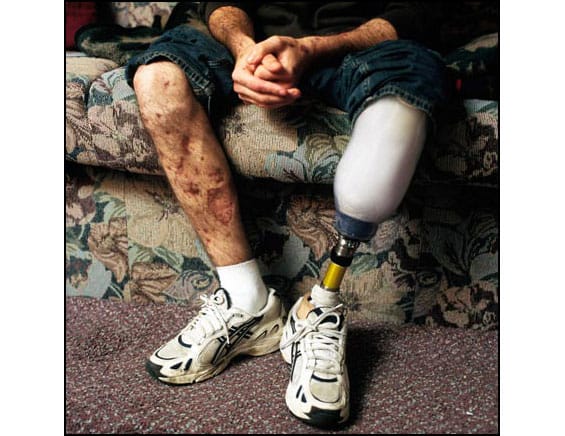
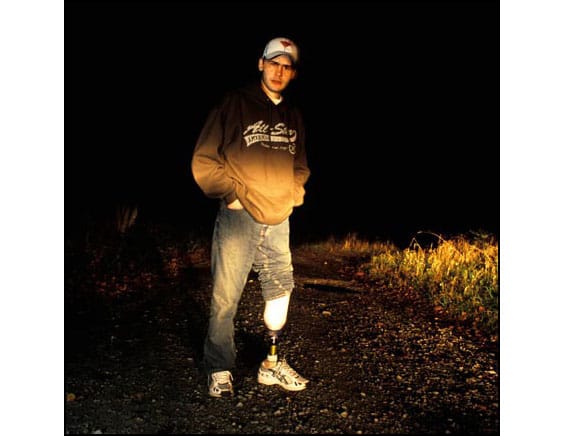
Spc. Sam Ross, 21, combat engineer, 82nd Airborne Division, was injured 18 May 2003 in Baghdad when a bomb blew up a munitions disposal operation. He is blind and an amputee.
I lost my left leg, just below the knee. Lost my eyesight, which is still unsettled about whether it will come back or not. I have shrapnel in pretty much every part of my body. Got my finger blown off. It dont work right. I had a hole through my right leg. Had three skin grafts to try and repair it. Its not too bad right now. It hurts a lot, thats about it. You know not really anything major. Just little things. I get headaches. I have a piece of shrapnel in my neck that came up through my vest and went into my throat and its sitting behind my trachea, and when I swallow it kind of feels like I have a pill in my throat. Some stuff like that. And my left ear, it dont work either.
I dont have any regrets. No not at all. It was the best experience of my life. Twenty-one years old and Ive seen a couple of countries. Ive been pretty much everywhere and done everything. Ive jumped out of airplanes. I got to play with mines. I got to see how the army works. I got to go mess around with a bunch of guys that feel the same way I do, that all enjoy it. I got to interact with people of another culture, people who live their lives 100% different than the way we live here.
I have one brother and one sister. Couldnt tell you where they live. For a while we grew up together. Mother? Father? Well they both exist. Theyre both alive, but circumstances regarding the relationship are kind of complicated.
I sleep. I dont do anything really. Aint nothing really to do around here. Its a shit hole. Same thing it was when I left.
One of the biggest things thats wrong with people nowadays theyre so anti-military. Not in the sense where they dont want a military, but they dont want our military involved in a conflict. And thats what makes us America.
I want to go into politics. Run for office maybe. This is still secret but Im talking with people about working with the army. Going on speaking tours. That kind of thing.
Spc. Sam Ross was photographed in the woods near his trailer where he lives alone in Dunbar Township, Pennsylvania, 19 October 2003
Sgt. John Quincy Adams
My head doesnt let me work
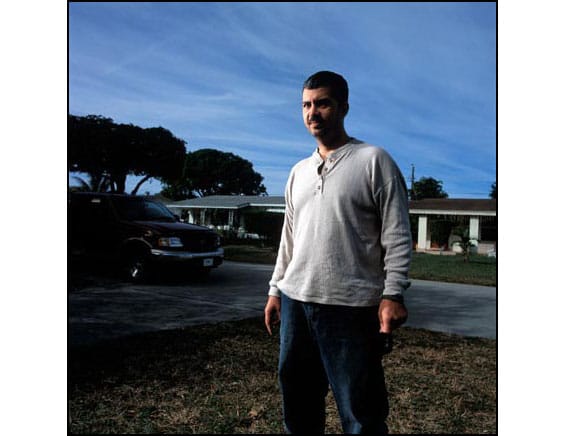
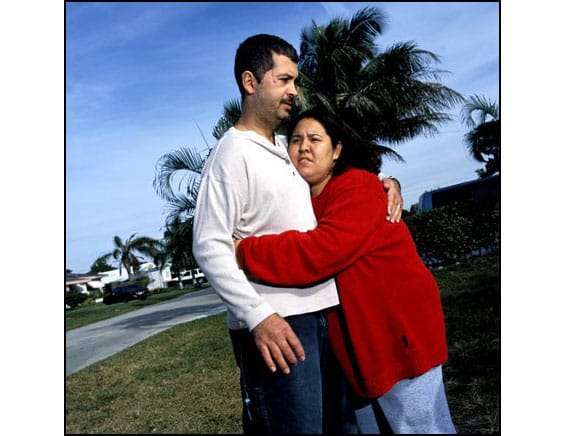
Sgt. John Quincy Adams, 37, a Reservist with the Florida National Guard, 124th Infantry, was on patrol in Ramadi 29 August 2003 when a remote-controlled bomb exploded under his humvee sending shrapnel into his head and body leaving him brain damaged.
I was doing landscaping and lawn service in north Miami with my father-in-law. I loved it. Now I like being with the kids and my wife. I try to be with them always. But the big one likes school and the little one stays behind. I take them both with me and my wife to the Veterans Hospital.
There is not much I can do now because if I do it and I fall, and I hit my head, it was cause for it to move my brain and the metal I have back here will move. My head doesnt let me work, plus my arm.
I joined the Guard for money and I liked putting on the uniform.
It was in Jordan I landed and there was, how can I say, it was my destiny and I felt inside me emptiness because my wife wasnt there, but I knew I had to do it.
Summer Adams, Johns wife: He cant run. We cant let him run. We cant let him risk falling. He needs a lot of sleep because the medication makes him very drowsy. Hes on medication for seizures, mood swings and depression.
He has metal in the right lower quadrant of the brain. He had a lot of rock and shrapnel that came on the side of his face and he has several entry and exit wounds in the arm which damaged nerves and tendons. And then the mental issue.
Sgt. John Quincy Adams was photographed at home with his wife Summer, in Miramar, Florida, 18 December 2003
Spc. Luis Calderon
From my neckline down I cannot feel anything
Spc. Luis Calderon, 22, from Puerto Rico, a tank operator, 4th Infantry Division, was injured 5 May 2003 in Tikrit, when a concrete wall with Saddams face on it, which he was ordered to destroy, came crashing down on his tank severing his spinal cord and leaving him a quadriplegic.
The wall, it was a mural of Saddam Hussein with his green uniform, beret and a big rifle pointing to the sky. I was excited, pumped to put the wall down. I was feeling good. I couldnt wait to hit the wall. It was a sunny day, a beautiful day, blue skies. My tank was an M-88. We were five days in Tikrit.
I hit the wall and it just crashed on me and crushed my head and broke my neck and I was dragging the wall still about 100 metres. I felt everything separated, like in relaxing mode, but in reality I was still driving the tank. I couldnt feel my hands on the wheel. I felt nothing. My sergeant was telling me to stop on the radio but I couldnt speak loud because my voice just went away.
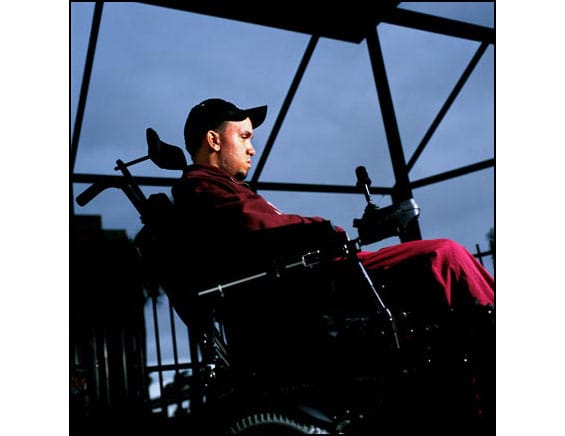
Ive had three surgeries. My spinal cord is C3-C4 which means quadriplegic. From my neckline down I cannot feel anything.
Im just happy I took the wall down. No regrets. I did my job. I got an Army Commendation medal. I didnt get a Purple Heart. I feel like I deserve one. It would make me more confident that I really did something.
Im disappointed that when they ask you to go, we go. And when we ask them where is our reward for doing something, they take their time. I dont know. I dont know how the system works but its pretty bad.
For the moment right now, I just want to heal.
(Despite his classification as a quadriplegic, Calderon waited more than seven months to be retired and discharged, a difference in benefits of several thousands of dollars a month.)
Spc. Luis Calderon was photographed at the Miami Veterans Hospital, 17 December 2003
Pfc. Alan Jermaine Lewis
Death has always been around
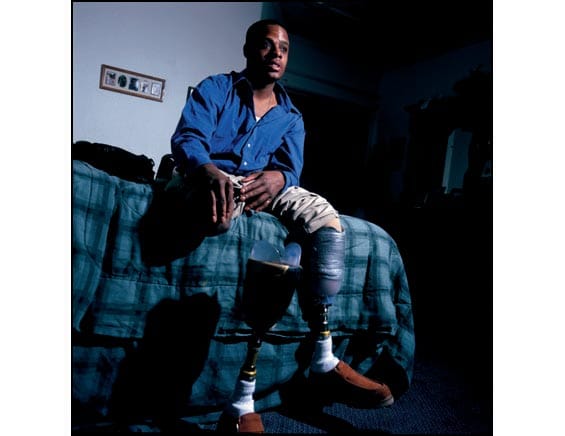
Pfc. Alan Jermaine Lewis, 23, a machine-gunner, 3rd Infantry Division was wounded 16 July 2003, on Highway 8 in Baghdad when the humvee he was driving hit a land mine blowing off both legs, burning his face, and breaking his left arm in six places. He was delivering ice to other soldiers at the time.
Ive always thought about death way before I joined the military , just growing up in Chicago and living out here in this world. I had a friend when I was six years old. His name was Charles and he got killed. He was shot in the head. I think it was a stray bullet. My oldest sister was killed by a stray bullet. I was just a few months old. And my father was killed when I was seven. He was being robbed. So death has always been around.
I remember every detail about my legs. every detail from the scars to the ingrown toenails to the birthmarks to the burn marks. I made it a habit even before I joined the military, to cherish every part of my body, cause I would always look at it like, What if this finger was gone, would I be able to function without it? Things like that Ive always had on my mind. I dont know why, maybe its Gods way of preparing me for what was going to happen.
Ive been dealing with the military since I was sophomore in high school. They came to the school like six times a year, all military branches. They had a recruiting station like a block from our high school. It was just right there.
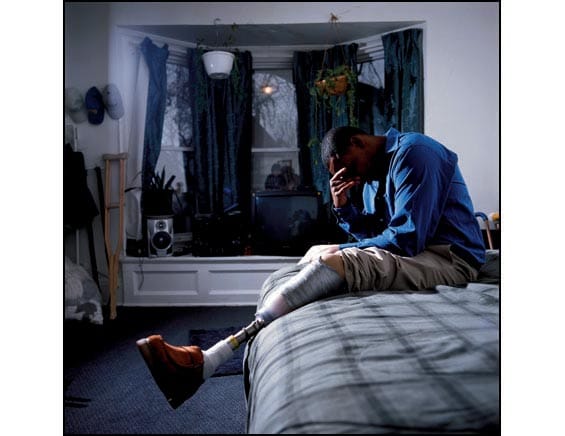
In basic training they break you down and then try to build you up. But I always had it in my mind that you cant break me down because I know who I am.
I always wanted to go into education and become a teacher but they just dont make enough to survive off. So I figure with my disability now and the money Ill get form the government, I can use that plus the money Ill get from being a teacher and live comfortable. So I want to go to college and study education public school primarily middle school, six to eighth grade.
The reasons for going to war were bogus but we were right to go in there. Saddam was a bad guy.
Pfc. Alan Jermaine Lewis was photographed at home in Milwaukee, Wisconsin, 23 November 2003
Pfc. Randall Clunen
Im an adrenaline junkie
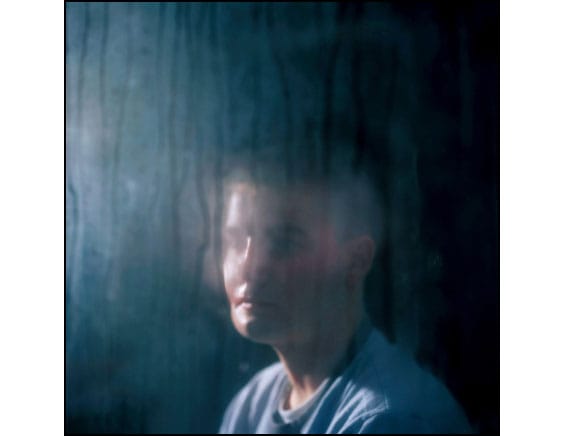
Pfc. Randall Clunen, 19, 101st Airborne, stationed in Tal Afar, was pulling guard 8 December 2003 when a suicide bomber broke through security and exploded himself and his vehicle. Chunks of shrapnel ripped into Clunens face.
I really have no idea what my mission was. We were trying to catch the people that were doing stuff. Looking for AKs, RPGs, just stuff like that. We found some weapons, but most of the time we would just go to get the people for information. And when we werent doing that we were sleeping or eating. We had TVs and Play Stations.
I liked it. The excitement. The adrenaline. Never knowing whats going to happen. I mean you could walk in a house and it would blow up. Or you could go in and get fired at. Im an adrenaline junkie and I like that. I want to get out there and hump stuff on my back. Thats whats I was doing. I was doing what I wanted. I did something with my life instead of sitting around doing nothing.
Yeah they (Iraqis) were scared. You have like nine Americans busting into your house just screaming pointing weapons. Yeah they were scared. We would go in when they were sleeping and we would just bust in and wake them up so they didnt have time to get their stuff.
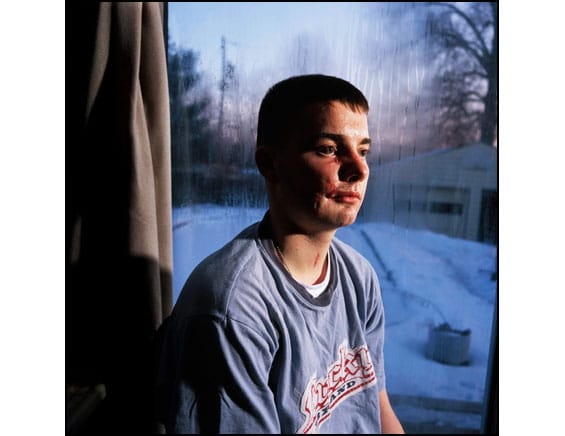
I have no political feelings. Im just a soldier out there. You know, were trying to help them live like us so they can be free and not be scared to do anything. Trying to set them free. Thats how we looked at it. Sometimes we hated being over there because they just didnt respect what we were doing. We were trying to help them and they didnt want us there at all.
It was a car bomb. A suicide bomber. He came just ripping through the gate and he exploded the car and himself. I got hit. My nose was sitting over here, like on the left side of my face and I couldnt breathe so they had to cut a trachea in. I was bleeding extremely bad. They kept me in a room by myself because I was just like really bad looking. I had tubes running all through me.
All the excitement that was going on, now its nothing. You just watch the news or you watch the war movies on TV. Full Metal Jacket, theres a couple of other ones. I want to find Hamburger Hill, thats a good one about the 101st. My dad and I, wed just sit there and watch them. A lot of John Wayne movies too, you know the cowboys and Indians, and then the war movies.
Pfc. Randall Clunen was photographed at his home in Salem, Ohio 14 February 2004
Spc. Corey McGee
We dont know who the bad guy is
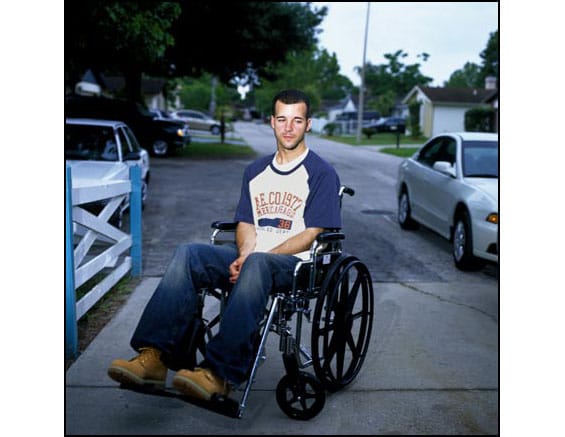
Spc. Corey McGee, 25, a 50-caliber gunner with the 10th Mountain Infantry, was injured in an ambush while backing up Marines in Fallujah 9 April 2004. Bullets pierced his neck causing nerve damage and partial paralysis.
Basically whats wrong with me now is that I had shrapnel in my neck and I was paralysed because of it. I cant really walk. I cant feel the right side of my face, from shoulder blade to my right ear. I have enormous amount of pain inside my neck. I cant sleep because it hurts so much. I couldnt even eat for a long time. Its hard for my body to keep it down. I cant ask for anything more, just to be alive. Im going to be better.
Everyday in Iraq you think okay, I made it today, Im going to make it tomorrow. If it werent for your buddies lifting up your morale, you would go crazy, you would lose it. There was just so much going on. You were never safe. You cant tell the enemy or who he is. If the bad guys knew that we were only there to help them, if we could show them. But its so hard because we dont know who the bad guy is. We dont know who to trust.
We made sense of our day by trying to survive every day.

Sometimes you feel hopeless and when you see somebody wave to you, that give s you so much hope for that country and hope for us, for the US, so that we will never have 9/11 happen again. I think thats why were over there. Its so that were bringing it to them, and theyre not bringing it to us. Basically its the war on terrorism. Theyre attacking US soldiers and I consider that to be an attack on the US the land, the sand. To me thats just the same thing as 9/11.
I have to say it definitely starts in basic training, thats when you start learning. Thats when you start loving your country.
I was a little bothered by the fact that no Weapons of Mass Destruction (WMD) were found. I was thinking that we were going in for a reason and that was one of them, of course we have several other reasons, but when you think that were searching for WMD and actually were not, then that leads you to think, okay, if thats not the case, what is to say that the other reasons were there, like rebuilding the government, are really happening. It kind of gives you a little doubt, it does.
Spc. Corey McGee was photographed at his home in Tampa, Florida, 17 May 2004
Sgt. Wasim Khan
Before I came to America, I thought Americans were smarter
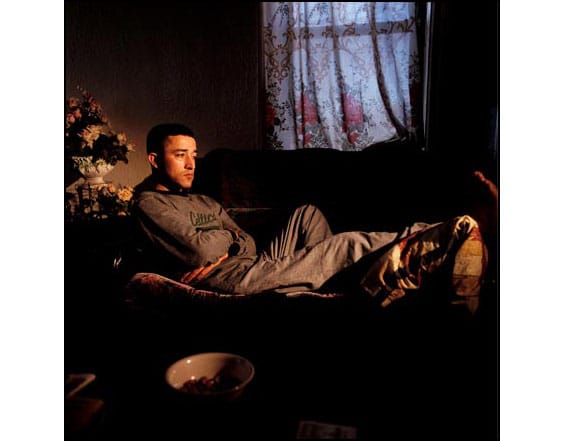
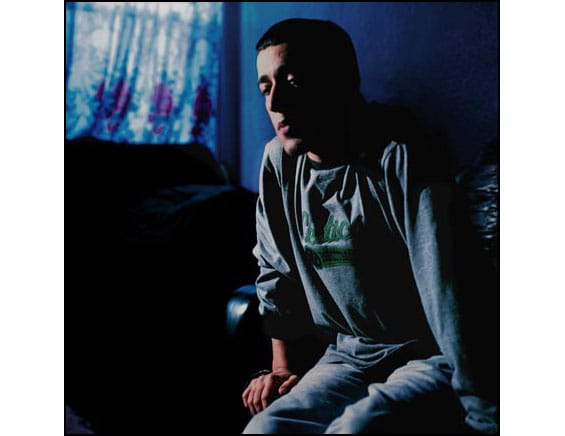
Sgt. Wasim Khan, 24, 1st Armoured Division, was pulling security in downtown Baghdad 1 June 2003, when an RPG attack shattered his leg and sliced his body with shrapnel. An immigrant form Pakistan, Khan received his citizenship while recovering at Walter Reed Military Hospital.
Ive had a total of seventeen surgeries, two in my eye and fifteen in my leg. I feel the pain. I got to eat something and take my medication. I cant move my leg so I have to keep it up on the couch. I have shrapnel in my arms and legs. I can feel them, theyre moving. In the shower, little pieces are falling out.
Im not really down to be honest with you. What happened, happened. They way I think, it was supposed to happen that day and I cant do anything about it. The good news is that Im still alive and God bless I still have both legs.
I feel like I am part of history. In Washington, we go out together, the Korean veterans, the Vietnam veterans, and now the Iraqi veterans. Theres this Vietnam veteran who comes on his own and brings us milkshakes three times a week to the hospital.
Actually before I came to America, I thought Americans were smarter. But when I talk to them, they dont know about other countries. Even some people dont know American history. I study. I read books. I read the newspaper. I watch the news. You should know about every other country. Its a good thing to know.
When I was here a couple of weeks ago they killed two Pakistani Muslims here in Brooklyn. They were coming from the mosque. It was on the news. They called them Taliban, Taliban, and they shot them. But Ive never had any problems.
Sgt. Wasim Khan was photographed at his home in New York City, 10 January 2004
Sgt. Jeremy Feldbusch
I knew about the Middle East as much as I needed
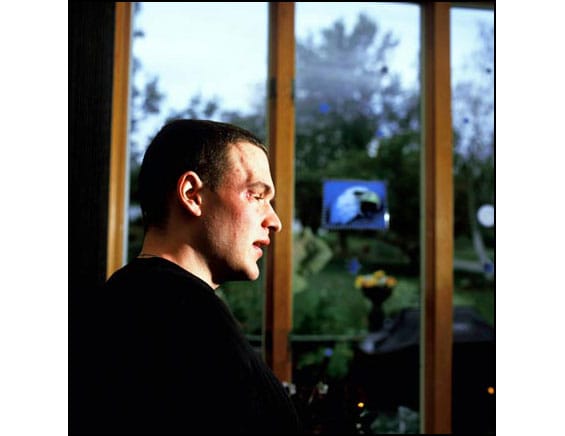
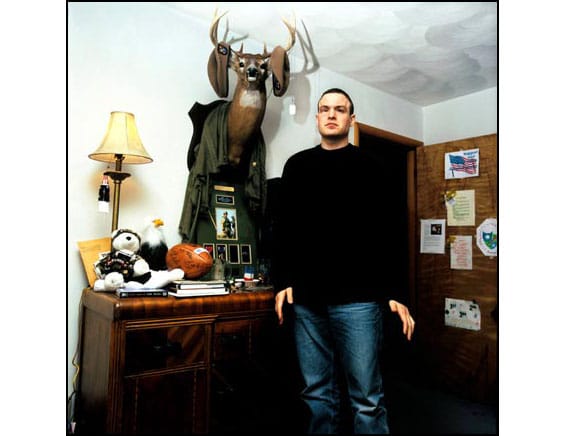
Sgt. Jeremy Feldbusch, 24, a Ranger, 3rd Battalion, 75th Regiment was injured 3 April 2003, during an artillery attack near the Hadithah Dam. Feldbusch, who was first in his class of 228 Rangers, is now brain-damaged and blind. He sees nothing but darkness.
I graduated from the University of Pittsburgh. I had a great time there. I was a biology major. At one point in my life, I wanted to be a doctor.
Even while I was going through college, I thought about going into the military. And when I was done, it was brought up to me again, about going into the army, and I thought, you know what, I would like to do that. There were lots of other things I could have done but I was like, you know, I want to do that. And I talked to recruiters around here, I knew the commander of the recruiting station and he was trying to get me signed.
Before I went, I knew about the Middle East as much as I needed to. But it didnt make a difference. I wasnt fighting a political war with them anyway. That was already taken care of. It was a new kind of war that was going to be fought, so that was where I was stepping in.
Thats about it. I dont have any regrets. I had some fun over there. I dont want to talk about the military anymore.
Sgt. Jeremy Feldbusch was photographed at his home in Blairsville, Pennsylvania, 18 October 2003
Lt. Jordan Johnson
Im not a hero. Im a survivor
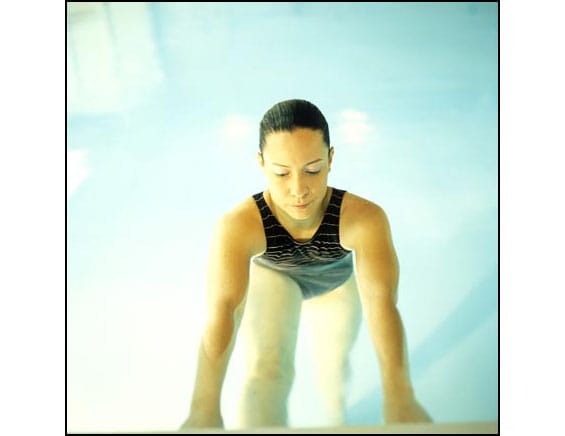
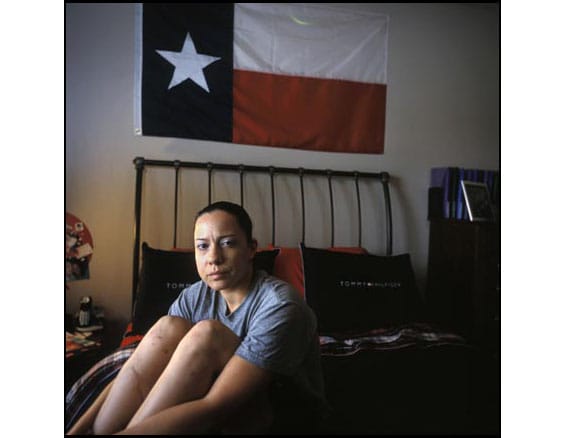
Lt. Jordan Johnson, 23, in charge of a platoon protecting the general of the 1st Armoured Division, was en route from Baghdad International Airport 20 July 2003 when her humvee crashed and flipped, smashing her leg and tail bone, and putting her into a coma. Another soldier died in the crash.
I really had a hard time wanting to be even here. They told me last month I have chronic post-traumatic stress syndrome so I meet once a week with a psychologist. It helps to talk to someone. Basically I just cant sleep. I literally only get maybe three or four hours of sleep a night. Its a very restless sleep. Its strange because I wear myself out. I do as much as I can physically and probably too much emotionally. Im just never tired. Im tired. I just cant sleep.
When I got to Walter Reed, there were support groups for all the soldiers who got injured in Iraq. I was the only female. It started off people really talking about their injuries, and it just became a woman bashing scenario. I was very uncomfortable. I felt let down. It would be nice to say that everyone is nice and treats you as equals, but they dont.
Someone asked me the other day, how does it feel to know that you were going over there and one of your missions was to find WMDs and how does it make you feel not to have found any? Its disappointing. You go in with a mindset as a soldier that you have a mission. We found Saddam, that was amazing. The fact that we havent found any weapons thats upsetting. So here my brothers gone over there in January, so now whats the mission?
Being part of the United States, what our main goal always seems to be is going in and proving that were a super power. Why are we trying to prove that?
All I really want out of this is to be able to walk again, to run again. I went from star athlete to not being able to do six repetitions. Its a very slow process, but Im dealing with it.
I dont need a medal or any kind of badge or award that says who I am because I know who I am. Im not a hero. Im a survivor.
Lt. Jordan Johnson was photographed during rehabilitation at Brooke Army Medical Centre in Sa Antonio, Texas, 26 March 2004
Spc. Robert Acosta
All the reasons we went to war, it just seems like theyre not legit enough for people to lose their lives for
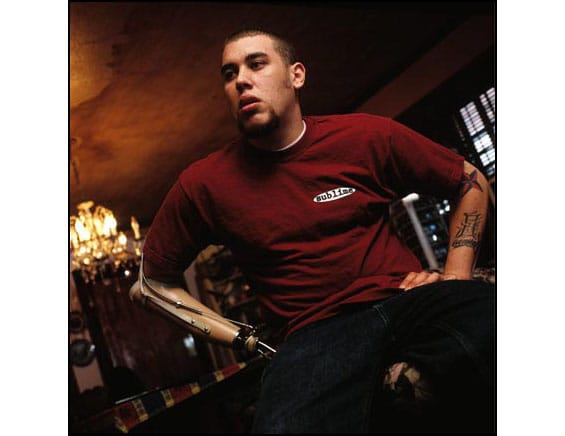
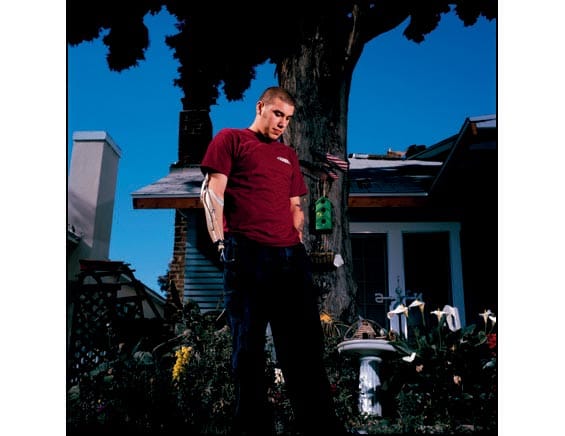
Spc. Robert Acosta, 20, an ammunitions specialist with the 1st Armoured Division, was in a humvee near Baghdad International Airport 16 July 2003 when a grenade was thrown into his vehicle. In the explosion he lost his right hand and the use of his left leg.
The first real eye-opener was just driving through the desert and seeing vehicles blown up and bits of uniforms everywhere and I guess the aftermath of war, and just people throwing rocks, seeing the hatred of people, the love of people. A lot of things that people arent supposed to see like destruction and houses where people lived, just destroyed. Little kids in the middle of nowhere. You know that they dont have no families. It looked like it had the potential to be a really pretty city but it was mangled, just destroyed.
It was 16 July. I think three guys were killed the day I was injured. It was broad daylight, 1800 hours, and the grenade flew in through the window, landed on the radio between me and my buddy. It went off in my hand, took my hand off, shattered my left leg, broke my right ankle, blew the whole body of the humvee out. My buddy Anthony, he was fine, nothing happened to him. I remember asking him are you alright, and he said, yeah are you? and I said, no dude, my hand is gone. I was telling him man, I dont think Im going to make it and he was telling me to shut up. He got me back. Hes in Germany right now. he got our because of like psychological or whatever. It messed him up.
At Walter Reed, it tripped me out. I guess you hear about guys getting hit and this and that but you dont realise until you actually see them. Because when somebody gets hurt, theyre out of there within hours. You hear rumours, you hear stories, some guy got hit, some guy that but you dont really see the reality of it until you get there and see them in hospital. Its a trip when youre one of those guys too. I mean we would go to the mall and it would be like me missing my hand, my buddy Ed missing a leg, my buddy Chris missing his whole arm. Were all in crutches or wheelchairs, whatever, and theyre just like five or six of us going through the mall, soldiers just back from the war, mad at the world just talking shit to everybody.
But in California, nobody really knows what soldiers are going through. They see on TV, oh yeah, two soldiers got wounded today and they think, Yeah hell be alright. But that soldier is scarred for life both physically and mentally. But they dont understand. They see one soldier wounded and theyll forget about it like as soon as they change the channel. Some people get brave and theyll ask me What happened to your hand? And I say I was in Iraq, got injured, lost my hand, whatever. And theyre like, The wars still going on? And Im like, oh my God, are you fucking serious? What do you live in a fucking cave?
Before I would go to a lot of parties. I would go to a lot of clubs. I was always out and about. I havent been to a club. I havent been to a party. I dont care what people think, I just dont like dealing with the questions. Like Was it hot? Did you shoot anybody? They want me to glorify war and say it was so cool and it was like I did this and that. Theyre just ignorant. I mean you watch action movies and they glorify all this stuff like war is something cool, like its something you want to do. But the reality of it is, seeing all that crap, fucks you up in the head, man. I cant sleep at night. It sucks. It really sucks.
You know Santa Ana really isnt the best place in the world. Opportunities in this town are very hard to come by. The education is just out the window. Like my brother went to high school this year. Hes a freshman, and he like had to sit on the floor in some of his classes. The books are all written in, its just graffiti and pages torn out. Thats how it was when I went to high school, like the people dont care.
Theres a lot of stuff that happens around here. You go to parties and see people shot up. I mean I grew up seeing a lot of stuff. Lost a lot of friends from drugs too. I mean my best friend from junior high is strung out on meth. I kicked him out of my house the other day. It hurt, but I cant deal with that. I probably would have been one of the many that got caught up in some wrong situation. So I mean getting out of here was like the best thing Ive ever done because you leave, you leave.
I loved the military. It was my life. I loved it. I miss being in the military because its like I had a routine. I was good at what I did. I had friends. I was successful. I was happy. And it was all taken away from me.
Yeah I got a Purple Heart. I dont care. No soldier wants a Purple Heart. Ill tell you that much. No soldier wants it. Awards dont mean nothing to me. I dont need anything to prove I was there. I know I was there. I got a constant reminder.
I mean like all the reasons we went to war, it just seems like theyre not legit enough for people to lose their lives for, and for me to lose my hand and use of my left leg, and for my buddies to lose their limbs. Like I just had a big conversation with my buddy the other day and like we just want to know.
I feel like we deserve to know.
Spc. Robert Acosta was photographed at his home in Santa Ana, California, 13 April 2004

