
Two men sitting at the next table along are way out of their habitat. Off the ships, maybe. They are sunk in shadow and I can see no more than a black leather jacket zipped to the throat and a tight fitting t-shirt. But something about them hair-triggers my instinct for preservation. Weve been regulars at this Italian family restaurant for many years and I know when Im in the presence of itinerants, people passing through.
Ten Seconds From The Sun is published by Little, Brown and Company, and available to buy here.
The remains of our starters of salami and potatoes, anchovies with butter, ravioli dressed in olive oil, lie spread on the table. Lily prods her main course salmon on a bed of linguine. An investigation with the fork reveals the fish is undercooked. She makes a comment Im too self-absorbed to catch first time around, and ask her to repeat it.
I said it looks like Francos fallen out with the chef again.
The proprietor is a hot-blooded Venetian who treats his chefs so badly they keep walking out on him, sometimes in the middle of a shift, leaving the boss to cook for the rest of the night. But he hasnt the right temperament for the kitchen.
You want to send it back?
No. Hows the lamb?
Undercooked too. I pour wine and watch Franco, pad and plate of bread in hand, approach the two men beside us.
The one in the leather jacket commands him to bring the shrimp. His voice is cracked and dusty. Not a sailors voice.
No shrimp, Franco explains.
What you mean, no shrimp?
Is off.
Ease off, the man mimics Francos Italian-English. Then why is it on the menu?
Franco can keep his cool because the hostility goes over his head. He cannot hear the intonation of these men leaning on the table with their elbows. Smoke from their cigarettes agitates Lily. I fear she is going to say something to them about it.
Instead she raises the subject of her brother, who is trying to quit smoking. Colin likens his smoking life to an old friend constantly in and out of prison that he cant afford to see any more. He calls smoking a weasel behind plate glass. I quite like that, dont you?
I dont like it as much as she does. I can feel the chill behind that plate glass.
The man in the t-shirt grunts, The spaghetti carbonara, is that still on? The voice conjures the same arid geography as his companions.
Yes, says Franco.
Well, thats something. Ill take a carbonara.
Make that two.
Two spaghetti carbonara. Franco writes down their order. You want something to drink?
Do we want something to drink! Do we want something to drink!
What do you think about chartering a Thames launch for their anniversary? Lily asks me, apropos something we were talking about earlier.
Your mother wont like that. Shell complain.
My mother would complain about the dust in heaven.
My eyes are veiled but I can tell the one in the leather jacket is looming hard in my direction. I can feel his breath upon my neck, like the strong hot breath of a horse. Because he cant draw me in by sight, he asks: What you drinking, chief?
The silence lasts a few seconds until Lily answers for me. The Cipress della Court.
I was asking your boyfriend.
I stare down at my plate. The lamb sits in a pool of blood.
Well have what theyre drinking. And cancel one of those carbonaras. Ill have what hes eating as well.
The lamb?
Yeah, lamb. Jesus Christ.
Would you like the lamb penetrated?
Even I stir, curious to know what he means.
Penetrated? Just cook it, chief. No need to shag it for me as well.
Their laughter paints the walls. I hear a jacket unzipped. Franco minces away. The room cools off as they lose interest in me and my shoulders fall in my shirt. I steal a glance at a hand making a fist around a hunk of bread. The way he makes a barrier with his arm around the side plate and bullies that bread, suggests etiquette taught by men. And the way they dont talk and eat.
I struggle to find my way back into Lilys company. Her head is in profile, staring down her long curved nose into the restaurant. She feels none of this tension that rakes and bruises me. Her flesh is loose on the bone, her eyes like swallows. I want to go back to where we were, discussing her parents forthcoming wedding anniversary. But I cant find the page.
The mobile phone with its winking red eye sits on the damask tablecloth. Our electronic link to the babysitter back home reminds us that our most precious cargo lies in bed a mile away. Every few minutes one or the other of us evoke them by name. Simply saying, Flora and Eliot purges them out of our systems for a while and allows us to live this moment tonight.
But this moment tonight keeps drifting into trouble and when Lily next mentions the children, it sounds like a prayer to me. What did you make them for tea, Ray? Whatever one of our children orders for tea the other is guaranteed to contradict. So it came to pass, I say, that I sailed fish fingers and chicken nuggets into the oven shelf. You spoil them. You should make them eat the same thing. I dont protest, and never do. I cant remember the last argument we had because it wouldnt have been important. Ive never once raised my voice to Lily. And lighting candles for them every night, is that really necessary?
Two hours ago, I was much happier, standing with my back to the cooling oven as the children ate like primitives in the kitchen, listening to them telling jokes, recalling school folklore. They kept blowing out the candles so they could light them again, so they could play with matches, play with fire.
I tell my wife, Flora said her Miss Mansfield is getting married in the summer and when she returns to school in September, will be Mrs Scott.
Lily twirls linguine on her fork. Did you know she wants to go to the wedding?
Yes, I did. But she cant.
She could go to the service I suppose.
Eliot our son couldnt care less about Floras teachers wedding, and talked over his sister in the kitchen about losing a trainer from his sports kit. Flora shouted at him, You always do that, ruin what I say, and called him fat-boy. Eliot, conscious of a few excess pounds, took it to heart. As he fled the kitchen he threw a punch at his sister. She tried to make the most of it, clutching the injury in both hands.
Okay, I said. Youve secured the penalty. Now stop it.
No, but how would you feel if your only brother hated you?
Eliot doesnt hate you.
Yes he does. Hed be happier if I was dead.
Thats a terrible thing to say. And it really is a terrible thing that kids can say. Her words aged me.
After tea, the eighteen-year-old babysitter arrived from her house across the road and the children tried being conciliatory. From the landing upstairs I overheard Flora announce to her brother: Eliot, I think we should agree to stop fighting and save ruining our childhood. Within ten minutes all was calm again, all was well in the household. Eliot decamped to his bedroom, erecting SimCity on the computer screen. Flora began practising for her Grade 1 flute exam. I stood in the bathroom, naked from the shower, unravelling from a twenty-four hour shift on the river, the ground still moving beneath my feet. Green, blue and purple bottles lined the glass shelf. Pink conch shells, polished moonstone, topaz and peridot in a Sicilian bowl all my wifes touches coloured the bathroom like an ocean. A sea breeze blew in through the open window and rattled the sash frame. Outside, the garden lawn was cracked and parched from drought and littered with bikes, climbing frame, paddling pool, water pistols, footballs, badminton rackets. Seeing these childrens things lying out there, lovely in the evening light, so intoxicated me it took minutes before I could respond to Lily calling me out for dinner at Francos.
From our table Lily is looking around the restaurant, trying to guess who among the crowd is out on a blind date. As the director of an introduction agency (for professionals too busy to find love) she may have even fixed them up. Academics, television producers, lawyers, bankers, architects pay a grand for a years membership and then she gives them access to the files, in which hordes of lonely hearts are profiled according to their interests... and their baggage. Clients are offered a minimum of thirteen dates for their money: a bakers dozen chances to find true love. For an extra five hundred quid she makes telephone calls on their behalf. Another five hundred and you get a personal matchmaking service to do all the prep work. Some cynics would say thats paying top dollar just to get laid. But Im not one of those cynics. Its Lily who sometimes worries, prone as she is to self-criticism. I tell these men on the phone, Come in and have a look at all the lovely ladies on our files. Like theyre hookers. She matches her clients according to lifestyles, aesthetics. . .and then they terminate the arrangement when one or the other lights up a cigarette.
Its her nature to scope a room to see whos in, if theres someone she might know, and its mine too. Except I look through my ears and nose. And I dont scope a room to see if I recognise anyone. I scope it to see if anyone recognises me. Right now Im trying to be as inconspicuous as possible, unmemorable, and watch her watching others. Its a view I like the most. Three prominent scars on her face split eyebrow, one-inch cicatrix below her bottom lip and a diamond on her chin catch the candlelight flickering in a blue glass vial on the table and give her otherwise unremarkable features a lift, some piquancy. They dramatise the conventional picture. My wife is pretty in obvious ways. There is nothing predatory or sexual. Her eyes show the strain of someone whos spent a lot of time around unhappy people, the lonely and unloved.
She has two expressions: one of dispassionate interest she uses at the office so her clients dont get the wrong idea, dont confuse her for a woman who can be taken away from the premises for £1000. The other expression she reserves for me. It implies there is only clear water between us. To see myself numbered in her eyes is the only security I have in the world. Weve been together twelve years and married for ten, and all the trust Ive earned, Ive earned in that time.
The life she led before me is all around us in this town, where she was born and raised. The life I led before her, she takes on faith is what I say it is. Which is true for most people, other than childhood sweethearts, before their slow tango down the aisle.
I pour Lily more of this lively red wine from Piedmont with a nose of blackberry, liquorice and wet fox. Any of these your clients, then?
I have eight hundred clients. Theres got to be a good chance one or two might be here. Im sure I know. . . Or is it need I recognise, you know, written on the faces?
A birthday party seated at the middle table put their hands together in applause. I twist round in my chair and see a dour-faced and perspiring Franco arriving with a candlelit cake. I wince as a camera flash fires off in my direction. Im on celluloid, irrevocably. The man in the leather jacket sees something too, something like my after-image in the dying glare. He comes after me again. Hey, chief. Havent we met before?
Its a gauntlet, thrown in from a dark corner. This time I do say something. I dont think so.
Yeah, we have. Same school maybe.
I didnt go to school round here.
Who said anything about round here?
Short bursts of laughter, the clinking of glasses, a plate crashing to the floor, pyrotechnics. Okay, I say, then where did you go to school?
In a convent. His laughter runs down my back like cold water.
I stare into my wifes eyes Then we didnt go to the same school right through to the back of her skull, until something on the next table short-circuits and I feel a cool breeze of withdrawal.
He rises to his feet and stands behind my back, then moves away seeking the toilets.
Lily determines the birthday boy over there is fifty tonight and tells me the over-fifties dont get filed in the agency. Such a person would have to place a classified ad, or go on a Saga holiday to find a partner. Some tribe in Africa used to throw their fifty-year olds off a cliff, she tells me. Did you know that?
A few minutes later he is back from the toilets, all frisky and sniffing and reconnects the circuit. Globe Town! he says from behind my chair. You went to school in Globe Town, near the Mile End Road.
Again its Lily who answers him, directing her remarks into the space I cannot see. His broken symmetry reflects in the retina of her eyes. Thats in London. He went to school two hundred miles away from London.
For the first time I stare across at his friend, who is smoking hard and watching hard. The smile on his face is twenty years in the past.
Now could you please leave us to finish our dinner, she says and this time I hear the shake in her voice. Her confidence dealing with men, this man, is waning and I dont know how to help. My hearts pumping so hard it makes my ribs ache.
The man slides back into his seat.
It is finished. But it will be months before I venture into Francos again.
Yes, theres lots of lonely people out there, Lily sighs with a quick glance across to the next table. It makes me think Ill always be in business, dont you agree? The smile is still live as she turns her attention on to me. Whatever she sees in my face wipes the smile off her own. Are you tired? she asks.
Yeah Im tired.
You want to go home?
Do you mind?
My darling. Youve been working for twenty-four hours. Lets go home.
I make a gesture to Franco as he passes along the floor. He reappears from the kitchen a few minutes later with the two mens bottle of wine and our bill. He looks hammered and unable to share platitudes with us as he normally does. But Im not looking to delay our departure. I pay cash just to get out faster.
A last broadside is made as I am steering Lily towards the door, one voice only crawling up my neck. See you again, chief. There is no possible reply to this but the taunt goes all around the room.
The sky is hot and flammable as we step outside the restaurant. The wind has swung round in the past hour and carries upon it a smell of oil and molasses. It rattles the foliage of the trees and muffles our footfalls as we walk through town. But the streets fail to resurrect me. I have not recovered from those two men and start looking for shadowy places to hide. But we live more in history here than in shadow. Much of the architecture has had more than one life. For instance, the Heritage Centre we pass to starboard has been a leper hospital, a chapel, a tavern and a barracks. Our only hotel was built as a residence for the Duke of York before he became King James 11 and later used as an ordnance storekeepers quarter. The Mission Church, now an arts centre, was first a public house where services for new immigrants were held in the bar.
Even Francos restaurant used to be a fort. Beneath its parquet floor the dead lie stacked up like coral.
I hear arid voices borne on the dirty wind. We may be leading danger to where our children lie sleeping. I would rather not go home just yet and suggest to Lily a wander down by the river. She takes this to be an amorous suggestion.
Five minutes later I hear the river breathing in the dark like a caged animal. Its pulse quickens as it runs to the sea, cleansing itself. A spirit tanker glides upriver from the deep, past a church ship anchored up on the north shore. I embrace Lily, since this was her expectation, and put my hand up inside her shirt to feel the skin on her back. I kiss her with my eyes open and stare out into a reach so wide and deep, sailors could throw a corpse overboard and still call it a burial at sea. People once came here from the far corners of the earth and created a restless asylum before moving on. Others came seeking refuge from East End industry and shrivelled from the loneliness and quiet before tailing it back to their old jackspaces. Prison ships, asylum hulks were anchored off our shores. This is where the trauma was sent, where nightmares refuelled on exhalations from the Channel. The river brings them in and moves them on again. When I came, I came by river too, in the middle of the night. Now Ive settled here, settled at last in this town on the River Thames, twenty miles downstream from the City of London and twenty miles upstream from the sea.
On our return to the town centre I anticipate two men springing out at us. But then, as our street comes nearer, mercy is extended: a blackout. The lights are out in all the houses and the street lamps are dark.
Lily says, Whats done this?
On winter mornings you can lose your children from under your nose in the mists drifting off the flood plains.
I say, Our children are in the darkness, then navigate our way home by my love of them.
Lily lets us in with her key and I ram home the bolts. Through the dark a smell of smoke is sharp in my nose. Lily shouts out the babysitters name. Flora screams and we hear feet running. Within seconds Flora, Eliot and the babysitter are in the hall with us. I feel Eliots fingers clutching my leg.
Whats happened? Lilys voice is on the edge of hysteria.
I think its a power cut.
Why didnt you call us on the mobile? Whats that smell of burning?
We tried to light the candles in the kitchen this is Flora and Eliot set the tablecloth alight. Stupid boy!
Flora, no... the babysitter says, still on our payroll.
Why arent they in bed?
They were, she defends herself. I was reading them a story when it happened.
You should get home. Can I pay you tomorrow, when I can see my purse?
Yes of course, Mrs Greenland.
After Lily cuts the babysitter loose and Ive re-bolted the door, Eliot says through the pitch black, I was frightened that burglars would come in and steal everything.
Was it Al Qaeda who did it? Flora asks.
No, darling. Just a common-or-garden power cut.
Tony Blair said a terrorist attack was was imminent. That means right away, doesnt it?
Tony Blair doesnt always know what hes talking about, Flora. Ill take you up to bed. You too Eliot, wherever you are. Its past ten already.
I get the candles from the kitchen while Lily is settling the children and place one in their bedroom, the bathroom and on the stairs. The last of the candles I take to our room. Lily comes in after a few moments and sits on the bed, loosening her clothes in the light of the flame. I left the candle burning in their room. Will you go in there and blow it out?
Of course.
Then I can go to sleep. Im bushed. She covers her naked body with the duvet. She seems to have forgotten Ive been up for twenty-four hours.
In a little while I pad softly out of our bedroom, into the childrens room and find them asleep. Then I do what I often do when Ive had a scare: perch on the edge of the lower bunk bed and listen to them sleep; Eliot above and Flora below. His arm hangs down the side of the bed. The duvet is twisted around her waist. Her blonde hair spun on the pillow is as ephemeral as cloud.
I blow out their candle and inhale the smell of hot wax. The outline of toys and furniture hardens as my eyes grow accustomed to the darkness. My agitation drips away slowly. Then the house lights come back on forceful and sudden. The children stir in their sleep before I can hit the light in their room. I draw the curtain tightly over the window and hear my heart pounding.
In our bedroom Lily sleeps in the candles lambent glow. I snuff out the flame between my fingers and move to the window. Outside, the street has a totemic menace. An echo from that world finds its way into the bedroom in a motion of air particles.
By rights I belong out there in the dark streets
Instead of on this island normal
I gatecrashed twelve years ago,
On false pretences.
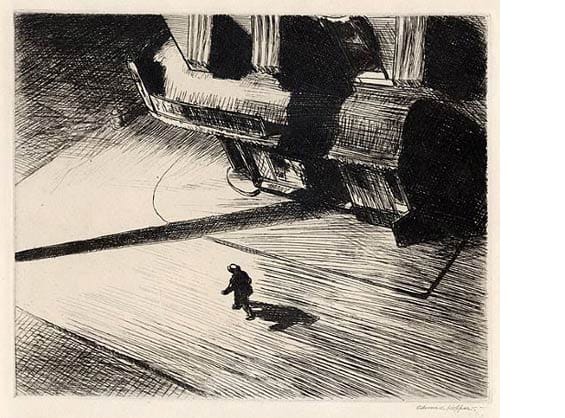
Night Shadows, Edward Hopper, 1921

