

A rapid economic slowdown was already evident when the ECB’s Governing Council met on September 12-13 last year. World trade growth had slowed since the start of the year – and eurozone growth, perennially dependent on international trade, had predictably decelerated. The slowdown was sharpest in the three largest eurozone economies, but the growth momentum was petering out everywhere. The evidence was not lost on the Governing Council, which coyly noted that risks to economic growth had “tilted to the downside.”
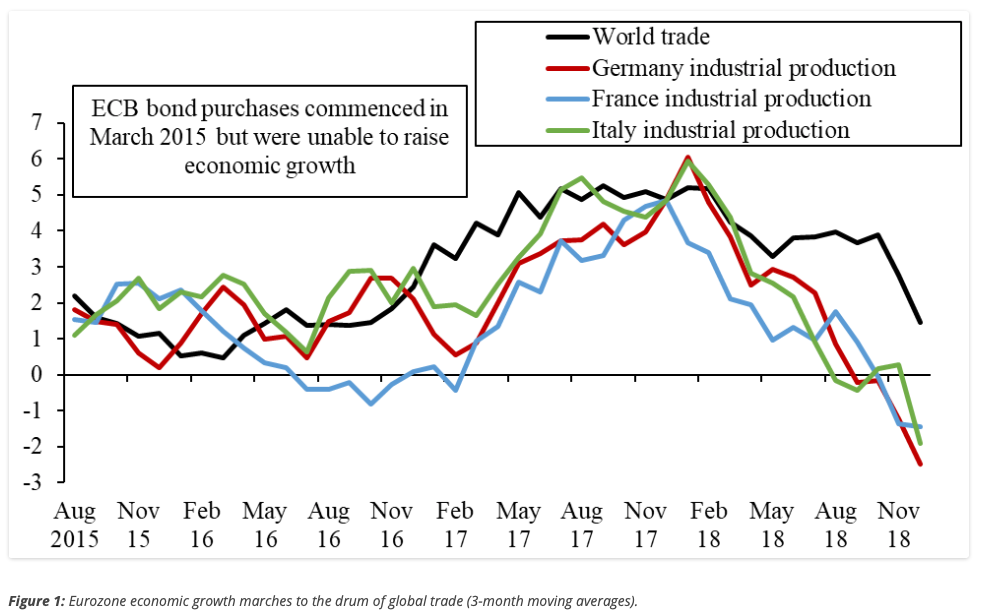
Thus began the latest cycle of kicking the can down the road. The Governing Council’s members expressed confidence that the “underlying” economy remained strong. They persuaded themselves that “broad-based expansion” was set to continue, and “inflationary pressures” would soon defeat the deflationary tendencies. Thus ignoring the “downside risks,” the Council acted on its optimistic assessment. The decision: asset purchases under the quantitative easing (QE) program, initiated to reduce long-term interest rates, would end in December.
True to that promise, the ECB ended QE in December, thus tightening monetary policy just as recession became a real threat.
