
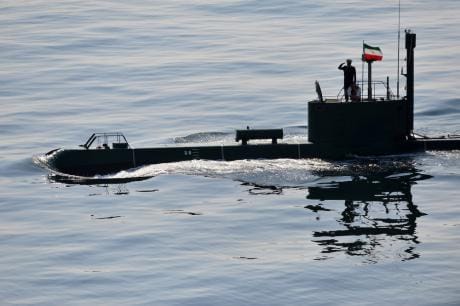
An Iranian navy vessel on patrol, 2012. Image: PAThis week, Islamic Republic of Iran navy commissioned the first major submarine developed and built inside the country. Tehran already has a submarine fleet: more than thirty now creaky vessels purchased from Russia and North Korea, as well as home-produced mini-submarines shared with the Iranian Revolutionary Guard Corps. What's different about Fateh, the new submarine, is its size: a 600-tonne boat with four torpedo-tubes, an endurance of five weeks, and a diving range of 200 metres.
Since the main purpose is patrolling the Gulf and the Arabian Sea, it may not matter that this size is some way off those of larger long-distance submarines, whether diesel or nuclear powered. The Fateh is the culmination of at least eight years' work: Iran announced the project in 2011, but it may have been begun in 2008. Even an eleven-year timespan would hardly be excessive for such an enterprise. In any event the launch's presentation on Iranian TV was celebratory.
This indigenous naval project is Iran's second to have been completed in the past year. It follows the Sahand frigate, classified by the IRN as a destroyer, which was unveiled in similar style before the Iranian media in December. Like the Fateh, the Sahand is expected to be the first of several warships of its type. The Sahand is also twice as big, at 1,300 tonnes, and equipped with a helicopter landing-pad, gun, and both surface-to-surface and surface-to-air missiles.
