
In trying to bring the complex subject of Rwanda's 1994 genocide to western audiences, does the film Shooting Dogs stray too far from the Rwandan experience? Duncan Woodside defends the filmmakers.
A film that seeks to condense and convey something as complex and recent as Rwanda's 1994 genocide, and to reconcile a part-fictionalisation of real events with a documentary style "matter-of-fact" tone, is sure to invite controversy. Sponsored by the BBC and shot on a low budget at a school in Kigali, Shooting Dogs ambitiously attempts to distil the key elements of Rwanda's three month genocide over a five day period, when outnumbered and ill-equipped Belgian United Nations peacekeepers, acting on the orders of foreign-based superiors, abandoned Tutsi refugees to the murderous attacks of the extremist Hutu militia. Events are largely seen through the eyes of two western Europeans; an Africa-weary Catholic priest played by John Hurt, and a young, idealistic teacher played by Hugh Dancy.
Shooting Dogs has attracted heavy criticism both for distortion of real events and for telling the story predominantly from the perspective of European protagonists, rather than Rwandans an approach chosen by the filmmakers to create empathy in the intended western audience, which seems a particularly crucial precondition for tackling in film the challenging topic of genocide (of which the 1984 film about Cambodia's genocide, The Killing Fields, is one well-known example).
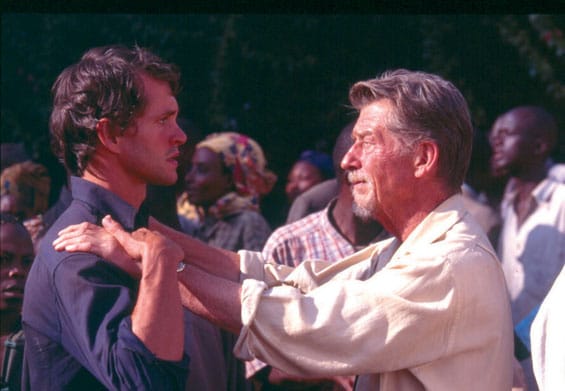
The "idealistic teacher" Joe (Hugh Dancy) and Christopher (John Hurt), the "Africa-weary Catholic priest"
Among the film's most uncompromising detractors is Linda Melvern, author of A People Betrayed: The Role of The West in Rwanda's Genocide (St Martins Press, 2000), who claims that the film shows "a shocking disregard for the historical record". In particular, she criticises the film's depiction of a BBC news crew challenging the Belgian UN peacekeepers as they prepare to depart, a scene which involves a fictional reporter using the word "genocide" to describe what is happening. In a context where the BBC did not actually refer to genocide until more than three weeks into the carnage, she sees this as a gratuitous glorification of the BBCs own role in reporting the situation, a role which she suggests in fact added to indifference and inaction, but which Fergal Keane has defended.
The BBC and other news organisations present in Rwanda at the time of the genocide from rival broadcasters to newspaper correspondents and wire reporters took some time to realise that the apparently chaotic bloodletting unfolding around them was a premeditated and government-directed drive to slaughter the Tutsi ethnic group. It is true that there were failures on the part of the international media. But it is doubtful whether their swifter diagnosis of genocide would have made a real difference to the response of key UN players, in view of member states' obstructive response to advance warning they received from other sources, and their foot-dragging during the genocide.
To imply that the film essentially amounts to a self-promoting propaganda exercise on the part of the BBC also ignores crucial aspects of the film itself. The fictional BBC reporter initially shows no interest in capturing events at the school. Yet, in one of the few interludes of grim humour in what is otherwise an unremittingly tense and claustrophobic film, Dancy's character tells the reporter that there are Europeans sheltering at the school a statement which sees the reporter and her crew rush with indecent and excitable haste to snatch this more audience-friendly story.
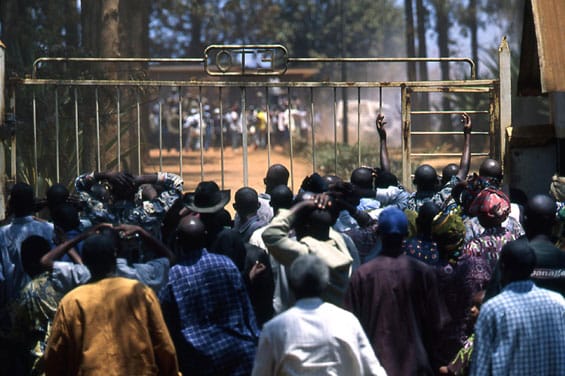
Hutus wait outside the Ecole Technique Officielle, Christopher's school, where hundreds of Tutsis seek refuge.
This is not the only moment where the film confronts the difficult point that blame for allowing the genocide of around 800,000 Rwandans to happen not only lies with western governments, but also with their own indifferent and racist citizens. In an episode recreated from the experiences of David Belton, the film's co-writer and producer, who worked in Rwanda covering the genocide for the BBC, Hugh Dancy's character is again talking to the BBC reporter when she tells him that she has not been able to shed a tear for the massacred Rwandans, despite having wept on a daily basis while in Bosnia, where massacres amounting to genocide were a feature of the 1992-1995 war. In Bosnia, when she saw the face of a dead woman she thought to herself "that could be my aunt or mother". But over here, she shame-facedly adds, she cannot react in the same way as "they're just dead Africans".
By examining such failures of empathy, the film subtly acknowledges the scope and significance of the racial and cultural divide between "the west" and sub-Saharan Africa. (It is perhaps the producers' preoccupation with this troubling reality that explains their decision to pay extras a flat rate of US$20 per person per day, regardless of whether they were Rwandan or European expatriates, despite the fact that it proved a struggle to find sufficient extras from the latter grouping.) For largely uninformed westerners, the choices faced by Hurt's and Dancy's characters whether to leave with the UN peacekeepers or whether to remain with the condemned refugees provide a readier point of access to the story than the dilemmas of Rwandan principal characters might. The film encourages the viewer to ask: "what would I do in that situation? Would I have the moral courage to make the more difficult choice?" This is an effective way of approaching potential failure of empathy among the audience, as well as making the international aspect of Rwanda's genocide easier to comprehend.
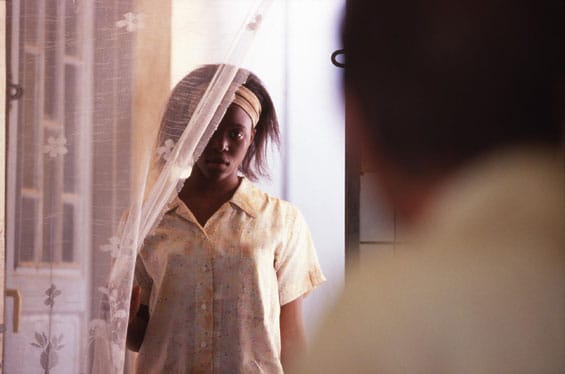
Marie (Claire Hope-Ashitey)
However, one key area where the film does let itself down is in its distorted portrayal of the anti-government forces during (and after) the genocide. In what amounts to a formulaic differentiation of "bad guys" and "good guys" the latter being the Tutsi-dominated rebel army the film's end credits identify a Rwandan production assistant as having served the rebel army that "liberated" the country. Unfortunately, this portrayal helps to perpetuate a damaging myth. The rebel army did indeed topple the extremist government in 1994, installing itself as the country's new government. But since then its own behaviour has been problematic.
By invading neighbouring DR Congo in 1996 and again in 1998 (ostensibly to track down Hutu genocide perpetrators, the interahamwe militia, who fled there when the extremist regime was toppled), Rwanda's "liberators" have themselves inflicted massive suffering on innocent people, contributing to a situation that left four million dead from war-related hunger and disease between 1998 and 2003. Rwanda's post-genocide government was allowed to get away with this (and an exploitation of Congo's vast mineral wealth) for far too long partly because they had been perceived by some western powers as liberators. Even now the power of this myth continues to have a residual influence on key western policymakers.

