
A special desk for Chinese
The Zimbabwe government has ordered the police to set up a dedicated desk to offer special treatment and service to Chinese nationals in the country, ZimOnline has learned.
The Chinese desk will handle all cases involving Chinese nationals and is expected to be equipped with the latest technology and enough resources to ensure cases are dealt with expeditiously.
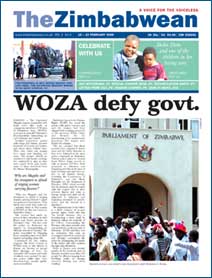
The Zimbabwean front page
Some of the police's best investigators are, according to authoritative sources, already learning Mandarin with instructors brought from China. Already, a special counter to deal with Chinese nationals has been set up at the biggest police station in the capital, Harare central police station.
A senior police officer (who did not want to be named because he is not allowed to disclose such information to the press) said: "The police commissioner (Augustine Chihuri) set up this desk under instructions from politicians who felt the Chinese should be given special treatment as they are contributing a lot to Zimbabwe's economy. Every case involving a Chinese national is dealt with by this desk."
Meanwhile, Kembo Mohadi, home-affairs minister, said the desk was being created to "assist our brothers" (the Chinese) because they were being specifically targeted by thieves, and added: "In any case, I am yet to meet any other foreigner who has been denied police protection."
President Robert Mugabe's government is cementing ties with increasingly rich Asian countries, mainly China, after falling out with the west over his poor human-rights record and failure to uphold democracy. As part of its kowtowing to the Chinese, the Harare administration has awarded lucrative contracts in Zimbabwe's mining, energy, construction and agricultural sectors to firms from the rising Asian giant.
It is understood that several Chinese businesspeople, many of whom keep vast sums of cash in their homes because they do not have accounts with Zimbabwean banks, have fallen victim to crime, which is on the rise because of worsening economic hardships.
N'angas join exodus
With most of Zimbabwe's hospitals and clinics desperately short of nurses, doctors and supplies, many people especially the terminally ill have been turning to traditional healers for treatment. Traditional healers and faith-healers have joined the mass exodus to South Africa, leaving Zimbabweans with little or no access to either modern medicine or traditional practices.
The n'angas have reportedly found lucrative markets in Limpopo province among the Venda, while others are doing a brisk trade in Johannesburg, where they are proving to be popular with the local community. They are cheaper than those from east Africa and South Africa itself, and to the convenience of their customer-patients accept payment in gadgets such as televisions, fridges and cellphones.
Magoni Kuzvireva (known as VaZavora), a traditional healer from Zaka in Masvingo who is now stationed in Tembisa said: "My patients back home are complaining why I left them but I had to come to look for greener pastures as the economic situation in Zimbabwe is making it difficult for my patients to pay. I have managed to open my small muti shop here."
Bulawayo women's Valentine gift
Police brandishing whips and carrying guns broke up demonstrations in Zimbabwe's second city Bulawayo by more than 500 women and students on Tuesday 14 February and arrested 159 protesters who were calling on President Robert Mugabe to resign.
The marchers were carrying red roses and waving placards, some of which read: "We are dying of starvation and all we need is food on the table. Not cheap politics."
Women of Zimbabwe Arise (Woza) leader Jenni Williams, who was among those arrested, told ZimOnline that the protest was part of a St Valentine's Day message to Mugabe and his ruling party to address Zimbabwe's fast-deteriorating economic crisis and ensure availability of basic commodities. Williams said: "We were marching for bread and roses. We deserve roses and the dignity they stand for. Our message to the regime, Mugabe in particular, is that he has failed and should just leave office. We are tired of starvation."
Zimbabwe is in its sixth year of a severe economic recession described by the World Bank as unprecedented in a country not at war. The economic crisis is apparent in the inflation figures released by the government's central statistical office: a staggering figure of 613.2% in January, up from the 585.5% recorded the previous month.
Meanwhile, on the evening of Sunday 12 February the police heavily assaulted informal traders near Harare's Market Square bus terminus. Baton-wielding police officers descended on the traders as they checked their goods after arriving by bus from Botswana.
One of the traders told ZimOnline: "It was hardly fifteen minutes after we had disembarked from the bus and we were checking our goods to see whether everything had been offloaded from the bus when a police truck suddenly appeared from around a corner. The policemen jumped off the truck and just started beating us without saying why they were beating us. We just had to run away."
A police spokesman, Oliver Mandipaka, said that he was not aware of the incident but said people were free to make formal complaints to police authorities if they felt they were treated unfairly by members of the law enforcement agency: "I am not aware that anybody was beaten up by the police. Anyone who thinks he has been unfairly treated by the police should make a formal complaint and we will look at that."

