
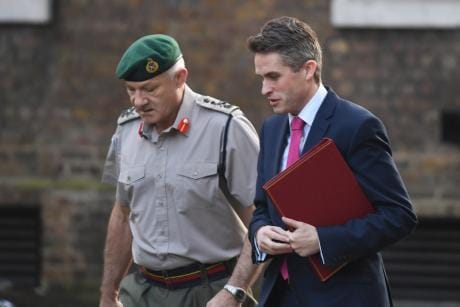
Defence Secretary Gavin Williamson and vice chief of the defence staff, General Sir Gordon Messenger arrive in Downing Street, London, for a cabinet meeting. Image: PAThe UK defence secretary Gavin Williamson delivered what he clearly hoped would be a high-profile speech on 11 February. Its theme was that Brexit is a golden opportunity for Britain to regain its place as one of the great nations of the world. Leaving the European Union, he said, will allow the UK “to consider how we not only project but maximise our influence around the world in the months and years to come.”
At the root of the vision is military power. In Williamson's words, this is “a moment when we must strengthen our global presence, enhance our lethality and increase our mass”. He wants to see new permanent overseas bases, a process already begun in Bahrain and planned to continue in Asia. The Royal Navy is at the core of the UK's expanding ambition, with the new HMS Queen Elizabeth aircraft-carrier (with the HMS Prince of Wales to follow) playing a key symbolic and strategic role in a rebooted interventionism (see "Britain's 21st-century defence", 15 February 2007),
This aspect of the speech has already provoked a strong reaction. China's vice-premier Hu Chunhua has reportedly cancelled trade talks with UK chancellor Philip Hammond in protest at Williamson's pledge (echoing earlier ones) that the HMS Queen Elizabeth would sail in the vicinity of islands in the South China Sea whose ownership is disputed but which Beijing controls and claims as its own.
