An 87-year-old woman has become a national symbol in Spain – sparking a crisis at the heart of the country’s politics that has today forced a snap election.
On 23 September, Maricarmen Abascal was forcibly carried on a stretcher from the apartment in Madrid where she has lived for 70 years, having been evicted by the real estate company that owns her building. As hundreds of people gathered to try to stop her eviction, riot police reacted with force, and images of their brutality were broadcast around the world.
The 12 days since have seen more protests and political action than in recent years, with legislators under mounting pressure from Spain’s housing movement, which is well organised through the Tenants’ Union (Sindicato de Inquilinas). This unrest has culminated in prime minister Pedro Sánchez calling an early election for 29 November after Parliament rejected his government’s emergency measures to tackle housing unaffordability.
For Abascal, whose tenancy dates back to 1956 and who had always paid the rent on time, the problems began after the building she lives in was bought by Urbagestión in 2018. The property management company initially raised her rent from around €500 to €2,650 a month; this was later reduced to €1,650, but was still far beyond what she received from her pension.
While Spain’s 1978 constitution recognises the right to decent and adequate housing, the law offers far less protection than it did 50 years ago. A political system has been established that makes it difficult to protect elderly and otherwise vulnerable people from destitution and property violence and leaves Gen Z facing a particularly bleak future as housing becomes a luxury commodity.
Anger has been building for years, as house prices move further away from wages, rent consumes an ever larger share of people’s incomes, and locals are pushed out of neighbourhoods where their families have lived for generations. With these problems particularly acute in Madrid, one of Europe’s major property investment markets, Abascal’s eviction became a focal point for this anger, and highlighted the need for radical changes.
Yet while some of us were trying to stop Abascal’s eviction, officials from Madrid's regional government were meeting with investors at ‘The District’, one of the major international fairs for property capital. It is fair to say that a battle for the right to housing is being fought in Spain, with echoes that resonate around the world.
In the days after Abascal’s eviction, years of organising suddenly came to the fore. The Tenants' Union was able to channel the widespread anger at her treatment into an unstoppable wave of popular protests – the epicentre of which was Madrid’s Puerta del Sol, the city’s emblematic central square.
Tents began to appear in the square on 26 September and, just as happened in 2011 with the 15M movement, it became a small camp city within days – home to more than a thousand people displaying an exemplary level of organisation. Other smaller protests and encampments spread to other cities across Spain, often led by young people, who are among the hardest hit by unaffordable housing. But the movement goes much further, reaching people of all ages and circumstances who are affected.
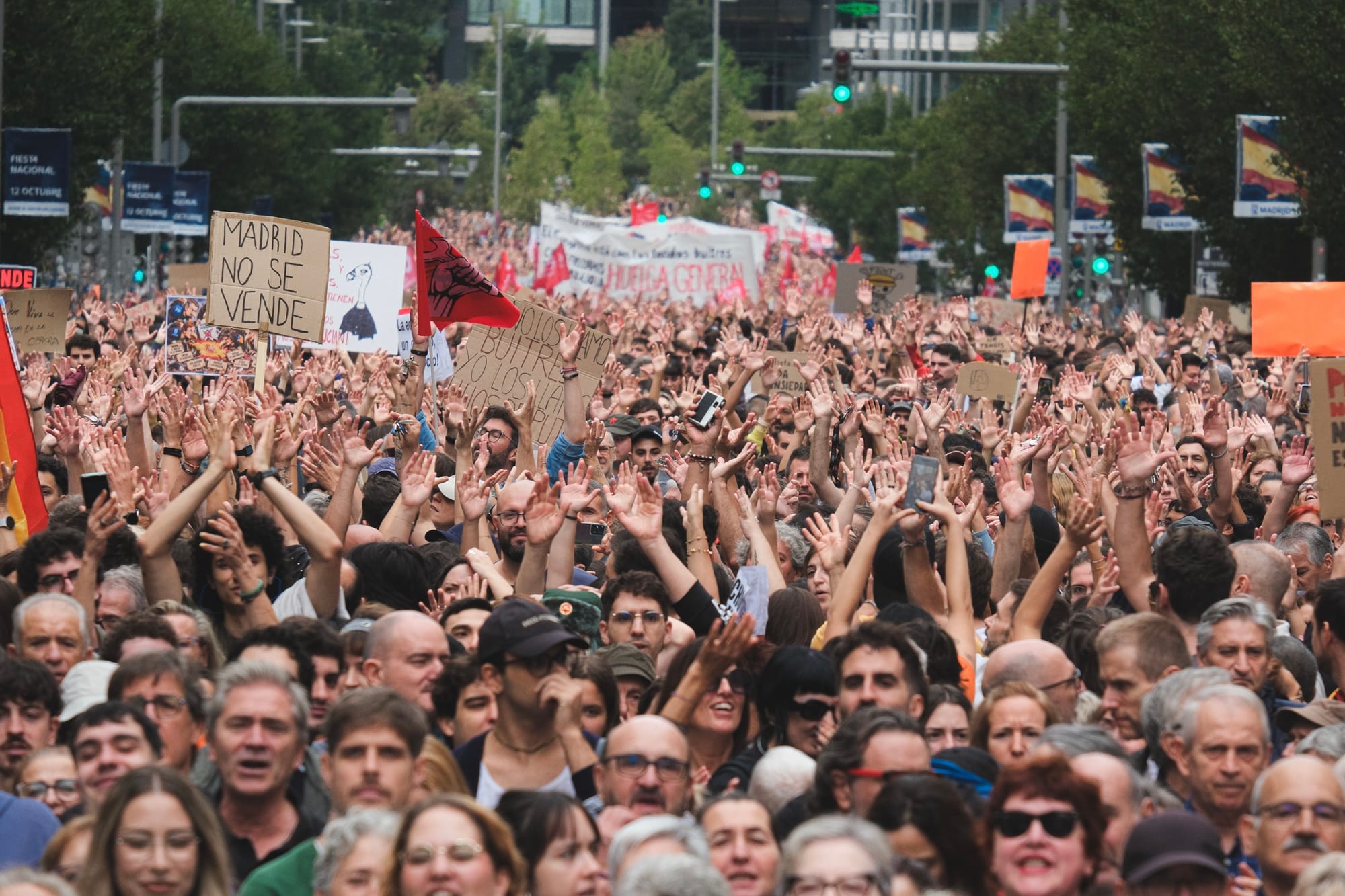
Victories that seemed unthinkable only days earlier quickly followed. On 29 September, Abascal – who had been hospitalised with severe stress and exhaustion – was told she would be allowed to return to her home, having been offered a new, affordable eight-year contract, under which her rent will not exceed 30% of her income. That she secured this days after being evicted says a great deal about the level of pressure the movement has achieved.
A significant political victory came the same day, when the Council of Ministers approved two emergency housing decrees. These contained protections against certain evictions until 2030, limits on rent increases, restrictions on speculative housing purchases by so-called ‘vulture funds’, an extraordinary measure giving certain tenants the right to extend expiring rental contracts for up to two years, and stronger renewal rights for tenants.
These measures are welcome and necessary, but they are not enough. Spain urgently needs indefinite rental contracts, as already exist in other European countries, so that no tenant's right to a home depends on the will of a landlord or a fund.
Yet on 2 October, Congress rejected both decrees. The defeats highlighted that Sánchez’s leftist government does not have the congressional majority needed to pass major reforms, and the prime minister has responded by calling a snap election that puts the housing crisis at the centre of national politics.
The citizen energy that made this moment possible must now be channelled into electing representatives willing to enact desperately needed political action. These have been historic and vertiginous weeks in Spain; we must maintain this momentum, here and in every place where the right to live a dignified life has been subordinated to unchecked capital.